
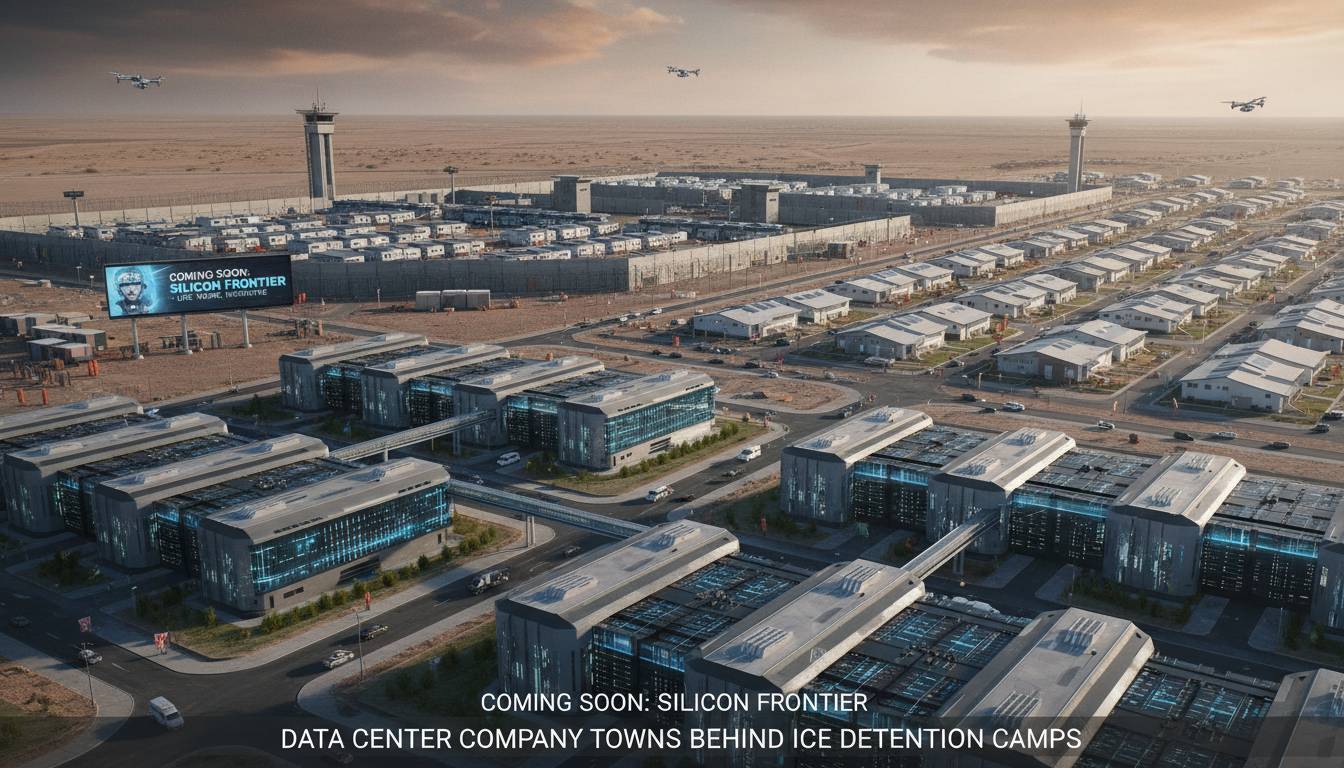

A new corner of the AI infrastructure boom is colliding with an older, more controversial business model in the United States: remote, privately managed housing compounds for workers. The phrase “Coming Soon, From the People Behind ICE Detention Camps: Data Center Company Towns” has gained attention after reporting tied the fast-growing data center buildout to firms with experience in immigration detention and large-scale workforce housing. The result is a debate that reaches beyond technology and into labor, land use, public accountability, and the future of rural development.
At the center of the discussion is Target Hospitality, a company that has provided housing and services for government and industrial clients, including the South Texas Family Residential Center in Dilley, Texas, also known as the Dilley Immigration Processing Center. In 2025, the company announced a purpose-built “data center community” and later expanded it by 160%, from 250 beds to 650 beds, with the ability to grow to 1,500 individuals. The company said the expanded contract carried about $83 million in committed minimum revenue through March 2028, with extension options through March 2032.
Why “Coming Soon, From the People Behind ICE Detention Camps: Data Center Company Towns” matters
The core issue is not that data centers need workers. Large AI and cloud campuses require thousands of construction workers during peak build phases, often in remote areas where hotels, rentals, and public services are limited. The controversy is that some of the companies now marketing turnkey housing for those workers built their expertise in sectors such as oilfield “man camps,” government emergency response, and immigration detention support.
Target Hospitality now markets “mission-critical turnkey services for remote data center builds,” including accommodations, food service, transportation, medical services, security, housekeeping, and waste management. That package resembles a self-contained campus model rather than ordinary local lodging. Supporters say it solves a real bottleneck in the race to build AI infrastructure quickly. Critics say it risks reviving a modern version of the company town, where a private operator controls not only the jobsite environment but much of daily life around it.
The phrase “company town” carries historical weight in the US. Traditional company towns often tied workers’ housing, food, and social life to a single employer. Today’s data center housing compounds are different in legal form and usually temporary, but the comparison persists because they centralize essential services under one contractor and can operate at a scale large enough to reshape small communities. That is the concern embedded in the headline “Coming Soon, From the People Behind ICE Detention Camps: Data Center Company Towns.”
The business model behind the new workforce campuses
The economics are straightforward. Data center developers want speed, predictability, and labor supply in places where land and power are available. Those sites are often outside major metro areas. Building or leasing a dedicated worker campus can reduce commute times, lower project delays, and help recruit specialized trades.
Target Hospitality’s public materials describe a vertically integrated model with several layers of service:
- Workforce accommodations
- Culinary and food services
- Transportation services
- Safety and security services
- Medical services
- Facilities maintenance
- Waste management
- Administrative support
According to Target Hospitality, this model is designed for “remote data center builds” and allows project owners to focus on construction. In investor disclosures, the company has also highlighted its government segment and its prior role at the Dilley family detention site. Its 2024 annual report states that services at the South Texas Family Residential Center were terminated effective February 21, 2025. That timeline matters because it shows how assets and operating know-how can move from government detention work into commercial infrastructure projects.
This is where the story broadens. The same operational capabilities that make a company useful to government detention systems—rapid deployment, food service, housing management, transportation, and security—also make it useful to hyperscale construction in remote areas. That does not mean the two activities are equivalent. It does mean they can share vendors, facilities logic, and management practices. That overlap is what has drawn scrutiny.
ICE detention firms remain a powerful force in parallel
The backdrop to this debate is a wider expansion in immigration detention and related contracting. GEO Group and CoreCivic, the two dominant private detention firms, have both disclosed major ICE-related growth. GEO said in late 2025 that five activated or reactivated facilities were expected to generate more than $300 million in incremental annualized revenue at full occupancy when normalized in 2026. GEO has also described itself in SEC filings as the largest service provider to ICE, with about 21,000 detention beds at 16 ICE processing centers and the ability to expand to at least 32,000 beds at 23 facilities.
CoreCivic’s filings show a similar trend. Its 2025 annual report says the company’s Farmville Detention Center contract with ICE is expected to result in about $40 million in annual incremental revenue, while other 2025 agreements covered the California City Immigration Processing Center, the West Tennessee Detention Facility, and the Dilley facility. In a 2025 earnings release, CoreCivic said fourth-quarter revenue from ICE rose to $244.7 million from $120.3 million a year earlier.
These figures matter because they show that detention contracting remains a large and expanding line of business. When companies with roots in detention, corrections, or government housing move into data center support, critics see continuity rather than coincidence. Supporters counter that operational expertise is transferable and that private contractors routinely serve multiple sectors. Both views are grounded in observable market behavior.
Impact on workers, towns, and local governments
For workers, dedicated housing can be a benefit and a risk. On the positive side, it can provide predictable meals, transportation, internet access, medical support, and proximity to the jobsite. In remote areas, those services may be better than the fragmented alternatives. Target Hospitality’s existing lodge model advertises chef-prepared meals, housekeeping, and on-site staff, features that can appeal to workers on demanding schedules.
But concentration also creates dependency. If housing, food, transport, and recreation are bundled into one employer-linked environment, workers may have fewer choices and less connection to the surrounding community. Labor advocates often worry that such arrangements can weaken bargaining power, obscure working conditions, or make it harder for local businesses to benefit from a construction boom. Those concerns are not proof of abuse, but they are central to the policy debate. The “company town” label persists because it captures that imbalance of control.
For small towns, the picture is mixed. A large temporary workforce can boost demand for local services, but a self-contained campus can also divert spending away from hotels, restaurants, and landlords. Local officials may welcome tax revenue and jobs while still worrying about roads, water, emergency response, and land-use conflicts. In detention-centered towns, similar tensions have long existed: facilities can become major employers while also tying local economies to controversial federal policies. AP has documented how rural communities have been drawn into ICE expansion through private detention contracts and reactivated facilities.
What stakeholders are watching
Several questions are likely to shape the next phase of this story:
- Scale: Will temporary worker campuses remain niche, or become standard for large AI and cloud projects?
- Oversight: Will counties and states require more disclosure on labor, safety, and housing conditions?
- Local spillovers: Will these campuses support local economies or bypass them?
- Corporate concentration: Will a small group of contractors dominate both detention-related and infrastructure-related housing markets?
A nonpartisan reading of what comes next
The strongest argument in favor of these projects is practical. The US is in a race to add data center capacity for AI, cloud computing, and digital services. Construction timelines are tight, labor is mobile, and many prime sites are far from major housing stock. A turnkey campus can reduce delays and help projects move from permitting to operation faster.
The strongest argument against them is institutional. When companies that have profited from detention systems expand into adjacent forms of managed housing, critics fear a normalization of privatized, highly controlled living environments. That concern is amplified when projects land in rural areas with limited oversight capacity and strong incentives to accept outside investment. The issue is not only who builds the housing, but what standards govern it and who benefits from it.
According to Target Hospitality, demand for these services is accelerating as AI and data center infrastructure expands. That statement aligns with the company’s 2025 contract expansion, though it is also a commercial claim made to investors. The broader inference is that more such campuses are likely if current data center construction trends continue. That is an inference, but it is supported by the company’s own growth plans and by the wider surge in infrastructure tied to AI.
Conclusion
“Coming Soon, From the People Behind ICE Detention Camps: Data Center Company Towns” is more than a provocative phrase. It describes a real convergence between America’s booming digital infrastructure buildout and a mature private industry built around remote housing, logistics, and government contracting. The immediate facts are clear: Target Hospitality has expanded a dedicated data center worker community, and private detention contractors continue to grow their ICE-related business at scale.
What remains unsettled is how the US will govern this model. If these campuses become a standard feature of AI-era construction, the debate will move quickly from headlines to zoning boards, county commissions, labor standards, and investor calls. The next chapter will not be decided by rhetoric alone. It will be decided by contracts, public oversight, and whether communities believe the benefits outweigh the costs.
Frequently Asked Questions
What is meant by “data center company towns”?
It refers to large, privately managed worker housing campuses built near remote data center construction sites, where lodging and services such as meals, transport, and security are bundled together.
Which company is most directly tied to this story?
Target Hospitality is the company most directly linked to the recent reporting because it has both government housing experience tied to Dilley, Texas, and a newly expanded data center worker community.
Are GEO Group and CoreCivic building data center housing camps?
The available public filings reviewed here primarily show GEO Group and CoreCivic expanding ICE-related detention and transportation business, not announcing equivalent data center housing projects.
Why are these projects controversial?
They raise concerns about worker dependency, local economic displacement, private control over essential services, and the involvement of firms associated with immigration detention or similar government contracting.
Why do developers use this model at all?
Because many large data center sites are in remote areas with limited housing, and turnkey campuses can help recruit labor and keep construction on schedule.
Is this trend likely to grow?
Public company statements suggest demand is increasing, and the expansion of AI infrastructure makes further growth plausible, though the exact scale will depend on project pipelines, local regulation, and labor market conditions.