
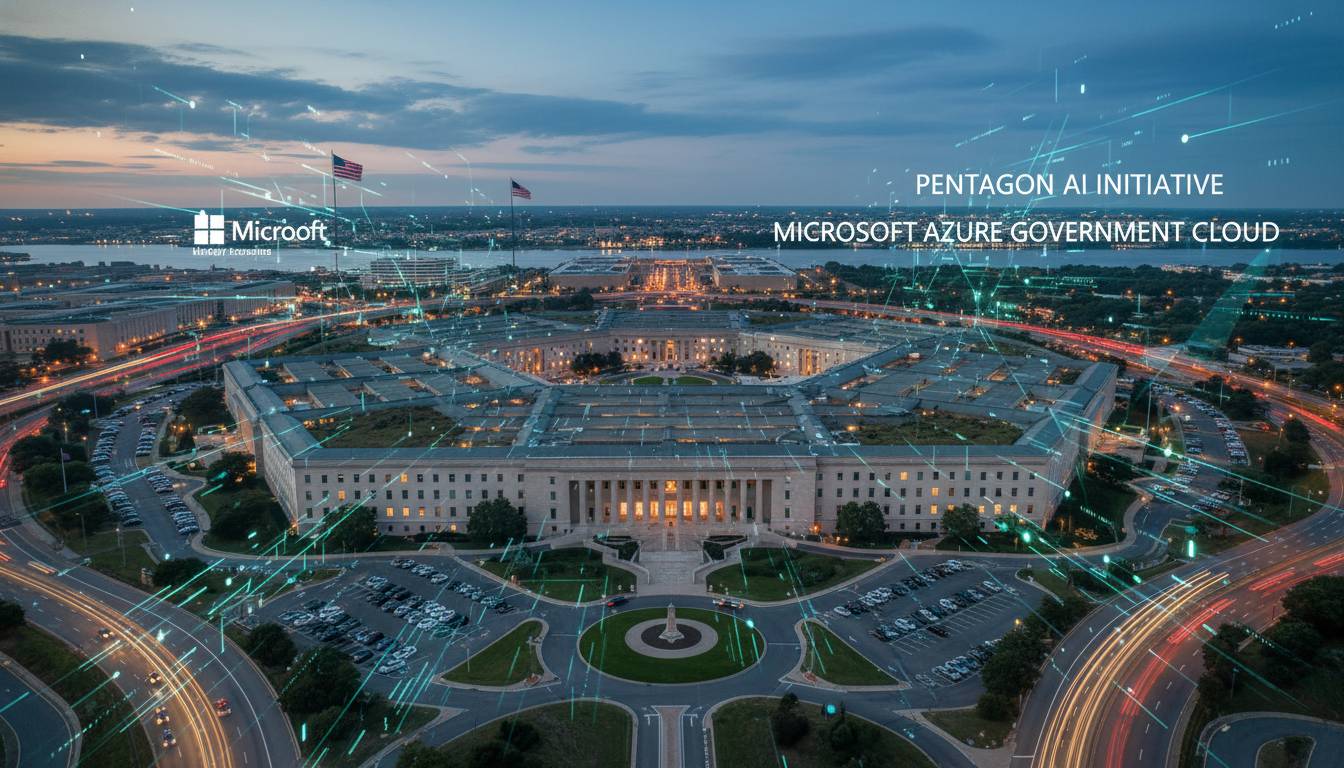

The Pentagon’s expanding use of artificial intelligence has entered a new phase after reports that U.S. defense officials tested OpenAI models through Microsoft’s enterprise infrastructure even while direct access to OpenAI tools remained restricted. The issue has drawn attention because it sits at the intersection of national security, cloud computing, AI governance, and corporate policy. It also comes as OpenAI and Microsoft deepen their work with the U.S. government, making the question of how access was structured especially significant.
The controversy matters beyond one procurement pathway. It raises broader questions about whether a ban on one route to an AI model is meaningful if the same underlying capability can still be reached through a partner platform. For policymakers, contractors, and civil liberties advocates, the episode highlights how quickly AI adoption is moving inside the federal government and how difficult it is to align technical controls, contract terms, and public expectations.
What the reports say
At the center of the story is the claim that Pentagon users were able to evaluate OpenAI models through Microsoft’s Azure OpenAI environment rather than through a direct OpenAI channel. Microsoft has spent the past two years building Azure OpenAI as an enterprise and government-facing service that provides access to OpenAI models within Microsoft’s own cloud and compliance framework. In September 2024, Microsoft said Azure OpenAI had been approved for Department of Defense Impact Level 4 and Impact Level 5 workloads in Azure Government. In April 2025, Microsoft said the service had also been authorized for IL6 data, a higher classification environment used by U.S. government customers.
That distinction is crucial. Azure OpenAI is not simply a consumer chatbot interface. It is a managed Microsoft service that wraps OpenAI models in Microsoft’s cloud controls, identity systems, and government compliance architecture. For defense users, that can make the difference between a prohibited commercial endpoint and an approved enterprise environment.
OpenAI’s own posture toward government and defense work has also shifted. In June 2025, the company launched “OpenAI for Government” and said a contract with a $200 million ceiling would help the Defense Department prototype how frontier AI could improve administrative operations and cyber defense. In February 2026, OpenAI announced that ChatGPT would be brought to GenAI.mil, the Pentagon’s secure enterprise AI platform, which OpenAI said serves 3 million civilian and military personnel.
Pentagon Reportedly Used Microsoft Workaround to Test OpenAI Models Despite Ban
The phrase “Pentagon Reportedly Used Microsoft Workaround to Test OpenAI Models Despite Ban” captures the central tension, but the facts suggest a more nuanced policy question than a simple end-run around rules. If a direct OpenAI product was unavailable or restricted, Pentagon teams may still have had lawful access to similar model capabilities through Microsoft’s separately authorized government cloud service. That would not necessarily mean a technical breach occurred. It could instead indicate that policy language lagged behind the structure of the AI supply chain.
The distinction matters because Microsoft and OpenAI operate under different contractual and operational layers. Microsoft sells Azure OpenAI as part of its own cloud stack, with its own security commitments and acceptable-use enforcement. OpenAI, meanwhile, maintains usage policies that prohibit harmful activity, including developing or using weapons and circumventing safeguards, while also allowing certain government and national security work under defined conditions.
In practical terms, defense officials evaluating AI tools may have viewed Azure OpenAI as a compliant procurement route rather than a workaround. Critics, however, are likely to argue that if the underlying model family remained the same, the spirit of any ban was weakened. That disagreement reflects a larger challenge in AI regulation: whether oversight should focus on the model developer, the cloud provider, the end-use case, or all three.
Why the issue matters for Washington
For the Pentagon, the appeal of large language models is clear. OpenAI said its government work includes document analysis, administrative support, acquisition data review, health-care related workflows for military families, and proactive cyber defense. Those are not marginal use cases. They touch some of the largest and most complex bureaucratic systems in the federal government.
The stakes are equally high for AI governance. If agencies can access frontier models through multiple vendors, then bans or restrictions aimed at a single company may have limited practical effect unless they are written in technology-neutral terms. Procurement officers may need clearer definitions covering:
- direct model access versus hosted access,
- commercial endpoints versus government cloud environments,
- testing versus operational deployment,
- administrative use versus mission-sensitive use,
- and classified versus unclassified workloads.
This matters politically as well. AI use by the military attracts scrutiny from lawmakers, watchdog groups, and civil liberties organizations, especially when systems could affect intelligence, surveillance, targeting, or cyber operations. OpenAI’s February 2026 agreement with the Pentagon states that its AI system will not independently direct autonomous weapons where law, regulation, or department policy requires human control. It also says the tools will not be used for domestic surveillance of U.S. persons under the agreement described by the company.
Microsoft and OpenAI’s growing defense footprint
The broader backdrop is that both companies are now more deeply embedded in U.S. government AI efforts than they were just a few years ago. Microsoft has steadily expanded Azure OpenAI’s government authorizations, while OpenAI has moved from a more cautious public stance on military applications toward structured defense partnerships focused on cyber defense, administration, and secure enterprise deployment.
According to OpenAI, GenAI.mil is the Department of Defense’s secure enterprise AI platform used by 3 million civilian and military personnel. That figure underscores the scale of the opportunity and the sensitivity of the environment. Once a model is available inside such a platform, the debate shifts from whether the military should test AI at all to how those systems are governed, audited, and constrained.
Microsoft, for its part, has emphasized that Azure OpenAI in government settings operates within Microsoft’s compliance and security boundaries. The company has also said customer data in these environments is not used to train foundational models and is not shared with OpenAI in the same way consumer interactions might be perceived by the public. Those assurances are likely to be central to any defense argument that Azure OpenAI is materially different from direct commercial access.
Competing interpretations of the episode
There are at least three plausible readings of the situation.
First, supporters of the Pentagon’s approach may say there was no workaround in any improper sense. Under this view, defense officials used an approved Microsoft government service that had already received relevant authorizations, making the testing process consistent with federal procurement and security rules.
Second, critics may argue that using Microsoft to reach OpenAI models undermined the purpose of a direct ban. If the concern was the model provider itself, then routing access through a cloud intermediary did not resolve the underlying policy issue. That interpretation is likely to resonate with those who want stricter AI procurement rules tied to model origin and downstream use.
Third, a middle-ground view is that the episode exposes ambiguity rather than misconduct. Federal AI policy is evolving faster than agency rulebooks, and cloud-based AI services often blur the line between platform provider and model developer. In that sense, the Pentagon Reportedly Used Microsoft Workaround to Test OpenAI Models Despite Ban story may be less about evasion and more about outdated governance frameworks confronting a fast-moving market.
What comes next
The most likely result is not a retreat from military AI adoption but a push for clearer guardrails. Agencies may revise procurement language to specify whether restrictions apply to direct vendors, underlying models, hosting environments, or all of the above. Congress and inspectors general could also seek more detailed reporting on how frontier AI systems are tested before deployment in defense settings. That would fit the broader pattern of Washington trying to catch up with commercial AI infrastructure.
For industry, the episode reinforces a commercial reality: cloud providers are becoming the gatekeepers for government AI access. That gives Microsoft a powerful role in shaping how OpenAI technology reaches federal customers, especially in classified or high-compliance environments. It also means future disputes over AI bans may increasingly hinge on cloud architecture and contract design rather than on the model alone.
Conclusion
The Pentagon Reportedly Used Microsoft Workaround to Test OpenAI Models Despite Ban story reflects a larger shift in how advanced AI enters government. The key issue is not only whether defense officials accessed OpenAI capabilities, but how they did so, under whose controls, and with what safeguards. Microsoft’s authorized government cloud services and OpenAI’s expanding defense partnerships have made that boundary far less clear than public debate often suggests.
What happens next will shape more than one contract. It will help determine whether U.S. AI oversight focuses on vendors, models, use cases, or infrastructure. As the Pentagon scales AI testing and deployment, that distinction may become one of the most important policy questions in Washington’s technology agenda.
Frequently Asked Questions
What is Azure OpenAI in this context?
Azure OpenAI is Microsoft’s managed cloud service that provides access to OpenAI models within Microsoft’s infrastructure, security controls, and compliance environment, including government cloud offerings.
Did the Pentagon have official access to OpenAI tools?
Yes. OpenAI announced a June 2025 government initiative with a Defense Department contract ceiling of $200 million, and in February 2026 it said ChatGPT was being brought to GenAI.mil.
Why is the word “workaround” controversial?
Because one side may see Microsoft’s platform as an approved procurement route, while another may see it as a way to reach the same underlying models despite restrictions on direct access.
Are OpenAI models allowed for military use?
OpenAI says its tools can support certain government and national security uses, but its policies prohibit harmful uses such as developing or using weapons in prohibited ways and circumventing safeguards. Its February 2026 Pentagon agreement also says the system will not independently direct autonomous weapons where human control is required.
How large is the Pentagon’s AI platform mentioned by OpenAI?
OpenAI said GenAI.mil is used by 3 million civilian and military personnel.
What is the bigger policy lesson?
Restrictions on AI access may be ineffective if they apply only to one vendor channel and not to equivalent access through cloud partners. Future rules will likely need to be more technology-neutral and more explicit.