


Earth’s rotation is changing in ways that are drawing unusual attention from scientists, timekeepers, and climate researchers. The main reason is not a sudden shift in the planet’s orbit or a hidden force deep underground. It is the redistribution of mass on Earth’s surface, especially from melting ice sheets and glaciers, which is now slowing the planet’s spin enough to affect the length of a day and even the future of global timekeeping.
The effect is tiny in everyday life, measured in milliseconds, but it is scientifically significant. NASA-funded research says climate-related movement of ice and water is now altering Earth’s rotation strongly enough that, if greenhouse gas emissions remain high, the climate signal could exceed the long-term slowing caused by the Moon’s tidal pull. That makes this more than a curiosity: it is a measurable planetary consequence of climate change.
Why Earth’s rotation changes at all
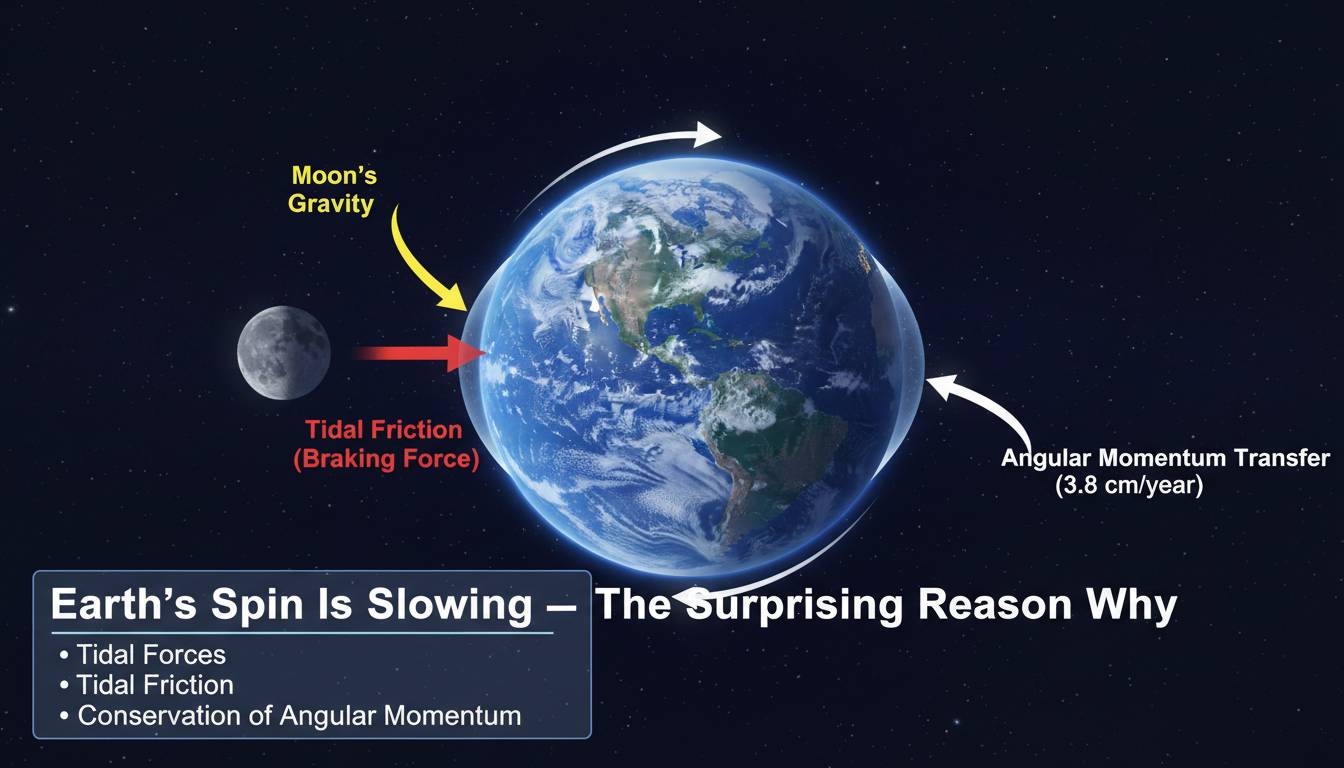
Earth does not spin at a perfectly constant rate. Over very long periods, the Moon’s gravity pulls on the oceans and creates tidal friction, which gradually slows the planet’s rotation. NASA says this lunar effect has increased the length of the day by about 2.4 milliseconds per century on average.
But shorter-term changes also matter. Earth’s rotation can speed up or slow down because mass moves around the planet. That includes shifts in the atmosphere, oceans, groundwater, ice sheets, and even processes inside the planet. When mass moves farther from Earth’s rotational axis, the planet spins slightly more slowly, much like a figure skater extending their arms.
That is where modern climate change enters the picture. As polar ice melts, water flows into the oceans and redistributes mass away from the poles and toward lower latitudes. According to NASA, that movement is now contributing to a measurable slowing of Earth’s spin and a gradual lengthening of the day.
Earth’s Spin Is Slowing at a Pace Not Seen in Millions of Years—and You Can Guess Why
The phrase capturing public attention — Earth’s Spin Is Slowing at a Pace Not Seen in Millions of Years—and You Can Guess Why — reflects a real scientific concern, though it needs careful context. The long-term slowdown of Earth’s rotation is ancient and natural, driven mainly by tidal friction. What is new is that human-driven climate change is now adding a detectable signal on top of that background trend.
NASA reported that under a high-emissions scenario, climate change could lengthen the day by as much as 2.62 milliseconds per century. That would be larger than the average contribution from the Moon’s tidal braking. According to Surendra Adhikari, a geophysicist at NASA’s Jet Propulsion Laboratory and co-author of the studies, “climate-related changes on Earth’s surface, whether human-caused or not, are strong drivers of the changes we’re seeing in the planet’s rotation.”
That does not mean days are suddenly becoming noticeably longer to people. A millisecond is one-thousandth of a second, and the change accumulates very slowly. Still, for systems that depend on ultra-precise timing, including satellite navigation, telecommunications, and financial networks, even tiny shifts in Earth’s rotation matter.
What the latest studies show
Recent research has focused on two related but distinct issues: the long-term effect of climate-driven water redistribution on Earth’s rotation, and the shorter-term fluctuations that affect leap seconds. NASA’s summary of two funded studies says melting ice and groundwater changes are altering both the length of the day and the position of Earth’s rotational axis.
A separate 2024 study highlighted another twist. Earth had recently been spinning slightly faster, raising the possibility that timekeepers might eventually need the first-ever negative leap second, meaning one second would be removed from Coordinated Universal Time rather than added. But melting polar ice is acting in the opposite direction, slowing the planet enough to delay that moment. The Associated Press reported that the likely timing shifted to around 2029, rather than earlier.
This is why the story can sound contradictory. In the short run, Earth’s rotation can fluctuate for several reasons, including processes in the core, atmosphere, and oceans. In the longer run, climate-driven ice melt is adding a slowing effect that is now large enough to influence how scientists think about timekeeping.
Why melting ice slows the planet
The physics is straightforward. When large amounts of ice sit near the poles, more of Earth’s mass is concentrated closer to the rotational axis. As that ice melts and the water spreads through the oceans, more mass shifts farther from the axis, especially toward the equator. That increases Earth’s moment of inertia and slows the spin.
Scientists often compare it to a spinning skater. Pulling the arms inward makes the skater spin faster. Extending them outward slows the spin. Earth behaves in a similar way, though on a vastly larger scale and over much longer periods.
Groundwater extraction can also play a role. Research highlighted by Scientific American described how large-scale groundwater pumping shifts enough water mass to affect Earth’s axis. While that is not the main driver of day-length change in the current headlines, it reinforces the same principle: moving water around the planet changes rotation.
Why this matters beyond astronomy
For most people, the change is imperceptible. No one will feel a day lengthen by a fraction of a millisecond. But modern infrastructure depends on exact synchronization between atomic time and Earth rotation. That is why leap seconds exist in the first place.
The issue matters in several areas:
- Global timekeeping: Coordinated Universal Time must stay aligned closely enough with Earth’s actual rotation.
- Navigation systems: Satellite-based positioning depends on extremely precise timing.
- Telecommunications: Networks can be disrupted by timing irregularities.
- Financial systems: High-frequency transactions rely on exact timestamps.
The world’s measurement authorities already decided in 2022 to phase out leap seconds by or before 2035, partly because they create technical complications. Even so, the current debate over whether Earth may require a negative leap second before then shows how unusual the present situation has become.
A broader climate signal
The slowing of Earth’s spin is not among the most damaging effects of climate change, but it is one of the clearest examples of how deeply the climate system can affect the whole planet. The same warming that raises sea levels and intensifies parts of the water cycle is also changing the geometry of Earth’s mass distribution.
That makes the story powerful scientifically and symbolically. Climate change is not only altering weather patterns, coastlines, and ecosystems. It is now measurable in the timing of the planet itself. According to NASA, the connection between climate and rotation is strong enough that future emissions pathways will influence how much the day lengthens over time.
There is also a caution here. Headlines can overstate the immediacy of the effect. Earth is not in danger of suddenly slowing in a way that disrupts daily life. The changes are extremely small and unfold over decades to centuries. But the underlying signal is real, and it is one more line of evidence showing that human activity is reshaping planetary systems.
Conclusion
Earth’s spin is slowing for a familiar physical reason and a newly important human one. The ancient driver remains the Moon’s tidal pull, but modern climate change is now adding a measurable braking effect by melting polar ice and redistributing water across the globe. NASA-funded studies indicate that this climate signal could eventually outpace the average long-term slowing caused by tides alone.
The result is not a crisis of longer days in any everyday sense. It is a precise, scientifically important shift that affects timekeeping and reveals how far-reaching climate change has become. In that sense, the surprising reason why Earth’s spin is slowing is not surprising at all: when humans change the planet’s ice and water balance, even the clockwork of Earth responds.
Frequently Asked Questions
Is Earth really spinning more slowly?
Yes. Over the long term, Earth’s rotation gradually slows, mainly because of tidal friction caused by the Moon. Climate-driven melting of ice is now adding to that slowdown by redistributing mass on the planet.
How much longer is a day becoming?
The change is extremely small, measured in milliseconds. NASA says climate change could lengthen the day by up to 2.62 milliseconds per century under a high-emissions scenario.
Will people notice longer days?
No. The effect is far too small to notice in daily life. It matters mainly for scientific measurement, satellite systems, and global timekeeping.
What does melting ice have to do with Earth’s rotation?
When ice near the poles melts and water spreads through the oceans, more mass moves farther from Earth’s rotational axis. That slows the planet’s spin, similar to a skater extending their arms.
What is a negative leap second?
A negative leap second would remove one second from Coordinated Universal Time to keep clocks aligned with Earth’s rotation. It has never been used before, but scientists have said it may be needed around 2029.
Is this caused only by climate change?
No. Earth’s rotation changes for several reasons, including the Moon’s tides, movements in the atmosphere and oceans, and processes inside the planet. Climate change is one important and increasingly measurable factor among them.
The post Earth’s Spin Is Slowing — The Surprising Reason Why appeared first on wordpress-1628269-6435114.cloudwaysapps.com.