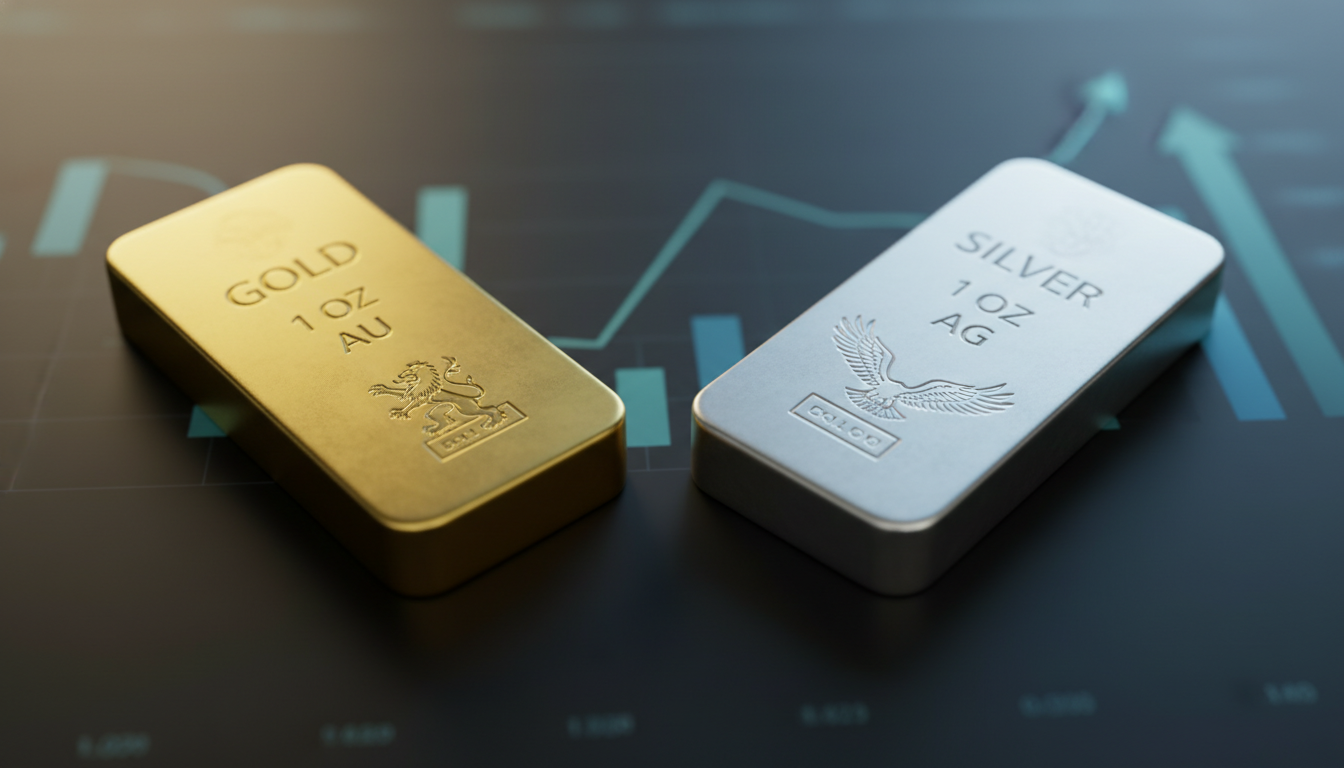

Silver’s story in 2026 reads like a thriller—fast-paced, unpredictable, and jolting. Its dramatic rise and sharper dives compared to gold provoke both intrigue and caution. Amid this volatility, the key question arises: Will silver outperform gold in performance? Let’s unravel this by exploring forecasts, industrial demand, speculative dynamics, and market reactions in a narrative that swings between optimism and realism.
2026 Market Volatility: Silver’s Wild Ride Compared to Gold
Silver’s swings have been nothing short of drastic. After a blockbuster rally in 2025—surging over 150%—silver shot to a peak above $120 per ounce at the end of January 2026, only to plunge nearly 35% in early February. Prices later rebounded to the low $90s.
Compare that to gold: while it appreciated strongly, its movements were more muted, revealing a calmer profile in the storm.
This disparity underscores silver’s heightened sensitivity to retail speculation and industrial demand shocks, while gold continues exhibiting relatively steadier investor sentiment typical of a monetary hedge.
Forecasts and Price Targets: Range of Future Scenarios
Institutional and Technical Forecasts
- Major banks anticipate gold will reach $5,000–$5,300 per ounce in 2026, with realistic consensus revolving around $5,000. Some bullish scenarios even stretch to $6,000+ under intensified geopolitical stress.
- Silver technical charts indicate a near-term target near $88 per ounce, based on Fibonacci extensions from recent price levels (~$83–$84).
Speculative & High-End Predictions
- Silver carries explosive speculative forecasts: Robert Kiyosaki predicts $200 near-term and even up to $500, while Tom Bradshaw envisions a long-tail spike to $375 by 2028 following a substantial corrective phase.
- Meanwhile, Citigroup suggests silver could climb to $150 in the short horizon, calling it “gold on steroids.”
- Conservative forecasts, such as those from EBC Financial Group and MoneyMagpie, set 2026 average targets for silver between $45–$70, with solid support driven by industrial demand and supply shortages.
Long-Term Structural Outlook
- Models from Libertex project silver in the $71–$117 range through 2026, potentially exceeding $189 by 2030, fueled by demand from clean energy and tech sectors.
- Longer-term macro forecasts also note silver’s supply deficits—five years running—are structural, not cyclical, supporting sustained upside if demand holds.
Why Silver May Outperform Gold … or Not
Performance Drivers in Silver’s Favor
- Industrial Demand: Over half of silver’s consumption stems from solar tech, EVs, AI and data centers.
- Lower Institutional Ownership: Governments and central banks heavily favor gold, leaving silver as a more latent asset that could catch up dramatically during speculative surges.
- Bull Market Dynamics: In bull phases, the gold–silver ratio tends to compress, giving silver amplified upside relative to the more restrained gold.
Risks Anchoring Silver’s Overextension
- Sharply Elevated Volatility: Silver’s thinner market makes it prone to exaggerated moves, as seen in its recent 30% drops that dwarfed gold’s sub-10% corrections.
- Speculative Waves: Leverage-driven trades and retail frenzy can erupt—and unwind—faster in silver.
- Macro Pullbacks: Dollar rebounds, policy shifts, or sudden investor sentiment shifts can hit silver harder.
Forecast Summary: Will Silver Surpass Gold?
Silver’s potential to outperform gold hinges on how the pendulum swings—between structural demand and speculative forces.
Silver Forecast Spectrum
- Base case (industrial strength): $50–$70 range in 2026
- Moderate bullish: $80–$100+, driven by continued momentum and safe-haven flows
- Speculative extremes: $150–$200+ for near-term or low-probability scenarios; up to $375 by 2028 after corrections
Gold Forecast Spectrum
- Realistic institutional: Around $5,000 by end of 2026
- Bullish: Up to $5,500–$6,000+ if geopolitical shocks or inflation pressures intensify
Expert Insight
“Silver’s gains, particularly in early 2026, match the S&P 500’s total return for 2025,” notes financial analyst Tom Bradshaw, underscoring silver’s unique leverage in accelerating markets—but he also cautions, “Overextension often precedes correction.”
This captures the dual nature of silver: potent upside paired with elevated risk.
Conclusion: A Tale of Two Metals
Silver certainly has the potential to outperform gold in percentage terms during sharp bull phases, thanks to its industrial appeal and speculative sensitivity. Forecasts even include eye-popping scenarios like $150–$200 in 2026 or $375 by 2028—but these belong in the high-risk, high-reward category.
Gold, by contrast, remains the anchor in the precious metals sphere: steadier, institutionally backed, and widely accepted as a global store of value. Even in conservative estimations, gold’s $5,000–$6,000 range suggests substantial growth, albeit at a more measured pace.
The bottom line? Silver may well outshine gold on the stage of volatility and short-term upside. Yet for those seeking long-term preserve-of-value and stability, gold still holds the spotlight.
FAQs
Will silver outperform gold in 2026?
Silver has shown significant upside and may outperform gold in terms of percentage gains—especially amid industrial demand and speculative rallies. But its volatility far exceeds gold’s, adding considerable risk to that potential outperformance.
What is a reasonable silver price target for 2026?
Moderate forecasts place silver between $50–$70 per ounce, reflecting structural demand and deficits. Bullish scenarios see silver reaching $80–$100+ if investor momentum stays strong.
Could silver hit $200–$300 per ounce?
While analysts like Robert Kiyosaki ($200) and Tom Bradshaw ($375 by 2028) present bold cases, these targets are highly speculative and considered extreme outliers—not consensus forecasts.
Why is gold considered more stable than silver?
Gold enjoys broad institutional support and usage as a reserve and hedge asset, making its price swings more muted. Silver’s market is smaller and influenced heavily by industrial cycles and speculative trading, making it far more volatile.
What could push silver prices higher during 2026?
Growing demand in renewable energy, AI, and electronics, combined with limited supply expansion and speculative safe-haven flows, could elevate silver’s price—especially in periods of heightened economic uncertainty.
If I want less risk, which should I choose?
Gold remains the safer choice for wealth preservation and longer-term stability. Silver may offer stronger short-term returns, but only at the cost of significantly higher volatility and downside risk.
