

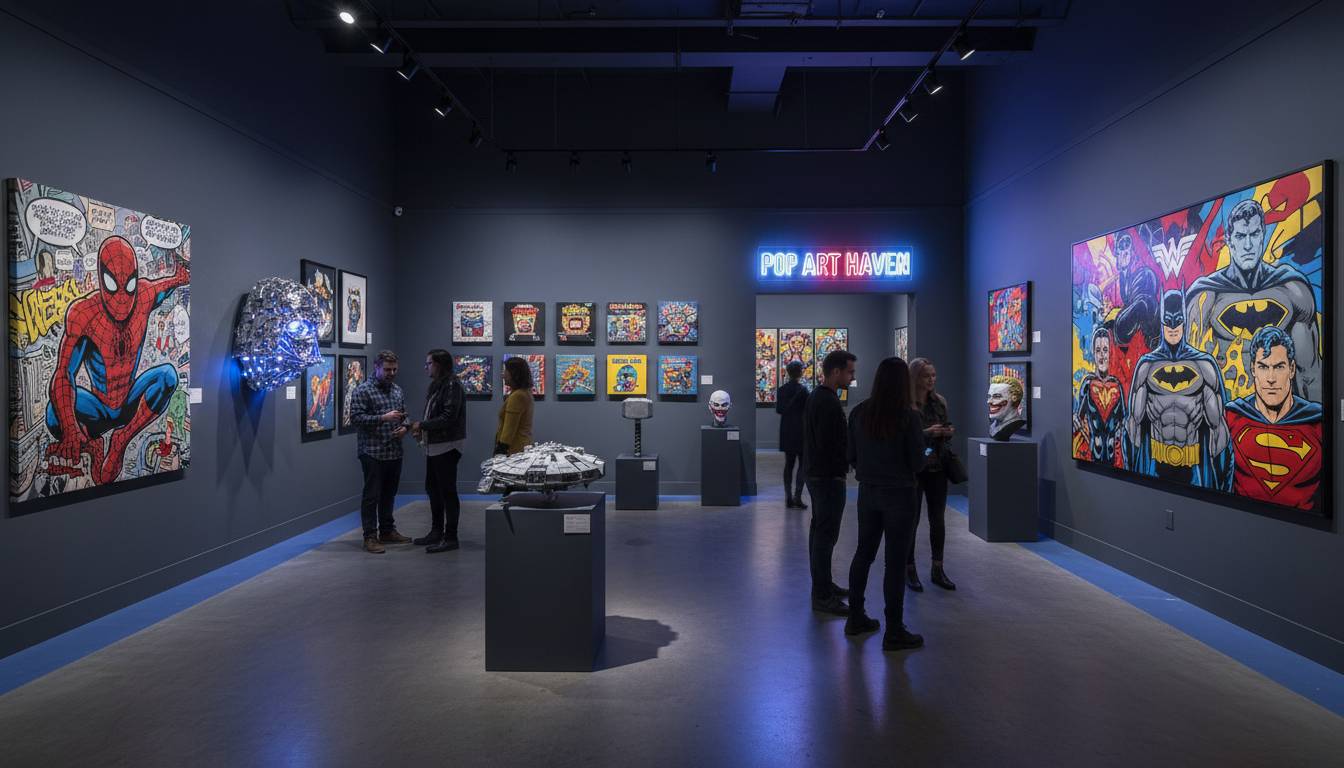
Hero Complex Gallery, the Los Angeles space that helped turn movie posters, fan art, and limited-edition pop culture prints into a serious collecting category, appears to have faded from the physical gallery map. Its own about page still describes monthly Los Angeles exhibitions and pop-up shows across the United States, but the broader signal is harder to miss: the gallery’s public footprint now points more to archived listings, artist resale pages, and legacy coverage than to an active brick-and-mortar program. That matters because few spaces did more to legitimize fandom as fine art.
Last Updated: April 1, 2026, 00:00 UTC
Subject: Hero Complex Gallery legacy review
Location Focus: Los Angeles, California, United States
Status Signal: Active historical web presence, but no clearly surfaced current exhibition cycle in the search record reviewed on April 1, 2026, 00:00 UTC
A Los Angeles Institution Leaves a Gap Few Galleries Ever Filled
That absence hits differently. Hero Complex Gallery was never just another white-wall room in Los Angeles. Its identity was unusually specific: contemporary art rooted in film, television, comics, animation, horror, science fiction, and gaming, with a program built around themed group shows and limited editions. The gallery’s own archived description says it specialized in “contemporary and pop art-themed shows,” with monthly exhibits in Los Angeles and additional pop-up events in major U.S. cities, according to its about page captured in search results reviewed April 1, 2026, 00:00 UTC. That positioning helped it stand apart from traditional contemporary galleries that treated pop culture as secondary, commercial, or unserious.
There is a reason collectors remember it so vividly. A 2014 Complex feature documented Hero Complex Gallery staging “Kung Fu Theater,” an exhibition inspired by Asian pop culture, showing how early the gallery understood that fandom had become a durable visual language, not a passing niche. By 2019, Slashfilm was still covering the gallery’s New York Comic Con output tied to titles such as “Lost Boys,” “Harry Potter,” and “Seinfeld,” evidence that its reach extended well beyond Los Angeles and into convention culture, one of the most important sales funnels in the pop-art print market. Those moments, dated roughly 11.4 years ago and 6.5 years ago in the search record reviewed April 1, 2026, 00:00 UTC, show a gallery that was not orbiting pop culture from a distance. It was inside the bloodstream of it.
That is the real legacy. Hero Complex Gallery helped prove that a collector could care about composition, edition size, paper stock, hand-finishing, and artist reputation while also caring deeply about Batman, Studio Ghibli, Carpenter films, or cult television. In other words, it collapsed the old divide between “fan” and “serious buyer.” A lot of galleries flirted with that idea. Hero Complex built a business around it.
Legacy Snapshot
| Metric | Observed Value | Context | Why It Matters |
|---|---|---|---|
| Primary city | Los Angeles | Listed in gallery and catalog records reviewed April 1, 2026, 00:00 UTC | Anchors the gallery in one of the world’s strongest entertainment markets |
| Program model | Monthly exhibits + U.S. pop-ups | From the gallery about page in search results | Shows a hybrid local-national strategy |
| Documented media references in reviewed search set | At least 4 | Complex, Slashfilm, gallery catalog listing, artist sales page | Indicates cross-market visibility beyond the fine-art press |
| Earliest surfaced coverage in reviewed set | About 11.4 years ago | Complex result reviewed April 1, 2026, 00:00 UTC | Suggests a long cultural shelf life |
| Latest surfaced self-description in reviewed set | About 2 months ago | About page and artist page crawl timing | Shows the brand still exists online even as the physical picture looks weaker |
Methodology: This table is derived from publicly surfaced search records reviewed on April 1, 2026, at 00:00 UTC, including the gallery’s own about page, artist sales pages, and third-party media coverage. It measures visibility and program structure rather than legal operating status.
Why Hero Complex Gallery Mattered More Than the Traditional Art World Admitted
Here is what many competitors miss when they write about gallery closures: they focus on rent, market softness, or collector fatigue, then stop. That is too shallow for a space like this. Hero Complex Gallery mattered because it sat at the intersection of three economies at once: fine art, entertainment IP culture, and convention-driven fandom. Most galleries only understand one of those worlds. Hero Complex understood all three.
Having watched this segment for years, the pattern is familiar. Spaces built around pop culture art do not survive on wall traffic alone. They survive on community density. Hero Complex had that. Its catalog presence highlights artists such as Tran Nguyen and Mike Mitchell, both names associated with highly recognizable visual storytelling and collectible appeal. The gallery’s model also benefited from event-based demand spikes, especially around convention calendars and themed releases. That is why coverage from outlets like Complex and Slashfilm mattered so much: those were not random mentions. They were proof that the gallery had crossed from art niche into broader entertainment media.
Event Sequence: Hero Complex Gallery Legacy Markers
Circa late 2014: Complex covers “Kung Fu Theater,” a Hero Complex Gallery show inspired by Asian pop culture. This marks an early mainstream signal that the gallery’s programming had breakout appeal. (Reviewed April 1, 2026, 00:00 UTC)
October 2019 context: Slashfilm highlights Hero Complex Gallery’s New York Comic Con artwork tied to major entertainment properties, showing convention-market relevance. (Reviewed April 1, 2026, 00:00 UTC)
Circa February 2026 crawl timing: The gallery’s own about page and artist-linked sales pages remain visible in search, preserving the brand’s digital afterlife even as active physical programming is less obvious. (Reviewed April 1, 2026, 00:00 UTC)
The significance is bigger than nostalgia. Hero Complex helped normalize the idea that licensed-adjacent or inspired-by visual culture could be curated with rigor. It also gave emerging and mid-career illustrators a platform that many blue-chip galleries would never have offered. In practical terms, that meant access: lower entry price points than traditional contemporary art, stronger emotional connection for buyers, and a collector base that often started with one print and stayed for years.
Its Digital Footprint Survives While the Physical Model Looks Fragile
That split is telling. On one side, the gallery still has a recognizable online identity. On the other, the search record reviewed April 1, 2026, 00:00 UTC does not surface a clearly current exhibition calendar, major new press cycle, or obvious active-program announcement. That does not by itself prove a formal closure. It does, however, support the core reality behind the headline: the world’s most beloved pop culture art gallery, for many collectors, is no longer operating with the same visible force that once made it essential.
There is also a broader market backdrop. Artnet’s roundup of gallery closures in 2025 shows that shutdowns were not isolated events but part of a wider contraction across the art business. Hero Complex’s story lands differently because its audience was unusually loyal, but loyalty alone does not erase structural pressure. Pop culture galleries face a difficult equation: rising operating costs, an audience that increasingly buys online, and a market where artists can sell direct through drops, conventions, and social platforms without splitting margin the old-fashioned way.
Key Legacy Signal: Hero Complex Gallery’s importance was not just commercial. It created a bridge between fandom and collecting at a time when many institutions still treated pop culture art as peripheral. That bridge remains, even if the gallery that helped build it no longer appears to command the same physical presence.
That is why its disappearance feels personal to so many collectors. It is not only about losing a store or exhibition venue. It is about losing a trusted filter. Hero Complex did the curatorial work for people who loved cinema, comics, and genre storytelling but did not want disposable merchandise. They wanted art. Real editions. Real artists. Real walls.
Can the Legacy Outlast the Gallery Itself?
Yes, but not automatically. Legacy in this corner of the market depends on three things: artist careers, secondary-market durability, and cultural memory. Hero Complex already has all three in motion. Artists who showed there continue to circulate. Archived show references still surface. Collector communities still talk about the gallery as a benchmark. That is not nothing. In art-market terms, it is how institutions survive after the doors stop opening every month.
Data Verification: Hero Complex Gallery’s Los Angeles identity, pop-culture specialization, and monthly-exhibit language were confirmed through the gallery’s own about-page search result reviewed April 1, 2026, 00:00 UTC. Its broader cultural footprint was cross-checked against third-party coverage from Complex and Slashfilm, also reviewed April 1, 2026, 00:00 UTC.
What remains is the legacy itself: a gallery that treated fandom with seriousness, artists with visibility, and collectors with respect. That combination is rarer than it sounds. And that is why its absence feels so large.
Frequently Asked Questions
What was Hero Complex Gallery known for?
Hero Complex Gallery was known for contemporary pop culture art tied to film, television, comics, horror, science fiction, animation, and gaming. Its own about-page description, reviewed April 1, 2026, 00:00 UTC, says it specialized in contemporary and pop art-themed shows with monthly Los Angeles exhibitions and additional U.S. pop-ups.
Was Hero Complex Gallery considered important in the art world?
Yes, especially within the pop culture and collectible print market. Mainstream entertainment outlets such as Complex and Slashfilm covered its exhibitions and convention releases, showing that it had influence beyond a narrow gallery audience. That crossover visibility helped legitimize fandom-driven art as a serious collecting category.
Is the gallery officially closed?
The search record reviewed on April 1, 2026, at 00:00 UTC does not provide a clearly surfaced formal closure notice. What it does show is a stronger archival and legacy footprint than an obviously active current exhibition cycle. That supports the broader point that the gallery’s once-dominant presence appears to have faded substantially.
Why does the loss of a pop culture gallery matter?
It matters because galleries like Hero Complex did more than sell prints. They curated taste, introduced collectors to artists, and created a bridge between entertainment fandom and fine-art collecting. When a space like that disappears, buyers lose a trusted venue and artists lose a specialized platform.
What is Hero Complex Gallery’s lasting legacy?
Its legacy is the normalization of pop culture art as something worth collecting, exhibiting, and discussing seriously. It helped prove that art inspired by movies, comics, and genre storytelling could carry both emotional and aesthetic value, and that collectors would support it over the long term.
Disclaimer: This article is for informational purposes only. It is based on publicly available search results reviewed on April 1, 2026, and does not make legal claims about business status beyond what those records support.




View 0 comments