

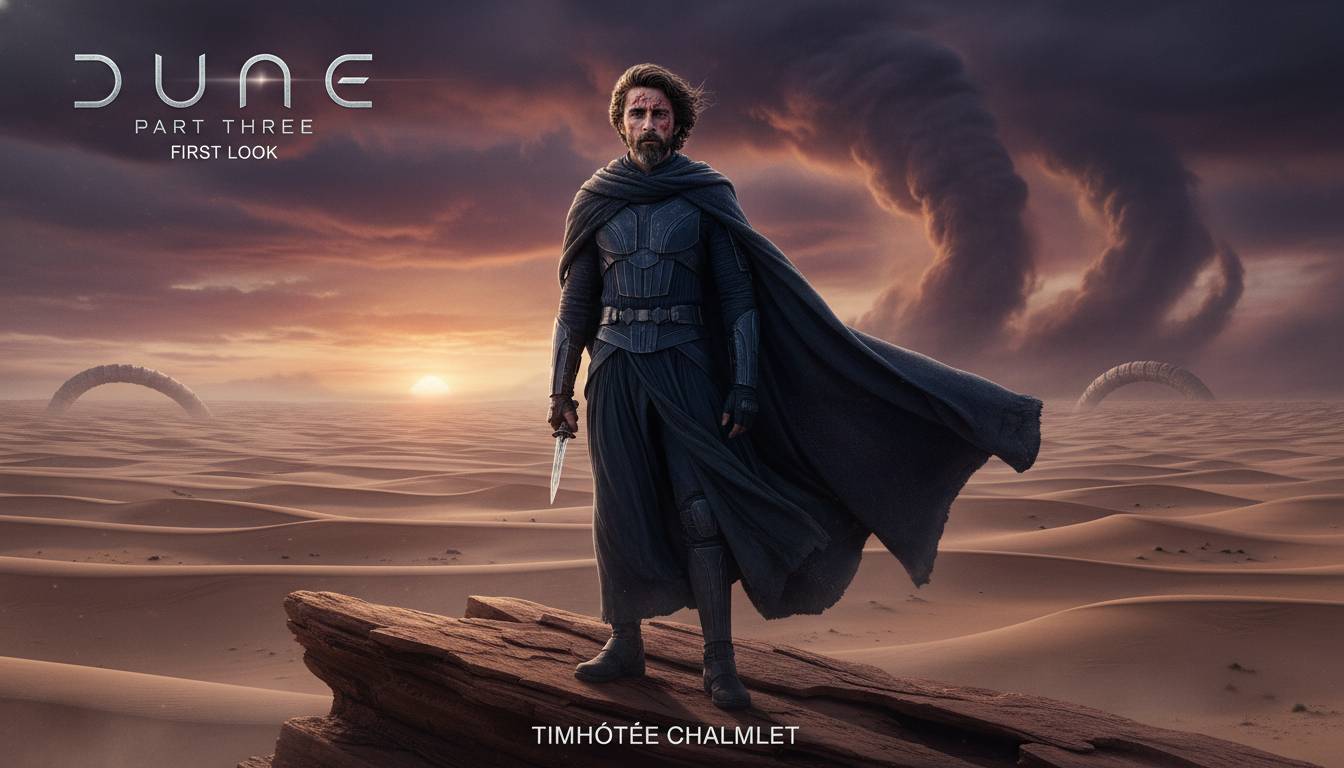
The first wave of attention around Dune: Part Three is already intense, and much of it centers on Timothée Chalamet’s striking appearance. Early reporting around the next film in Denis Villeneuve’s Dune saga points to a darker, more physically worn version of Paul Atreides, fueling online discussion about where the story is headed next. With the sequel moving forward under its official title and production plans becoming clearer, the first look has quickly become one of the most talked-about movie images tied to the franchise.
A darker image of Paul Atreides takes center stage
The phrase “Timothée Chalamet Looks Messed Up in the First Look at ‘Dune: Part Three’” has gained traction because it captures the immediate reaction many viewers had to the early image and descriptions circulating around the film. Chalamet’s Paul appears more battle-worn, emotionally burdened, and physically altered than in the first two installments, a visual shift that aligns with the increasingly severe arc of the character after the events of Dune: Part Two. While studios often use first-look material to establish tone rather than reveal plot, the image appears designed to signal that the next chapter will be harsher and more psychologically complex.
That reaction is not happening in a vacuum. Villeneuve’s adaptation of Frank Herbert’s universe has steadily moved from political awakening to holy war and imperial consequence. A more damaged-looking Paul fits the trajectory of the source material and the ending of the second film, which left the character in a position of immense power but also deep moral peril. The visual language of exhaustion, injury, or spiritual unraveling therefore carries narrative weight, even before a trailer or full synopsis arrives.
For fans, the first look matters because Dune has become one of the defining large-scale science-fiction franchises of the decade. Chalamet’s performance has been central to that success, balancing vulnerability, calculation, and mythic intensity. A visibly altered Paul suggests that Dune: Part Three will not simply repeat the spectacle of earlier entries, but push further into the cost of leadership and prophecy.
What is confirmed about Dune: Part Three
One of the most important recent developments is that the project has moved beyond rumor and into a more concrete production phase. Variety reported that the third film carries the official title Dune: Part Three and is set to be shot with IMAX cameras, though not entirely in that format. The same report said filming was expected to begin imminently, with Timothée Chalamet and Zendaya returning.
Additional reporting has also tied the film to Frank Herbert’s Dune Messiah, the novel that follows Paul Atreides after his rise to power. Variety previously reported that Denis Villeneuve was finishing the script for the next installment and that there was interest in adding Robert Pattinson to the ensemble. That report referred to the project as Dune: Messiah, reflecting the long-standing expectation that the third movie would adapt that book, even as the official production title now appears to be Dune: Part Three.
Another notable sign of forward momentum came when Jason Momoa posted a video of himself shaving for the first time in six years ahead of filming, saying he was doing it for Villeneuve and Dune 3. That matters because Momoa’s Duncan Idaho died in the first film, and his return would be consistent with the broader Dune mythology familiar to readers of Herbert’s novels.
At the business level, the franchise remains a major asset for Warner Bros. Chalamet has already delivered major commercial results for the studio through Wonka and Dune, and Variety reported in 2024 that he signed a first-look deal with Warner Bros. after those successes. That broader relationship adds to the strategic importance of Dune: Part Three as both a prestige release and a tentpole event.
Why Timothée Chalamet’s appearance matters
In franchise filmmaking, first-look imagery is rarely accidental. Costuming, makeup, lighting, and posture all work together to communicate a film’s emotional direction. In this case, the conversation around “Timothée Chalamet Looks Messed Up in the First Look at ‘Dune: Part Three’” reflects more than celebrity fascination. It reflects audience recognition that Paul Atreides is entering a phase of decline, conflict, or fragmentation.
That is especially significant because Chalamet’s screen persona has often blended youthful sensitivity with intensity. In Dune, that combination helped make Paul feel both human and mythic. A more ravaged look could indicate a deliberate move away from the ascendant hero image and toward a ruler trapped by the consequences of his own rise. That would be consistent with the thematic reputation of Dune Messiah, which is widely seen as a corrective to simplistic hero worship.
According to Bruce Markoe, senior vice president and head of post-production at IMAX, the use of IMAX cameras changes how audiences experience scale and immersion, a point cited in Variety’s reporting on the third film. That technical choice suggests Villeneuve is again pairing intimate character deterioration with massive visual presentation. In practical terms, a damaged-looking Paul framed in IMAX could become one of the defining images of the film’s marketing campaign.
Franchise stakes and audience expectations
The stakes for Dune: Part Three are unusually high because the first two films established both critical credibility and blockbuster relevance. The franchise has managed to appeal to awards voters, science-fiction fans, and mainstream moviegoers at the same time. That is difficult to sustain in a third installment, particularly when the story becomes more introspective and politically bleak.
Several factors are shaping expectations:
- Story direction: The move toward Dune Messiah material suggests a more morally ambiguous chapter.
- Visual ambition: IMAX camera use points to another technically ambitious production.
- Returning cast: Chalamet and Zendaya are expected back, while Momoa’s preparation has fueled speculation about Duncan Idaho’s role.
- Potential additions: Robert Pattinson has been linked to the project in industry reporting.
There is also a release-window dimension. Variety reported that Chalamet’s box-office momentum was expected to continue with 2026’s Dune: Part III, indicating that the film is being positioned as a major theatrical event. For studios and exhibitors alike, that matters in an era when premium-format releases carry outsized commercial importance.
The broader significance of the first look
The strong reaction to Chalamet’s appearance shows how much audience investment now exists in the emotional state of Paul Atreides. This is no longer just a conversation about costumes or makeup. It is a conversation about whether Villeneuve will complete the trilogy by challenging the very idea of a chosen one. The first look appears to support that interpretation, presenting Paul not as triumphant, but as visibly burdened by what he has become.
That approach could strengthen the franchise artistically. A third film that leans into consequence rather than repetition would distinguish Dune from many blockbuster trilogies that simply escalate action. At the same time, it carries risk. A darker, more psychologically fractured Paul may be compelling to longtime readers and critics, but it could also test casual viewers expecting a more conventional heroic arc. That tension is likely to define the film’s reception when fuller marketing materials arrive.
Conclusion
The early response to “Timothée Chalamet Looks Messed Up in the First Look at ‘Dune: Part Three’” highlights just how closely audiences are watching every signal from Denis Villeneuve’s next chapter. What is confirmed so far points to a film with an official title, IMAX-backed production ambitions, returning stars, and a story direction rooted in the aftermath of Paul Atreides’ rise. If the first look is any indication, Dune: Part Three is preparing to present its central figure not as an untouchable savior, but as a leader marked by power, violence, and consequence.
Frequently Asked Questions
Is Dune: Part Three officially happening?
Yes. Industry reporting has identified the project under the official title Dune: Part Three, with filming plans moving forward.
Why are people saying Timothée Chalamet looks “messed up” in the first look?
The reaction refers to a darker, more worn-down appearance that suggests Paul Atreides is under greater physical and emotional strain in the new film. This interpretation fits the story’s expected direction.
Is Dune: Part Three based on Dune Messiah?
Reporting has linked the third film to Frank Herbert’s Dune Messiah, even though the official production title now appears to be Dune: Part Three.
Will Zendaya return?
Yes. Variety reported that Zendaya is expected to reprise her role alongside Timothée Chalamet.
Is Jason Momoa coming back?
Momoa has publicly shown himself preparing for Dune 3 filming, which has fueled expectations of his return.
Will the movie use IMAX cameras?
Yes. Variety reported that Dune: Part Three will be shot with IMAX cameras, though not entirely in that format.



View 0 comments