

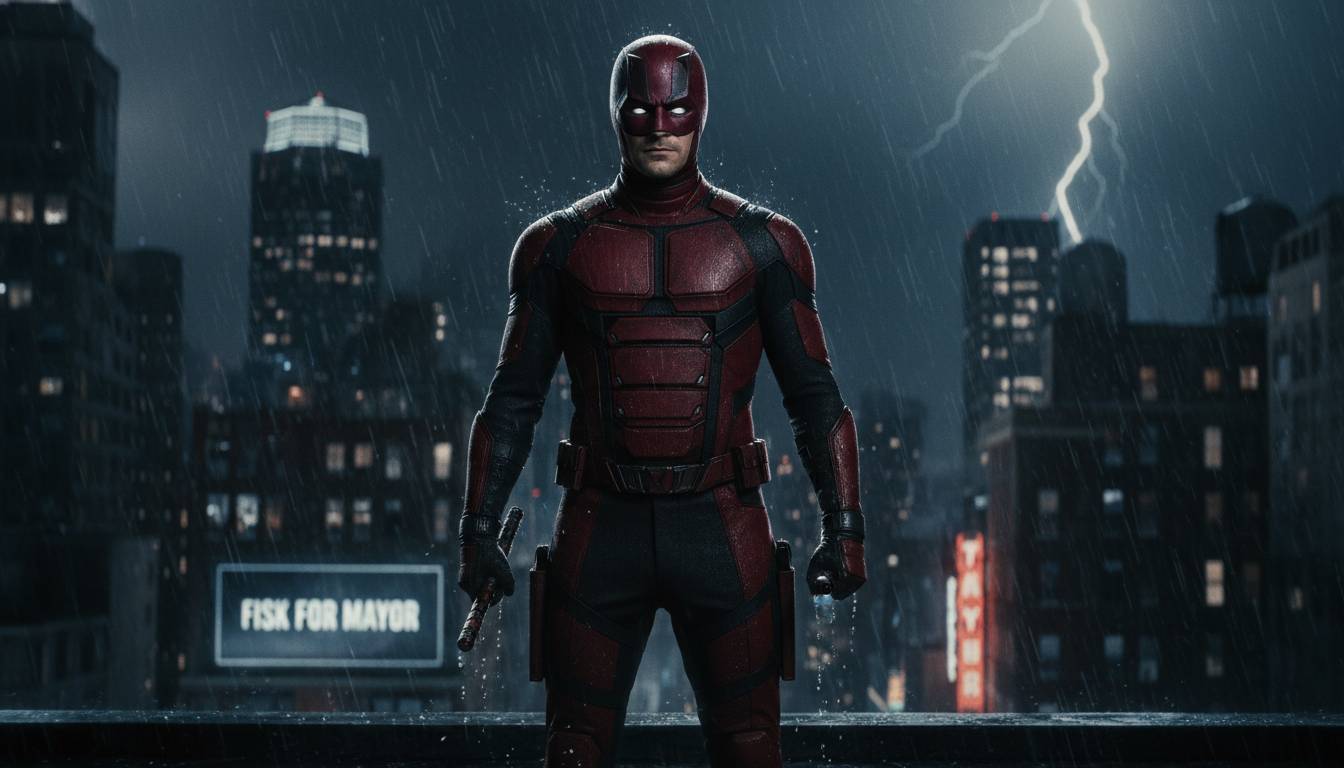
Daredevil: Born Again pulls from Frank Miller and David Mazzucchelli’s landmark comic, but it does not mirror it beat for beat. That distinction matters. Charlie Cox said years before the Disney+ series arrived that fans should not assume the title meant a direct adaptation of the 1986 storyline, and the finished show has already proved him right by remixing deaths, relationships, and Matt Murdock’s supporting cast. That is why one of the comic’s most devastating Karen Page moments still looks like a scene Marvel probably will not bring to live-action.
The scene fans keep circling back to
The moment in question is Karen Page selling Matt Murdock’s secret identity for drugs in the original Born Again comic. It is one of the most infamous scenes in Daredevil history because it is not just a plot twist. It is the trigger. Karen’s decision sets off the chain reaction that lets Wilson Fisk dismantle Matt’s life piece by piece, turning a superhero story into a psychological demolition job.
In the comic, Karen has fallen far from the version many readers knew from earlier Daredevil stories. She is isolated, exploited, and desperate. When she gives up Matt’s identity, the act lands with unusual force because it is both intimate and transactional. Fisk does not beat Daredevil in a fair fight. He buys the truth, then weaponizes it. That is what makes the scene so memorable, and so ugly in a way that still stings decades later.
It is also exactly the kind of material Marvel Studios has strong reasons to avoid adapting directly. Not because it lacks dramatic value. Quite the opposite. The problem is that the scene depends on a version of Karen Page that the live-action franchise has never fully built, and probably does not want to build now.
Why the Disney+ series already points in another direction
Before the series premiered, Charlie Cox made it clear that Marvel’s Born Again would not necessarily be a straight adaptation of the comic arc. That warning turned out to be accurate. Coverage around the show’s launch and early episodes highlighted that the series uses the title more as a thematic signal than a page-to-screen blueprint. It is interested in reinvention, fallout, and Matt being broken down, but not in reproducing every major comic event exactly as written.
That is visible in one of the show’s biggest early choices: the death that reshapes Matt’s world is not lifted directly from the Born Again comic. MovieWeb noted that the series puts an MCU spin on a controversial comic-style tragedy by having Bullseye kill Foggy Nelson, rather than replaying one of the better-known Karen or Elektra beats from the comics. That is a major tell. When Marvel had a chance to recreate a familiar emotional wound, it chose substitution over replication.
The same pattern shows up with Karen herself. Coverage from ComicBook and ScreenRant focused on Karen’s distance from Matt, her move away from New York, and the emotional aftermath of Foggy’s death. That version of Karen is wounded and complicated, yes, but she is not the Karen of Miller’s Born Again. She is not being framed as a self-destructive ex-actress whose addiction leads her to betray Matt’s identity for a fix. She is being framed as someone grieving, retreating, and possibly rebuilding.
Marvel has a character problem, not a courage problem
That is the key distinction. Fans sometimes assume Marvel would skip the comic scene because it is too dark for Disney+. I do not think that is the full story. The bigger issue is continuity. Deborah Ann Woll’s Karen Page, across the Netflix era and into the revived continuity, has been written with a different emotional architecture. She has secrets, guilt, and trauma, but she has also been one of Matt’s most loyal anchors. Turning her into the person who sells him out would not feel like a tragic reveal. It would feel like a hard character rewrite.
And that rewrite would come with baggage. CBR’s older discussion of Born Again and Karen Page argued that the comic’s treatment of Karen remains controversial, especially because it ties her downfall to drugs, pornography, and dependency in ways that many readers still debate. That criticism has not disappeared with time. If Marvel adapted the scene now, it would not just be adapting a classic twist. It would be importing one of the most contested parts of the source material into a franchise that has already established Karen very differently.
There is also a practical issue. The original Born Again comic works because Karen’s betrayal happens before reconciliation. The TV universe has already spent years making viewers invest in Matt, Foggy, and Karen as a damaged but deeply bonded trio. Once that bond has been dramatized on screen, especially over multiple seasons, breaking it in this specific way becomes much harder to sell.
What Marvel is more likely to borrow instead
If Marvel keeps mining Born Again, it will probably continue lifting structure rather than exact scenes. That means Fisk using power indirectly. Matt losing control of his life. New York turning hostile. Faith, guilt, and identity being tested. Those are the durable parts of the comic. They survive adaptation. The Karen identity-sale scene does not, at least not without rebuilding her from the ground up.
There is evidence for that broader strategy already. Articles discussing the show’s comic references have pointed out that Born Again on Disney+ includes nods, echoes, and rearranged story beats rather than strict recreations. Even pieces celebrating scenes taken straight from the comics tend to frame them as selective lifts, not wholesale adaptation. Marvel seems comfortable honoring iconography. It is much less interested in chaining itself to the exact moral and narrative mechanics of Miller’s run.
That makes sense for a long-form franchise. A direct adaptation of Karen’s betrayal would dominate everything around it. It would redefine Karen permanently, likely beyond repair, and force the series to spend enormous time justifying why this version of the character made that choice. For one shocking scene, that is a steep cost.
The best argument against adaptation is emotional, not logistical
What makes the comic scene great is also what makes it unlikely. It is cruel, intimate, and irreversible. In print, that kind of rupture can be the engine of a masterpiece. In an ongoing live-action universe, it can become a trap. Marvel has already shown that it prefers to preserve Karen as part of Matt’s emotional history rather than recast her as the architect of his destruction.
So yes, the scene remains one of the best in Born Again. It is unforgettable. It is central to the comic’s power. But the more the Disney+ series defines its own continuity, the clearer it becomes that this is one of those great comic moments destined to stay on the page. Not because Marvel does not know its value. Because it knows exactly how much it would break.
Frequently Asked Questions
What scene from the Born Again comic is Marvel unlikely to adapt?
The most likely answer is Karen Page selling Daredevil’s secret identity in Frank Miller and David Mazzucchelli’s Born Again comic. It is one of the story’s defining moments, but it depends on a much darker version of Karen than the one established in live-action.
Did Charlie Cox say the show would not directly adapt the comic?
Yes. Cox said fans should not assume the title meant a direct adaptation of the 1986 comic storyline. That has held true, since the Disney+ series uses the comic more as inspiration than as a strict blueprint.
Why would Marvel avoid adapting Karen Page’s betrayal?
The biggest reason is character continuity. Live-action Karen has been portrayed as flawed but fundamentally loyal to Matt. Reworking her into the person who sells out his identity would feel less like tragedy and more like a sharp, possibly alienating rewrite.
Is the comic scene controversial even among fans?
Yes. Many readers consider it powerful and essential, but others have long criticized how Born Again handles Karen’s downfall. That debate makes the scene even harder to translate into a modern live-action series without backlash.
What parts of Born Again is Marvel more likely to adapt?
Marvel is more likely to adapt the comic’s themes and structure: Fisk attacking Matt indirectly, the collapse of Matt’s personal life, and the idea of spiritual and emotional rebirth. Those elements fit the current series far better than Karen’s specific comic arc.
Could Marvel still reference the scene without adapting it exactly?
Absolutely. The series could echo the idea of betrayal, leaked secrets, or Fisk weaponizing private information without making Karen the one responsible. That would let Marvel preserve the comic’s tension while protecting the live-action version of the character.

View 0 comments