

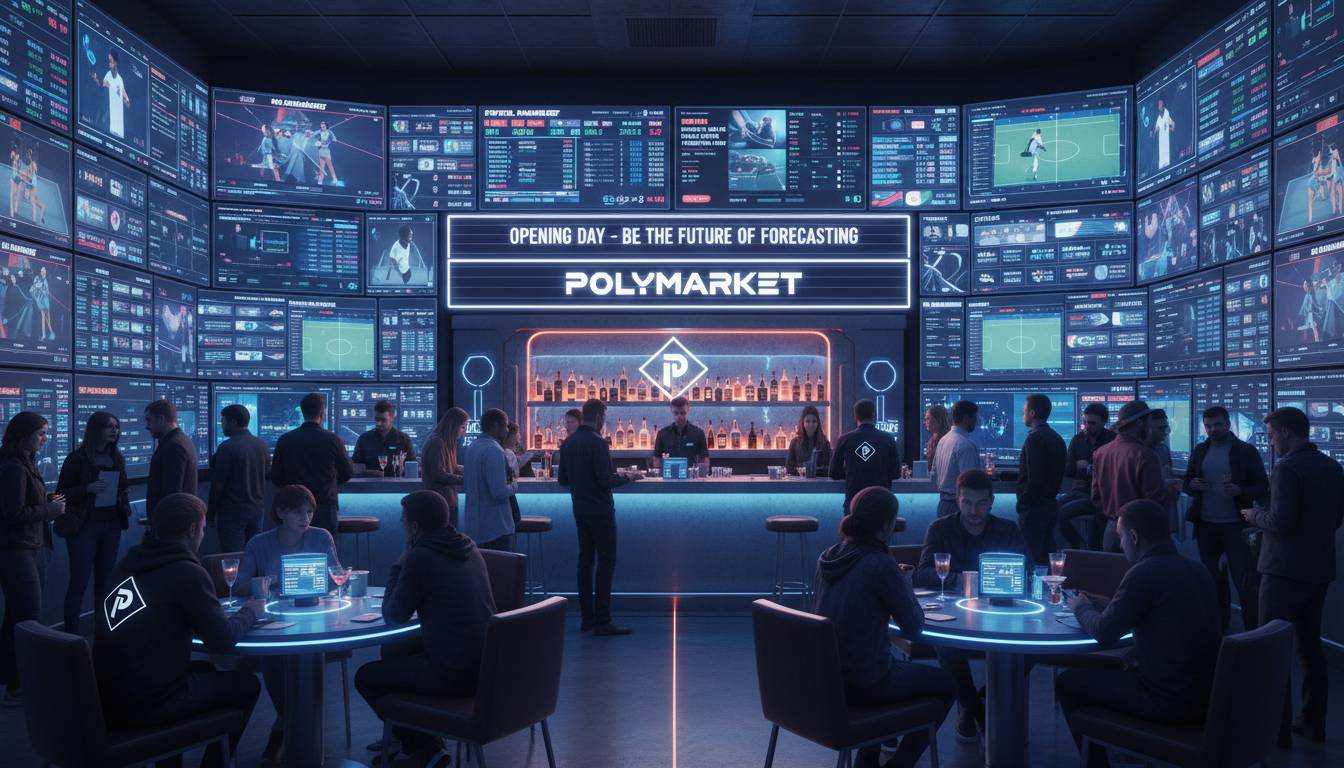
Polymarket’s plan to open a bar packed with screens has drawn attention because it extends the prediction-market brand beyond apps, embeds, and social feeds into a physical venue concept. The company has not, in the material publicly surfaced through official documentation and mainstream reporting reviewed for this article, published a detailed launch document with a confirmed address, opening date, capacity, or operating model for the bar. What is verifiable is the broader context: Polymarket has been expanding its media footprint, product surface, and U.S. ambitions while prediction markets move deeper into mainstream culture.
<!– META TAGS – Place in –>
Buzz around a reported Polymarket bar filled with screens arrives as the company keeps widening its public footprint in 2026 through product updates, embeddable live odds tools, and a push toward a regulated U.S. return. Official Polymarket documentation confirms active expansion in market formats and data distribution tools, while major U.S. media reports document the company’s regulatory and commercial repositioning.
ℹ️
What is confirmed and what is not.
Publicly available sources reviewed for this article confirm Polymarket’s product expansion, live ticker embeds, weekly matching-engine maintenance schedule, and previously reported U.S. re-entry plans. They do not, on their own, provide a full official fact sheet for the reported bar concept as of March 19, 2026.
Verified Polymarket Context Signals
Live since Feb. 12, 2026
Product expansion documented by Polymarket
March 6, 2026
Applied to new markets created after that date
Mondays, 20:00 ET
Typical duration about 90 seconds
Sources: Polymarket Documentation changelog, matching engine docs
March 2026 Product Signals Put the Bar Story in Context
On its own, a “bar full of screens” can sound like a marketing stunt. In Polymarket’s case, the idea fits a company that has spent the past year turning prediction data into a media product as much as a trading product. Polymarket’s official documentation shows that the platform offers embeddable market widgets and a live ticker tool designed for websites and livestreams. That matters because a screen-heavy venue would be a physical extension of the same logic: keep odds visible, keep markets ambient, and make event-driven probabilities part of the viewing experience.
Polymarket’s documentation states that users can embed single markets and create a custom live ticker through its ticker tool. That is a concrete sign that the company already thinks in terms of display surfaces, not just mobile and desktop trading interfaces. A bar environment lined with screens would simply move those surfaces into a hospitality setting where sports, politics, macro events, and breaking news can be watched alongside changing market odds.
The timing also matters. Polymarket’s changelog shows that on February 12, 2026, it launched 5-minute crypto markets. On March 1, 2026, the company documented an expansion of taker fees and maker rebates across all crypto markets, effective for new markets created after March 6, 2026. Those are not hospitality announcements, but they show an operating business still adding formats and refining monetization. A company in active product-build mode is more likely to experiment with new distribution channels and brand experiences than one in retrenchment.
Separately, Polymarket’s matching-engine documentation says the engine restarts weekly on Mondays at 20:00 ET, with a typical duration of about 90 seconds. That level of operational disclosure is relevant because any screen-centric public venue tied to live odds would depend on uptime, latency, and clear communication around maintenance windows. In other words, the bar story is easier to understand when viewed through Polymarket’s existing emphasis on live, visible, continuously updating market data.
Polymarket’s Verified 2026 Operating Markers
| Date | Event | Why It Matters |
|---|---|---|
| Feb. 12, 2026 | 5-minute crypto markets launched | Shows continued product experimentation and faster event cadence |
| March 6, 2026 | Fee and rebate expansion for new crypto markets | Signals broader monetization and liquidity design |
| Weekly | Matching engine restart Mondays at 20:00 ET | Highlights live-market operational discipline |
Source: Polymarket Documentation | reviewed March 19, 2026
Why a Screen-Heavy Venue Fits Prediction Markets Better Than a Standard Campaign
Prediction markets are unusually visual products. Prices move in real time, probabilities compress complex information into a single number, and the underlying events are often already being watched on televisions, streams, or social feeds. That makes a bar full of screens a more natural extension for Polymarket than, say, a conventional billboard campaign. The venue concept would place the product in the same environment where people already consume sports, election nights, earnings headlines, and geopolitical developments.
There is also a competitive logic. Axios reported on February 1, 2026, that prediction markets such as Polymarket and Kalshi had pushed deeper into the mainstream through media, sports, and influencer partnerships. That report framed prediction markets not just as trading venues but as increasingly visible information brands. If that trend is accurate, a physical venue becomes less surprising. It would be another distribution node in a broader contest over where people encounter probabilities first: on TV, on X, on publisher sites, or in a branded real-world space.
Polymarket’s own embed documentation reinforces that interpretation. The company explicitly markets live-updating widgets and a ticker for websites and livestreams. A bar with many screens would be a venue-native version of the same product architecture. Instead of one embedded widget on a publisher page, the company could display multiple live markets across walls, pair them with live event feeds, and turn passive spectators into active market observers.
That does not mean the concept is risk-free. A screen-saturated venue tied to live event probabilities could intensify criticism that prediction markets blur the line between information, entertainment, and speculation. Axios’ February 2026 report on misinformation pressures in prediction markets is relevant here because it shows the reputational downside of becoming a media brand. The more Polymarket behaves like a broadcaster or ambient information layer, the more scrutiny it may face over how markets are framed, promoted, and interpreted.
📊
The strategic logic is distribution.
Polymarket already distributes live odds through embeds and tickers. A bar full of screens would extend that same distribution model into a physical setting where viewers already track live events.
July 21, 2025 to March 2026: U.S. Re-entry Efforts Shape the Backdrop
Any discussion of a Polymarket-branded venue in the United States has to be read against the company’s regulatory history and re-entry plans. Axios reported on July 21, 2025, that Polymarket expected to provide trading access to Americans after acquiring QCX for $112 million. That report said QCX came with a Commodity Futures Trading Commission license and quoted Polymarket CEO Shayne Coplan saying the acquisition was laying the foundation to bring Polymarket back to the United States as a regulated and compliant platform.
That background matters because a public-facing venue is easier to launch when a company is moving toward regulatory normalization rather than away from it. A bar concept tied to a prediction-market brand would likely draw more attention from regulators, local authorities, and media than a software update would. The company’s U.S. posture therefore becomes central context, even if the bar itself is framed as a brand or hospitality activation rather than a place where regulated contracts are directly traded.
There is another reason the timing matters. Front Office Sports reported on January 31, 2026, that Polymarket had been barred from Nevada for at least two weeks under a court order. That report underscored the uneven legal terrain around event contracts and prediction markets in the United States. So while a bar full of screens may sound like a straightforward consumer brand move, it would exist in a market where jurisdiction, licensing, and the distinction between information display and wagering access remain highly sensitive.
In practical terms, that means the buzz around the venue may be driven by more than novelty. It may also reflect curiosity about how Polymarket intends to present itself publicly in the U.S. during a period when prediction markets are becoming more mainstream but remain contested. A screen-heavy bar can be read as branding, community-building, media theater, or a test of how far the category can move into everyday public life without triggering a fresh regulatory backlash.
Polymarket’s Recent Public Timeline
Axios reports Polymarket expects to provide U.S. access after acquiring QCX for $112 million.
Front Office Sports reports Polymarket is barred from Nevada for at least two weeks under a court order.
Polymarket documents a faster crypto market format in its official changelog.
Polymarket extends taker fees and maker rebates to all crypto markets created after that date.
How Live Odds, Embeds, and Tickers Create a Physical-Media Play
The strongest factual link between Polymarket’s existing business and the reported bar concept is its documented screen-ready product stack. The company’s embed FAQ says users can place live-updating widgets on websites and newsletters, and it directs users to a live ticker builder for livestreams or websites. Those tools are built for passive viewing as much as active trading. They let odds function as ambient media.
That distinction is important. A standard exchange interface is designed for execution. A ticker or embedded market is designed for attention. If Polymarket opens a venue full of screens, the screens are likely to matter as much as the bar itself because they turn the company’s core product into a spectator layer. In a sports-bar setting, that could mean live game feeds paired with event-contract probabilities. In a politics setting, it could mean election maps beside market odds. In a macro setting, it could mean central-bank headlines next to rate-cut probabilities or crypto price-event markets.
This is where the venue concept becomes more than a novelty story. It suggests a possible business model around audience formation. Screen density creates dwell time. Dwell time creates repeated exposure to odds. Repeated exposure can deepen brand familiarity even among people who never place a trade. For a company trying to broaden its footprint in the United States, that kind of physical-media presence could be valuable even before direct trading access becomes widely available.
Still, the absence of a fully detailed official public fact sheet means caution is necessary. Without a confirmed launch date, location, or operating details from a primary announcement reviewed here, the bar story should be treated as a developing brand move rather than a fully documented commercial rollout. The buzz is real. The complete public record, at least in the sources reviewed for this article, is still incomplete.
Digital Tools That Make a Screen Venue Plausible
| Tool | Documented Use | Venue Relevance |
|---|---|---|
| Market embeds | Live-updating widget for websites and newsletters | Can translate into screen modules for public display |
| Live ticker | Custom ticker for livestreams or websites | Fits multi-screen walls and ambient odds displays |
| Subgraphs | Query positions, orders, activity, open interest, P&L | Supports data-rich visualizations if used internally or by partners |
Source: Polymarket Documentation | reviewed March 19, 2026
What the Buzz Says About Polymarket’s Brand in 2026
Even without a complete public launch dossier for the bar, the reaction itself is informative. Polymarket is no longer treated purely as a crypto-native niche platform. The company appears in mainstream business coverage about regulation, media influence, and U.S. expansion. That shift changes how even a venue rumor or soft announcement is received. A bar full of screens is not being read as a random side project. It is being read as another signal that prediction markets are trying to become part of everyday media consumption.
That interpretation lines up with the broader category trend. Prediction markets have become more visible in election coverage, sports conversations, and online breaking-news cycles. As that visibility grows, companies in the sector have stronger incentives to own the environments where probabilities are seen. A branded venue offers one such environment. It can host watch parties, product demos, creator events, or media activations. It can also generate social content that extends far beyond the physical location.
At the same time, the category’s controversies travel with it. Reports in 2026 have highlighted concerns around misinformation, ethics, and the social effects of turning sensitive real-world events into tradable probabilities. A venue that puts those probabilities on dozens of screens could intensify both fascination and criticism. That tension is part of why the story has traction. It sits at the intersection of crypto branding, media distribution, gambling-adjacent culture, and regulatory uncertainty.
For now, the most defensible conclusion is narrow. The reported Polymarket bar concept is generating buzz because it fits the company’s documented push into visible, real-time data products and its broader effort to expand public reach. But until the company publishes fuller primary-source details, the story is best understood as a high-attention brand development with incomplete public specifications.
Conclusion
Polymarket’s reported plan to open a bar full of screens has attracted attention because it matches the company’s broader trajectory: more live data surfaces, more public visibility, and more ambition around mainstream distribution. Official documentation confirms that Polymarket already offers embeddable market widgets, a live ticker, and ongoing product expansion in 2026. Mainstream reporting confirms that the company has pursued a regulated U.S. return while operating in a politically and legally sensitive category.
What remains unconfirmed in the reviewed public record is the full operational blueprint for the bar itself. That gap matters. It means the safest factual reading is not that Polymarket has fully documented a new hospitality business line, but that a venue concept associated with the company is drawing attention because it would be a logical extension of its screen-first prediction-market brand.
Frequently Asked Questions
What is Polymarket’s reported bar concept?
The concept being discussed is a Polymarket-linked bar filled with screens showing live content and, by implication, prediction-market data. In the sources reviewed for this article as of March 19, 2026, a full official public fact sheet with confirmed venue details was not available, so the concept should be treated as a developing brand story rather than a fully documented rollout.
Why does a bar full of screens make sense for Polymarket?
Polymarket already offers embeddable live market widgets and a custom live ticker for websites and livestreams, according to its documentation. That means the company already builds products designed for passive viewing on screens, not only for active trading. A venue full of displays would extend that logic into a physical setting.
Is Polymarket operating legally in the United States?
Polymarket’s U.S. status has been in flux. Axios reported on July 21, 2025, that the company expected to provide U.S. access after acquiring QCX for $112 million, while Front Office Sports reported on January 31, 2026, that Polymarket was barred from Nevada for at least two weeks under a court order. The legal landscape remains jurisdiction-sensitive.
What official Polymarket updates are confirmed in 2026?
Polymarket’s documentation confirms that 5-minute crypto markets launched on February 12, 2026. Its changelog also says fee and maker-rebate coverage expanded to all crypto markets created after March 6, 2026. Separately, its matching-engine documentation says weekly restarts occur on Mondays at 20:00 ET and typically last about 90 seconds.
Does Polymarket already have tools built for screen displays?
Yes. Polymarket’s embed documentation says users can place live-updating widgets on websites and newsletters, and it offers a live ticker builder for websites and livestreams. Those tools are directly relevant to any venue concept centered on multiple screens and continuously updating odds displays.
Why is this story getting so much attention?
The story combines several high-interest themes at once: crypto branding, prediction markets, sports-bar style viewing culture, and U.S. regulatory tension. It also arrives at a time when prediction-market companies are becoming more visible in mainstream media and public discourse, making any physical-world expansion more likely to draw outsized attention.
Disclaimer: This article is for informational purposes only and is not investment, legal, or regulatory advice. Readers should verify venue, licensing, and product-access details independently through official company statements and applicable local rules.

View 0 comments