

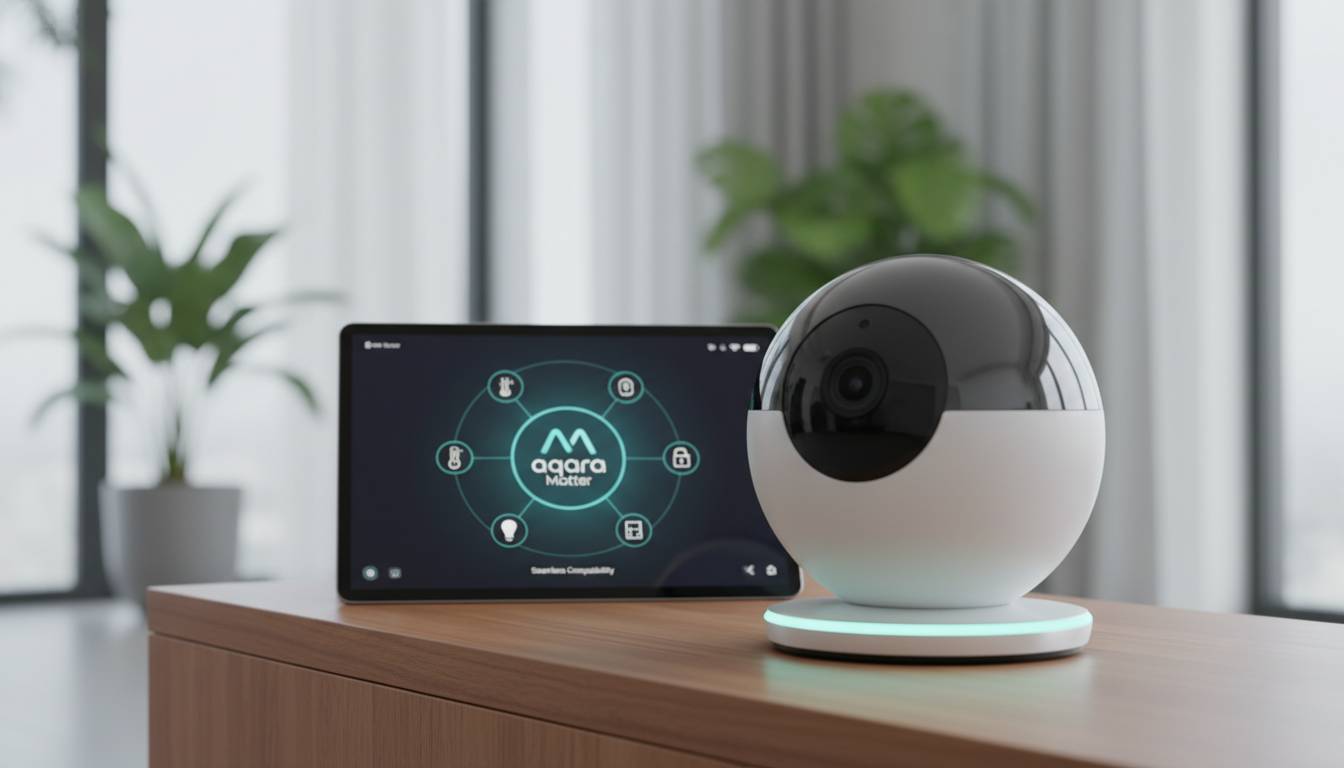
Aqara is pushing deeper into the smart home interoperability race with new camera-hub products and Matter-enabled hubs that aim to reduce one of the biggest frustrations in connected homes: compatibility gaps. The company’s recent launches and CES 2026 announcements suggest a clear strategy for the US market—combine cameras, hubs, Thread border routing, and Matter control in a single device so users can connect across Apple Home, Amazon Alexa, Google Home, and other ecosystems with fewer workarounds. The key question, however, is whether Aqara’s New Matter Smart Home Camera Hub will truly have no compatibility caveats. The answer is increasingly positive for hub functions, but more nuanced for camera functions.
Aqara’s New Matter Smart Home Camera Hub Will Have No Compatibility Caveats—Almost
Aqara’s recent product lineup shows why the company is drawing attention. The Doorbell Camera Hub G410, announced globally on July 10, 2025, combines a video doorbell with a Matter controller, Thread border router, and Aqara Zigbee hub. Aqara says the device supports more than 50 types of third-party Matter-compatible devices, a notable step toward reducing ecosystem lock-in. The company’s Hub M100 and Hub M200 also emphasize “seamless” Matter support and broad compatibility with Apple Home, Alexa, Google Home, and other Matter ecosystems.
That matters because smart home buyers in the US increasingly expect one device to work across multiple platforms without requiring separate bridges, duplicate setups, or app-specific limitations. Aqara’s messaging directly targets that pain point. On its US product pages, the company positions its newer hubs as a way to “end compatibility issues,” while its camera-hub products are marketed as central devices that can connect sensors, automations, and third-party Matter accessories.
Still, the phrase “no compatibility caveats” needs careful interpretation. Aqara’s hub features are becoming more universal, but camera compatibility has historically been constrained by the Matter standard itself. Until recently, Matter did not support cameras as a native device category, which meant Aqara camera hubs could act as Matter hubs without exposing the camera stream itself as a Matter camera. That distinction is central to understanding the current state of the market.
Why Matter Changes the Smart Home Equation
Matter is designed to solve a long-standing industry problem: devices that work only within one brand’s ecosystem. Built on a common application layer and often paired with Thread for low-power mesh networking, Matter allows certified devices to be controlled by multiple major platforms. For consumers, that means a single smart home product can potentially appear in Apple Home, Google Home, Amazon Alexa, and other compatible systems without custom integrations.
Aqara has been one of the more aggressive brands in adopting this model. Its Hub M3, M100, and M200 all support combinations of Zigbee, Thread, Wi‑Fi, and Matter. In practice, these hubs do two important jobs:
- They connect Aqara’s legacy Zigbee accessories to newer Matter ecosystems.
- They act as Thread border routers and Matter controllers for newer devices.
- They help users keep local automations running even when cloud services are interrupted.
That architecture is especially important in the US market, where households often mix brands rather than buying into a single vendor. A user might have Apple Home on an iPhone, Alexa speakers in several rooms, and Google Nest displays in the kitchen. Aqara’s newer hubs are designed to sit in the middle of that mixed environment.
According to the Connectivity Standards Alliance, Matter 1.5 added support for new device types including security cameras, a milestone that opens the door for camera makers like Aqara to move beyond partial interoperability. That is why recent Aqara announcements are drawing attention: the company is no longer just bridging sensors and switches; it is moving toward native Matter camera support as the standard evolves.
What Aqara’s Camera Hubs Actually Support Today
For buyers evaluating Aqara’s New Matter Smart Home Camera Hub, the practical compatibility picture is mixed but improving. Aqara’s current camera-hub products already support major ecosystems through a combination of Matter, HomeKit, Alexa, Google Home, and in some cases RTSP for platforms such as Home Assistant. The G410 doorbell, for example, supports HomeKit Secure Video and also functions as a Matter controller and Thread border router. The Camera Hub G5 Pro similarly serves as a smart home hub while offering RTSP and broad ecosystem support.
However, there has been an important caveat. Reviews of the G5 Pro noted that while the device could function as a Matter hub, the camera itself could not yet be added as a native Matter camera because the specification had not supported that category at the time. In other words, the hub side was interoperable, but the video side still depended on platform-specific integrations such as Apple HomeKit, Google Home, or Alexa.
That distinction is likely to change as Matter camera support moves from specification to shipping products. At CES 2026, Forbes reported that Aqara unveiled the Camera Hub G350 as part of its next-generation Matter hub strategy. Separately, Tom’s Guide reported that Aqara expected its first Matter camera in the first half of 2026, citing Cathy You, Aqara’s Senior Vice President and Head of Global Division.
According to Cathy You, Aqara’s first Matter camera is expected in the first half of 2026. That statement is significant because it suggests Aqara is preparing to close the final interoperability gap between hub functions and camera functions.
What This Means for US Consumers
For US buyers, Aqara’s approach could simplify smart home planning in several ways. First, a combined camera and hub reduces hardware clutter. Instead of buying a separate camera, Zigbee hub, and Thread border router, users can potentially deploy one device that handles all three roles. Second, broader Matter support lowers the risk of being locked into one voice assistant or mobile platform.
The benefits are especially clear for households that want:
- Cross-platform control across Apple, Google, and Amazon ecosystems.
- Local automation support for faster response times.
- A migration path from older Zigbee accessories to Matter-based setups.
- Fewer compatibility surprises when adding third-party devices.
There are still practical limits. HomeKit Secure Video, for example, requires an iCloud subscription and an Apple home hub, and Aqara notes that some HomeKit video modes have resolution limits. That means “seamless compatibility” does not always mean identical features across every platform. A device may connect everywhere, but advanced features can still vary by ecosystem.
That is not unique to Aqara. It reflects the broader smart home market, where standards improve baseline interoperability but premium features often remain platform-dependent. In that sense, Aqara’s New Matter Smart Home Camera Hub may remove many compatibility caveats, but not every feature caveat.
Industry Significance and Competitive Impact
Aqara’s strategy matters beyond its own product line. The smart home industry has long been divided between open-standards advocates and companies that prefer tightly controlled ecosystems. Matter is shifting that balance by making interoperability a competitive necessity rather than a niche feature. Aqara appears to be betting that consumers now value flexibility as much as hardware design or app experience.
That could put pressure on rivals in cameras, hubs, and security devices. If Aqara succeeds in shipping a camera hub that works broadly across ecosystems without major setup friction, competitors may need to match that level of openness. The likely result is a market where buyers compare products less on basic compatibility and more on privacy, AI features, local storage, subscription costs, and automation quality.
There is also a privacy angle. Aqara’s hub portfolio increasingly emphasizes local control, and some products are designed to keep more automation processing on-device. For consumers wary of cloud dependence, that could become as important as Matter support itself.
Conclusion
Aqara’s New Matter Smart Home Camera Hub Will Have No Compatibility Caveats is an ambitious claim, and the company is closer than many rivals to making it credible. Its latest hubs and camera-hub devices already offer broad support for Matter, Thread, Zigbee, Apple Home, Alexa, and Google Home, while recent announcements indicate native Matter camera support is moving into the product pipeline.
For now, the most accurate conclusion is this: Aqara has largely solved compatibility on the hub side, and it is on the verge of doing the same for cameras. US consumers should still check feature-level differences between ecosystems, especially for video resolution, secure storage, and advanced camera controls. But if Aqara delivers on its 2026 roadmap, its next generation of Matter camera hubs could mark one of the clearest signs yet that the smart home industry is finally moving beyond compatibility headaches.
Frequently Asked Questions
What is Aqara’s New Matter Smart Home Camera Hub?
It refers to Aqara’s newer camera-hub products and announced next-generation devices that combine camera functions with smart home hub features such as Matter control, Thread border routing, and Aqara Zigbee connectivity. Examples include the G410 doorbell camera hub and the announced G350 camera hub.
Does Aqara’s camera hub work with Apple, Alexa, and Google Home?
Yes. Aqara’s newer hubs and camera-hub devices are designed to work across major ecosystems, including Apple Home, Amazon Alexa, and Google Home, though some advanced features may differ by platform.
Does Matter fully support cameras now?
Matter 1.5 added support for security cameras, which is a major step forward. However, support in real-world products depends on when manufacturers ship compatible hardware and software updates.
Are there still compatibility caveats with Aqara camera hubs?
There can be. Hub functions are broadly compatible, but camera-specific features such as secure video, recording resolution, and advanced settings may still depend on the platform being used.
Why is a Thread border router important?
A Thread border router connects Thread-based smart home devices to the wider home network and helps enable Matter communication. Aqara’s newer hubs often include this function, reducing the need for extra hardware.
Should US buyers wait for Aqara’s first native Matter camera?
If native Matter camera support is a priority, waiting could make sense. Aqara has indicated that its first Matter camera is expected in the first half of 2026, which may offer a more complete interoperability experience than earlier camera-hub models.

View 0 comments