

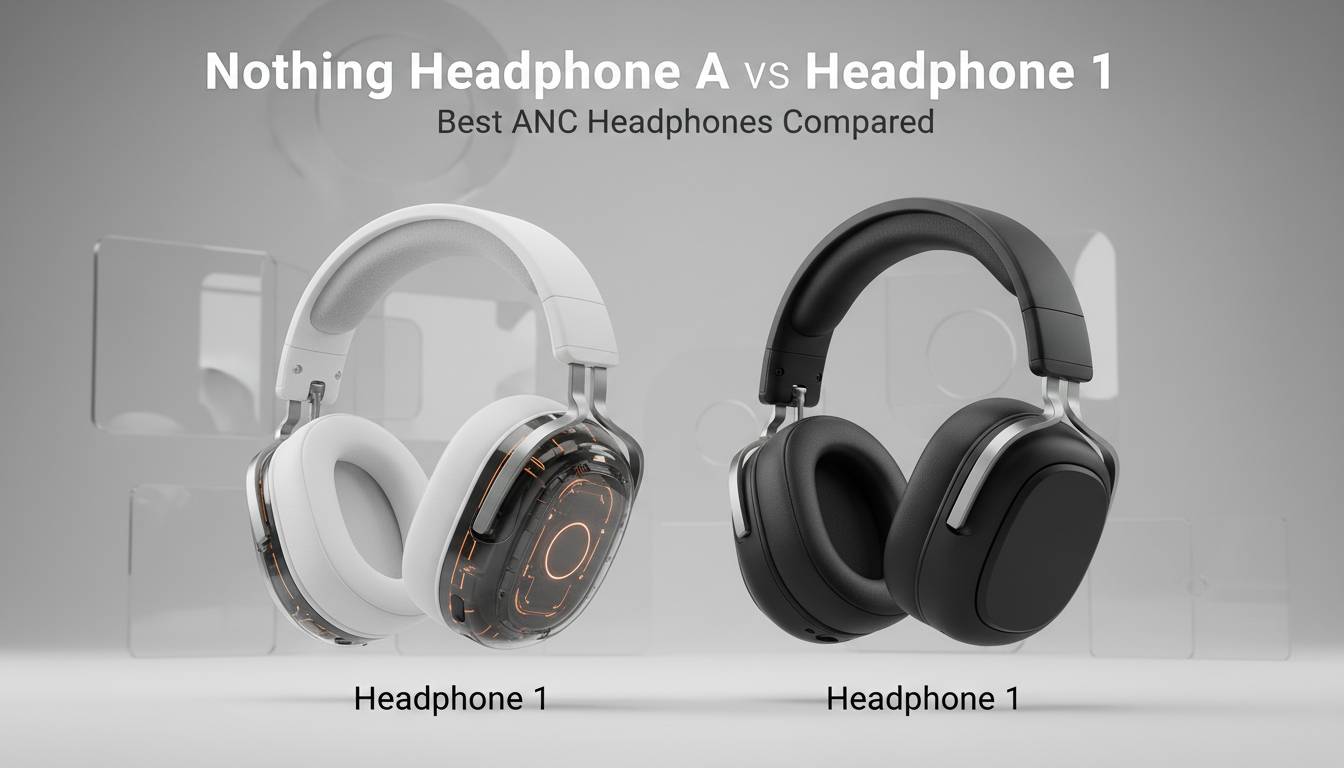
Nothing now has two over-ear ANC models aimed at different buyers: the original Headphone (1), which launched at $299 with KEF-tuned sound and a more premium build, and the newer Headphone (a), which arrived at $199 with dramatically longer claimed battery life and a lighter design. Based on the currently available specs and early review data, the better pick depends less on branding and more on whether you value sound tuning and materials over price, comfort, and endurance.
$199 vs $299: The clearest difference is price
For most shoppers in the US, the first decision point is simple: Headphone (a) sits at $199, while Headphone (1) launched at $299. That $100 gap changes the whole comparison because these two headphones are not trying to win on the same terms. Headphone (1) was Nothing’s first full-size model and positioned as a more design-forward, premium-feeling product. Headphone (a) is the cheaper follow-up, built to hit a lower price while keeping ANC, LDAC, and Nothing’s signature hardware controls.
That pricing also affects expectations. At $299, Headphone (1) competes more directly with upper-midrange wireless ANC headphones, where buyers expect stronger materials, better tuning, and fewer compromises. At $199, Headphone (a) lands in a more aggressive value bracket, where battery life, comfort, and core features can matter more than luxury finishes. TechRadar’s March 5, 2026 review frames Headphone (a) as a lower-cost model that still keeps the essentials while improving on some of the original’s weaknesses.
If your budget is fixed below $250, Headphone (a) is the obvious entry point. If you are willing to spend closer to $300 and care about premium touches, Headphone (1) stays relevant. Price alone does not decide the winner, but it sets the standard each model has to meet.
135 hours vs 80 hours: Battery life is a landslide win for Headphone (a)
On paper, battery life is the biggest gap in this matchup. According to Nothing’s US support pages, Headphone (a) is rated for up to 135 hours of playback with ANC off and 75 hours with ANC on using AAC at 50% volume. Under LDAC, it is rated for up to 90 hours with ANC off and 62 hours with ANC on.
Headphone (1), by comparison, is rated for up to 80 hours with ANC off and 35 hours with ANC on using AAC at 50% volume. With LDAC, Nothing lists up to 54 hours with ANC off and 30 hours with ANC on.
Those numbers are not close. Using Nothing’s own figures, Headphone (a) offers 55 more hours than Headphone (1) with ANC off in AAC mode, and 40 more hours with ANC on. In LDAC mode, the newer model still leads by 36 hours with ANC off and 32 hours with ANC on. For travelers, commuters, and anyone who hates charging over-ear headphones every few days, this is the most decisive advantage in the entire comparison.
Fast charging also favors the cheaper model. Nothing support material surfaced in search results states that a 5-minute charge on Headphone (a) can deliver up to 8 hours of playback with ANC off or 5 hours with ANC on. Headphone (1) search results point to a shorter quick-charge return, with reports citing up to 2.5 hours of ANC-enabled listening from a 5-minute charge.
If battery life is your top priority, Headphone (a) wins this category outright.
310g vs 329g: Comfort and portability lean toward Headphone (a)
Weight matters more with over-ear headphones than spec sheets often suggest. Search results from 9to5Google and retailer listings put Headphone (a) at 310 grams, while multiple sources list Headphone (1) at 329 grams. That 19-gram difference is not huge on paper, but over long listening sessions it can help reduce neck and clamp fatigue, especially for users who wear headphones for workdays or long flights.
The reason is straightforward: Headphone (a) appears to replace some of the original model’s aluminum components with plastic. Gearnews reported that the cheaper model cuts cost and weight partly through material changes, and early coverage consistently describes it as the lighter, less premium-feeling option.
That does not automatically make Headphone (1) uncomfortable. Reviews of the original note that it has enough cushioning for multi-hour sessions, though comfort can be affected by clamp force and the bulkier construction. The trade-off is familiar: the more premium model often feels nicer in the hand, while the lighter model is easier to live with on your head.
For buyers who commute daily, pack headphones into a backpack, or wear them for long office sessions, Headphone (a) has the practical edge. For buyers who care more about finish quality and don’t mind a little extra heft, Headphone (1) still has appeal.
40dB ANC and fewer microphones: Noise canceling is closer than battery life
Both models support active noise cancellation, but the available evidence suggests this is not as one-sided as the battery comparison. Nothing support pages indexed in search results state that Headphone (a) supports ANC with up to 40 dB of noise reduction. Coverage from 9to5Google also says the cheaper model keeps 40 dB ANC while using two fewer microphones than Headphone (1).
Headphone (1) is consistently described as offering hybrid ANC and a four-microphone ENC system for calls, with some reviews also mentioning dedicated ANC microphones. That broader microphone setup suggests the original may still have an advantage in call handling or noise-processing sophistication, even if the cheaper model matches it on headline ANC depth.
The problem is that ANC quality is not fully captured by a single dB claim. Real-world performance depends on tuning, seal, ear pad design, and how well the system handles low-frequency rumble versus voices and sudden sounds. Publicly available review coverage so far gives more concrete praise to Headphone (a) as a strong value ANC option, but there is not enough official comparative lab data from Nothing to declare a total ANC knockout.
So the fairest conclusion is this: Headphone (a) looks strong enough on ANC to satisfy most buyers at $199, while Headphone (1) may still justify itself for users who care about the fuller hardware package and potentially stronger call performance.
KEF tuning vs lower-cost tuning: Sound quality is where Headphone (1) fights back
If Headphone (a) dominates on battery and value, Headphone (1) makes its strongest case on audio pedigree. Nothing marketed the original model with “Sound by KEF,” and review coverage from What Hi-Fi highlights a custom 40mm dynamic driver tuned in partnership with KEF, with the drivers, chambers, and software audited in KEF’s labs. That is a meaningful differentiator because KEF is a recognized hi-fi brand, and Nothing clearly used that partnership to position Headphone (1) above a typical style-first release.
Headphone (a), by contrast, appears to keep a 40mm driver and LDAC support but drops the KEF tuning partnership. 9to5Google explicitly notes that the cheaper model offers familiar sound specs without tuning by KEF.
Still, the surprise in early reviews is that Headphone (a) may actually sound better for some listeners. TechRadar’s March 2026 review says the newer model fixes sound issues the reviewer had with Headphone (1), especially around soundstage, describing the cheaper pair as more open and expansive. That does not make it objectively superior for every listener, but it does weaken the assumption that the more expensive model automatically sounds better in practice.
This is the most subjective part of the comparison. On brand positioning and component story, Headphone (1) has the stronger audiophile pitch. On early listening impressions, Headphone (a) may be the more immediately enjoyable and less flawed tuning for mainstream buyers. If you care about the KEF collaboration and premium intent, Headphone (1) still has the stronger identity. If you care about how the headphones actually come across in casual listening, Headphone (a) may be the safer buy.
LDAC, controls, wired listening, and IP rating: Features are strong on both sides
Neither model looks stripped down in core features. Search results indicate Headphone (1) supports Bluetooth 5.3, dual-device connectivity, LDAC, USB-C audio, 3.5mm wired audio, spatial audio features, and an IP52 rating. Android Authority and other review coverage repeatedly flag the IP52 rating as unusual in over-ear headphones, which gives the original model a practical durability advantage over many rivals.
Headphone (a) also appears well equipped for the price. Coverage points to LDAC support, 40 dB ANC, and the same physical control philosophy that Nothing has leaned on instead of touch-heavy gestures. That matters because physical rollers and paddles are often easier to use accurately than swipe surfaces, especially while walking or wearing gloves.
Where Headphone (1) likely keeps the edge is in the total package. The original model is more often described as the one with the fuller premium feature set, stronger materials, and more ambitious positioning. Headphone (a) is the one that trims cost without abandoning the essentials. In other words, the cheaper model does not feel bare-bones; it feels selectively simplified.
For many buyers, that is exactly the right compromise. If you want the broadest spec sheet and more premium construction, Headphone (1) still has a case. If you want the features that matter most day to day, Headphone (a) covers the basics very well.
Which buyer wins with each model in 2026?
Headphone (a) is the better buy for most people because it undercuts Headphone (1) by $100, lasts far longer on a charge, weighs less, and still keeps the features most shoppers actually use: ANC, LDAC, and physical controls. On current evidence, it is the stronger value product and the easier recommendation for students, commuters, travelers, and anyone shopping under $200.
Headphone (1) makes more sense for a narrower buyer. It is the model to choose if you care about the KEF collaboration, want the more premium-feeling build, value the IP52 rating, or simply prefer the original’s design and positioning. It also remains the more “flagship” expression of what Nothing was trying to do in over-ear audio.
The key point is that this is not a case where the cheaper model is obviously inferior. Based on Nothing’s current battery figures and early review coverage, Headphone (a) looks like the more practical and better-priced product, while Headphone (1) is the more premium and more specialized choice. That shifts the burden of proof onto the original model: unless you specifically want its materials, branding, or KEF-tuned identity, the cheaper pair is hard to ignore.
Final verdict: Headphone (a) wins on value, Headphone (1) wins on premium appeal
If the question is which pair of ANC wireless headphones wins overall, the answer is Headphone (a) for most buyers in 2026. It costs less, lasts much longer, and appears to fix enough of the original’s weaknesses to become the more compelling everyday option.
Headphone (1) is not obsolete. It still offers the more premium story, the KEF partnership, and a feature set that includes extras like IP52 protection and a more upscale build. But unless those advantages matter more to you than price and battery life, Headphone (a) is the smarter purchase.
Frequently Asked Questions
Q: Is Nothing Headphone (a) better than Nothing Headphone (1)?
A: For most buyers, yes. Headphone (a) costs $199 versus $299 for Headphone (1), weighs about 310g versus 329g, and is rated for up to 135 hours of playback with ANC off versus 80 hours on the original. Headphone (1) still has stronger premium credentials, including KEF tuning and IP52 protection.
Q: Which Nothing headphones have better battery life?
A: Headphone (a) has much better claimed battery life. Nothing lists up to 135 hours with ANC off and 75 hours with ANC on for Headphone (a), compared with 80 hours and 35 hours respectively for Headphone (1) in AAC mode at 50% volume.
Q: Does Nothing Headphone (1) sound better than Headphone (a)?
A: Not necessarily. Headphone (1) has the stronger audio pedigree because it was tuned with KEF, but early review coverage says Headphone (a) improves on some of the original’s sound issues, especially soundstage. Which sounds better will depend on your preferences, but the cheaper model is not clearly behind.
Q: Which model is better for travel and commuting?
A: Headphone (a) is the stronger travel pick on current specs because it is lighter and has far longer battery life. Nothing rates it for up to 75 hours with ANC on in AAC mode, which is more than double the 35-hour ANC-on figure listed for Headphone (1).
Q: Does Nothing Headphone (1) have any advantages over Headphone (a)?
A: Yes. Headphone (1) offers a more premium build, KEF-backed tuning, and an IP52 rating that is uncommon in over-ear ANC headphones. Buyers who care about materials, brand collaboration, and flagship positioning may still prefer it despite the shorter battery life and higher price.

View 0 comments