

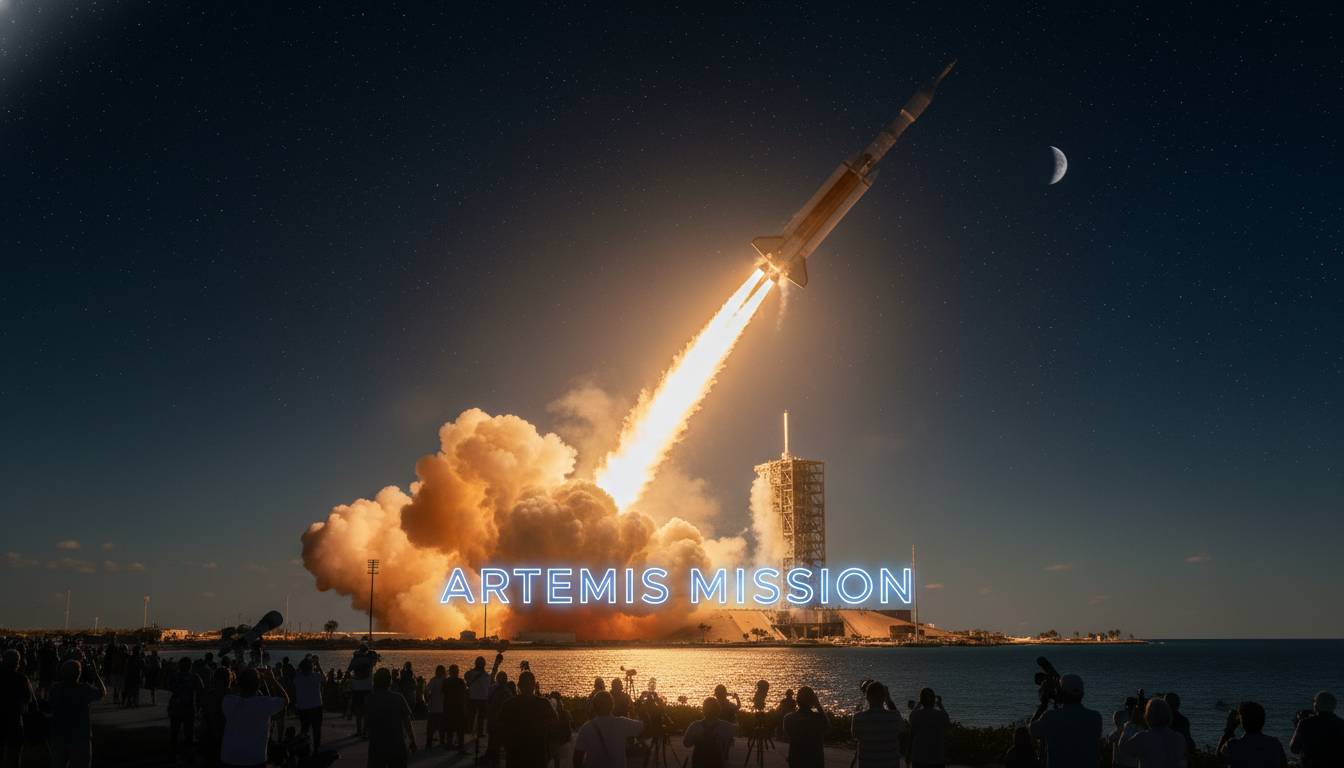
NASA’s Artemis II mission has not blasted off as of April 2, 2026. Instead, the agency is targeting launch no earlier than April 1, 2026, with additional opportunities extending into early April from Launch Complex 39B at Kennedy Space Center in Florida, according to NASA’s official mission pages. That distinction matters. Artemis II is still poised to become NASA’s first crewed lunar flyby mission in more than 50 years, carrying four astronauts around the Moon on a roughly 10-day test flight that will shape the timeline for later lunar landing missions.
Artemis II Has Not Yet Launched, but the Mission Is at the Pad
The headline phrase “blasts off” suggests a completed launch, but NASA’s own updates show Artemis II remained in final prelaunch status heading into April 2026. NASA lists Artemis II as “No Earlier Than April 1, 2026” on its official mission page and describes the mission as the first crewed flight of the Space Launch System rocket and Orion spacecraft. NASA also states that the mission will send four astronauts around the Moon and back to Earth on an approximately 10-day flight.
That crew consists of NASA astronauts Reid Wiseman, Victor Glover, and Christina Koch, along with Canadian Space Agency astronaut Jeremy Hansen. NASA identifies Wiseman as commander, Glover as pilot, and Koch and Hansen as mission specialists. The agency has repeatedly framed Artemis II as a systems-validation mission rather than a lunar landing attempt. Its purpose is to test the integrated performance of Orion, SLS, ground systems, and crew operations before Artemis III and later missions.
NASA’s March 18, 2026 update added important timing detail. The agency said the Artemis II crew entered quarantine at 5 p.m. CDT on Wednesday, March 18, 2026, in Houston. In the same update, NASA said rollout to Launch Pad 39B was targeted to begin at 8 p.m. EDT on Thursday, March 19, 2026. The 11-million-pound stack, carried by crawler-transporter 2, was expected to travel about four miles at roughly 1 mph, with the trip taking up to 12 hours. Those are not ceremonial details. They show Artemis II had moved into the narrow operational window where launch processing, crew health protection, and range coordination all become mission-critical.
NASA later reported that the crew arrived at Kennedy Space Center on Friday, March 27, 2026. In that update, the agency said Artemis II was targeting launch no earlier than 6:24 p.m. for a window opening Wednesday, April 1, 2026, and lasting two hours. NASA also said the early April launch window included opportunities through Monday, April 6, 2026. A separate NASA mission-planning page listed viable opportunities in the March 27 to April 10 period on April 1, 3, 4, 5, and 6, while noting that weather, commodity replenishment, and Eastern Range scheduling could further constrain actual attempts.
Why Artemis II Matters More Than a Single Launch Moment
Artemis II is not just another crewed mission. It is NASA’s first human mission beyond low Earth orbit since Apollo 17 in December 1972. That gap is more than 53 years. NASA explicitly says Artemis II will be the first time in over 50 years that humans see the Moon close-up again. Historically, that places the mission in a category of its own. Comparatively, Artemis I in November 2022 proved the uncrewed architecture. Artemis II is the first live test with people aboard. In practical terms, that means every subsystem, from launch escape readiness to deep-space navigation and reentry operations, carries a different level of scrutiny.
The mission profile is also specific. NASA describes Artemis II as a crewed lunar flyby, not a landing. The four-person crew will launch aboard SLS Block 1, ride in Orion, travel around the Moon, and return to Earth. NASA’s Artemis II materials describe the mission duration as about 10 days. That duration is long enough to test life support, communications, guidance, and crew procedures in deep space, but short enough to remain a controlled demonstration before surface operations begin on later flights.
There is another reason the mission matters: it is the first crewed test of the complete Artemis transportation stack. NASA has emphasized that Artemis II is the first crewed flight under the Artemis campaign and a step toward sustained lunar exploration and eventual Mars missions. That is not rhetoric alone. The agency’s architecture updates and mission pages consistently tie Artemis II to future Moon landings, surface systems, and long-duration exploration planning.
What NASA’s Latest Updates Reveal About Readiness
NASA’s recent updates show a mission that is close, but still governed by engineering reality. In February 2026, NASA said it rolled the SLS and Orion stack back to the Vehicle Assembly Building on February 25, 2026, to troubleshoot helium flow to the rocket’s interim cryogenic propulsion stage. That is exactly the kind of issue that can shift launch timing without changing the broader mission plan. NASA’s public posture has been consistent: readiness and system performance dictate the date, not the calendar.
By mid-March, NASA said ground teams had finalized rollout preparations and the crew had begun quarantine. By late March, the astronauts had arrived at the launch site. Those milestones matter because they indicate the mission had advanced through major prelaunch gates: vehicle integration, pad transfer, crew movement, and countdown preparation. NASA also conducted earlier integrated tests, including a countdown demonstration in December 2025 and crew timeline rehearsals in 2023, to validate launch-day procedures.
From an operational standpoint, Artemis II is a high-complexity mission with multiple constraints. NASA has said launch dates must avoid trajectories that would place Orion in extended eclipses and must support the proper Earth reentry profile. That means launch opportunities are not interchangeable. They are determined by orbital mechanics first, then filtered by weather, range availability, and ground support conditions.
The Crew, Vehicle, and Mission Profile in Focus
The Artemis II crew brings a mix of test, military, station, and international experience. Reid Wiseman, a former International Space Station commander, leads the mission. Victor Glover, the first Black astronaut assigned to a lunar mission, serves as pilot. Christina Koch, who set a record for the longest single spaceflight by a woman, joins as mission specialist. Jeremy Hansen becomes the first Canadian assigned to a mission around the Moon. That lineup gives Artemis II both technical depth and symbolic weight.
On the hardware side, NASA is flying Orion atop the SLS Block 1 configuration. The mission will launch from Launch Complex 39B at Kennedy Space Center, the same historic complex associated with Apollo and later heavy-lift programs. NASA’s reference materials and mission pages describe Artemis II as the first crewed test of SLS, Orion, and Exploration Ground Systems together. That integrated point is crucial. A rocket can perform well in isolation. A spacecraft can pass uncrewed tests. But crewed deep-space exploration depends on the whole chain working together, under pressure, in sequence.
That is why the wording around this mission should stay precise. If the launch has not occurred, saying Artemis II “blasts off” is inaccurate. A more accurate framing on April 2, 2026 would be that Artemis II is in final launch preparations, with launch opportunities beginning in early April. If the mission launches after this date, the title can be updated to reflect the actual event and exact launch time.
Frequently Asked Questions
Has NASA’s Artemis II mission launched yet?
No. As of April 2, 2026, NASA’s official mission pages indicate Artemis II is targeting launch no earlier than April 1, 2026, with additional opportunities in early April, rather than confirming a completed launch.
What is Artemis II?
Artemis II is NASA’s first crewed mission in the Artemis program and the first crewed flight of the Space Launch System rocket and Orion spacecraft. It is designed as a lunar flyby mission, not a Moon landing.
Who is on the Artemis II crew?
The crew includes NASA astronauts Reid Wiseman, Victor Glover, and Christina Koch, plus Canadian Space Agency astronaut Jeremy Hansen. NASA identifies them as commander, pilot, and two mission specialists.
How long will the Artemis II mission last?
NASA says Artemis II is expected to last about 10 days. During that time, the crew will travel around the Moon and return to Earth.
Why is Artemis II important?
It is NASA’s first human mission beyond low Earth orbit since Apollo 17 in 1972. The flight is meant to validate the systems, hardware, and operations needed for later lunar landing missions under Artemis.
Where will Artemis II launch from?
NASA plans to launch Artemis II from Launch Complex 39B at Kennedy Space Center in Florida using the SLS rocket and Orion spacecraft.
Conclusion
Artemis II stands at the threshold of a historic return to deep-space human flight, but precision matters: as of April 2, 2026, NASA’s official information supports a story about final launch preparations and opening launch opportunities, not a completed liftoff. The mission remains one of the most consequential crewed test flights in modern spaceflight, with a four-astronaut crew, a roughly 10-day lunar flyby profile, and a central role in NASA’s long-term Moon-to-Mars strategy. When Artemis II does leave Pad 39B, it will mark more than a launch. It will mark the first crewed step back toward the Moon in a new era of exploration.

View 0 comments