

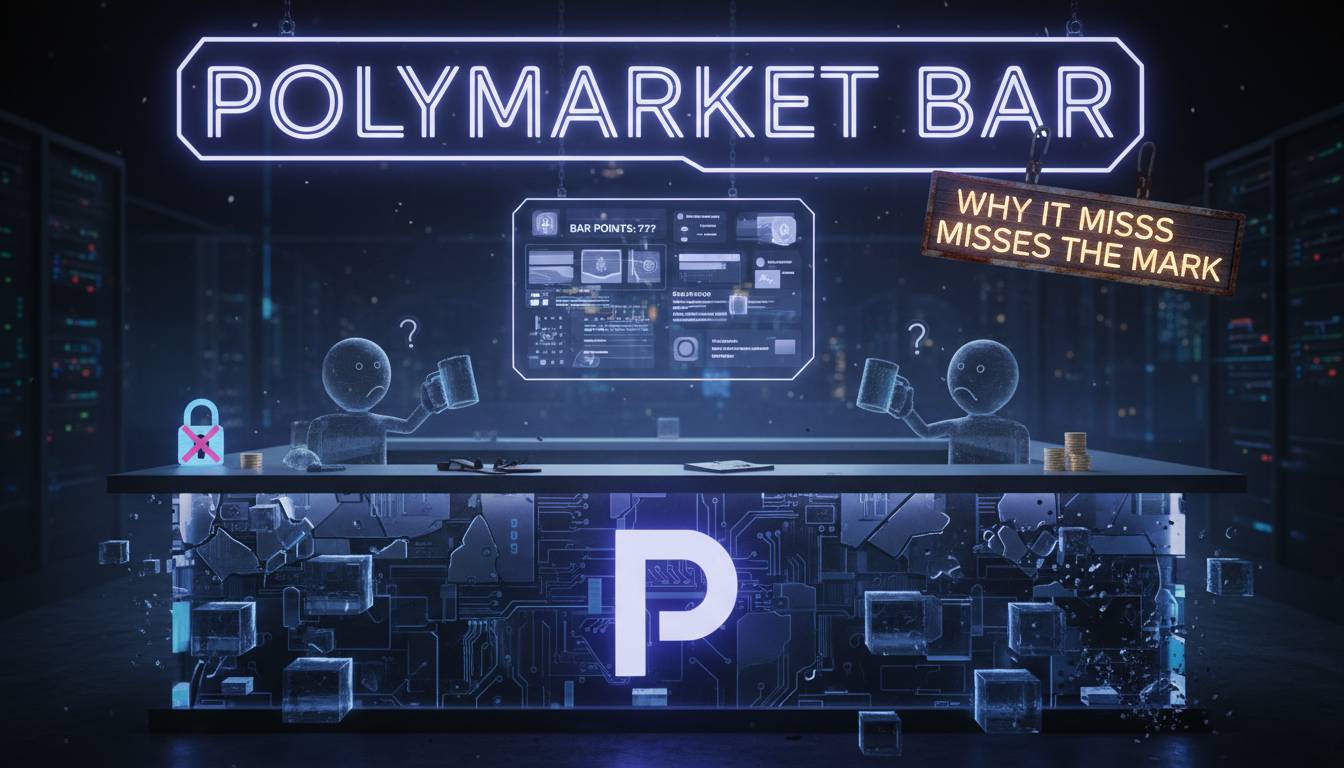
Polymarket’s “Situation Room” pop-up bar opens in Washington, D.C. on Friday, March 20, 2026, for a weekend run, with organizers promising nearly 80 screens, a six-foot globe and interactive touch tables, according to Axios. The concept arrives as prediction markets face fresh scrutiny over ethics, insider-trading concerns and the commercialization of geopolitical crises, which is why the launch lands as a branding stunt with awkward timing rather than a clear product win.
There is a simple pitch behind the venue: turn the logic of a sports bar into a live-monitoring room for politics, markets and global events. Polymarket’s own framing, as cited by Axios and echoed in social posts, is “live X feeds, flight radar, a Bloomberg terminal and Polymarket screens.” In operational terms, that makes the bar less about hospitality than about extending the platform’s core habit loop into a physical space.
🔴
The problem is timing, not just taste.
Polymarket’s D.C. pop-up opens on March 20, 2026, weeks after renewed criticism of prediction markets tied to war-related contracts and alleged insider activity, including reporting highlighted by Axios and Yahoo News in early March 2026.
Polymarket “Situation Room” Pop-Up: Verified Details
| Item | Reported Detail | Source / Time |
|---|---|---|
| Location | Downtown Washington, D.C., near Foggy Bottom | Axios, March 19, 2026 |
| Opening window | Friday start, weekend-long run | Axios, March 19, 2026 |
| Screens | Nearly 80 | Axios, March 19, 2026 |
| Features | Six-foot globe, interactive touch tables | Axios, March 19, 2026 |
| Strategic framing | “Proof of concept” for more activations | Axios interview with Josh Tucker, March 19, 2026 |
Source: Axios | Published March 19, 2026, 10:23 UTC
March 20 Launch Meets a March 2026 Ethics Problem
As a marketing exercise, the bar is easy to understand. Washington is a city built on information asymmetry, status signaling and real-time reaction. A venue that packages those instincts into a prediction-market lounge is almost too on-brand. Axios reported that Polymarket growth strategist Josh Tucker described D.C. as a “proof of concept,” suggesting the company sees the pop-up as a test rather than a one-off novelty.
But the same city also sharpens the criticism. In early March 2026, reporting cited concerns that traders may have profited from advance knowledge around military events tied to Iran-related contracts. Axios reported that Rep. Ritchie Torres introduced the Public Integrity in Financial Prediction Markets Act of 2026. Yahoo News, citing blockchain analytics firm Bubblemaps, said six suspected insider accounts collectively made $1.2 million on Polymarket bets related to U.S. strikes on Iran. Those are not side issues for a company trying to present itself as an information venue. They go directly to whether event markets reward insight, access or something darker.
That is why the bar misses the mark. It turns a live controversy over incentives into an aesthetic. Instead of distancing the brand from the harshest critique of prediction markets, it risks staging that critique on 80 screens.
Why a “Sports Bar for Situation Monitoring” Creates the Wrong Signal
Polymarket’s product case has always been that prices aggregate information better than pundits do. That argument is strongest when markets cover elections, macro data or corporate events with clear resolution criteria. It is weakest when the underlying event is war, assassination risk or human suffering. A physical bar built around “situation monitoring” blurs that line further because it invites spectatorship first and judgment later.
There is also a brand hierarchy problem. Bloomberg terminals, flight trackers and wall-to-wall feeds are visual shorthand for seriousness. Yet a pop-up bar is still a pop-up bar. The result is a mismatch between the imagery of institutional decision-making and the reality of a promotional activation. That mismatch matters because Polymarket is still working to rebuild legitimacy in the United States after years of regulatory friction and a later return through regulated channels, as reported in 2025 coverage from Axios, CNBC and Cointelegraph.
Timeline: From U.S. Exit to D.C. Pop-Up
January 2022: Polymarket settled with the CFTC and agreed to stop offering unregistered event-based binary options markets in the U.S., according to widely reported coverage and public regulatory records.
July 21, 2025: Axios reported Polymarket planned a U.S. return through the acquisition of QCX for $112 million.
Late 2025 to early 2026: Multiple outlets reported a limited U.S. beta and broader relaunch steps.
March 19, 2026: Axios reported the “Situation Room” pop-up bar would open in D.C. for the weekend.
In that context, the bar looks less like product expansion and more like attention arbitrage. It may generate foot traffic and social posts. It does not obviously solve a trust problem.
80 Screens Do Not Fix the Core Product Questions
The harder issue is that physical spectacle does not answer the main questions surrounding prediction markets in 2026. How are suspicious trades monitored? What standards govern sensitive contracts? How should platforms handle markets that may create incentives around violence or state action? Those are governance questions, not ambiance questions. Reporting in March 2026 kept those issues in circulation, including criticism from lawmakers and media coverage of alleged insider-style gains.
Brand Upside vs. Strategic Risk
| Potential Benefit | Counterweight |
|---|---|
| High social-media visibility in D.C. | Can amplify criticism just as quickly |
| Physical community-building for traders | Associates trading with spectacle around crises |
| Proof-of-concept for future activations | Proof-of-concept may validate the wrong brand identity |
| Distinctive positioning vs. standard crypto events | Distinctive does not mean durable or trusted |
Source: Author synthesis based on Axios reporting and March 2026 coverage of prediction-market scrutiny
That does not mean the idea is commercially useless. A niche audience in Washington will likely find it amusing, even compelling. But the standard for a successful brand extension is not whether a concept is memeable. It is whether the concept reinforces the company’s strongest claim. Polymarket wants to be seen as a serious information market. A bar themed around watching the world unravel in real time pushes the brand toward entertainment at the exact moment it needs credibility.
Two Paths as Polymarket Tests Its U.S. Image
There are two plausible readings of the launch. The optimistic one is that Polymarket is trying to create an offline community around a digital product, similar to how finance, sports and crypto brands build loyalty through events. The harsher reading is that the company is leaning into virality because virality is easier than answering structural criticism. Based on the available reporting, the second interpretation is hard to dismiss.
💡
What the launch really signals:
Axios reported the D.C. bar is a “proof of concept.” That suggests Polymarket is testing whether its product can become a lifestyle brand, not just a trading venue. The risk is that the lifestyle image may age worse than the product itself.
If Polymarket wants the bar to mean more than a weekend stunt, it will need to pair the spectacle with visible governance improvements, clearer standards for sensitive markets and stronger evidence that it can police abuse. Without that, the “Situation Room” concept looks clever in a screenshot and thin in strategic terms.
Frequently Asked Questions
What is the Polymarket “Situation Room” bar?
It is a Washington, D.C. pop-up bar that opened for a weekend run beginning Friday, March 20, 2026. Axios reported it features nearly 80 screens, a six-foot globe and interactive touch tables, framed as a “sports bar” for monitoring live events.
Why are critics saying the concept misses the mark?
The criticism is mainly about context. The launch follows March 2026 scrutiny of prediction markets tied to war-related contracts and alleged insider-style trading gains. In that setting, a themed bar can look like a celebration of spectacle rather than a response to governance concerns.
Is the bar an official long-term Polymarket venue?
Available reporting describes it as a pop-up, not a permanent venue. Axios said the D.C. activation is a “proof of concept,” which implies Polymarket is testing the format before deciding whether to repeat it elsewhere.
Does this launch affect Polymarket’s core business?
Not directly in product terms, based on public reporting. The bar is a marketing activation. Its importance is reputational: it shapes how users, regulators and media interpret Polymarket’s brand while the company continues rebuilding its U.S. presence.
What would make the concept more credible?
Publicly documented controls around suspicious trading, clearer standards for sensitive event contracts and stronger transparency on market governance would matter more than venue design. Those are the issues raised in March 2026 reporting around prediction-market oversight and insider concerns.
Disclaimer: This article is for informational purposes only. Information may have changed since publication. Always verify information independently and consult qualified professionals for specific advice.

View 0 comments