

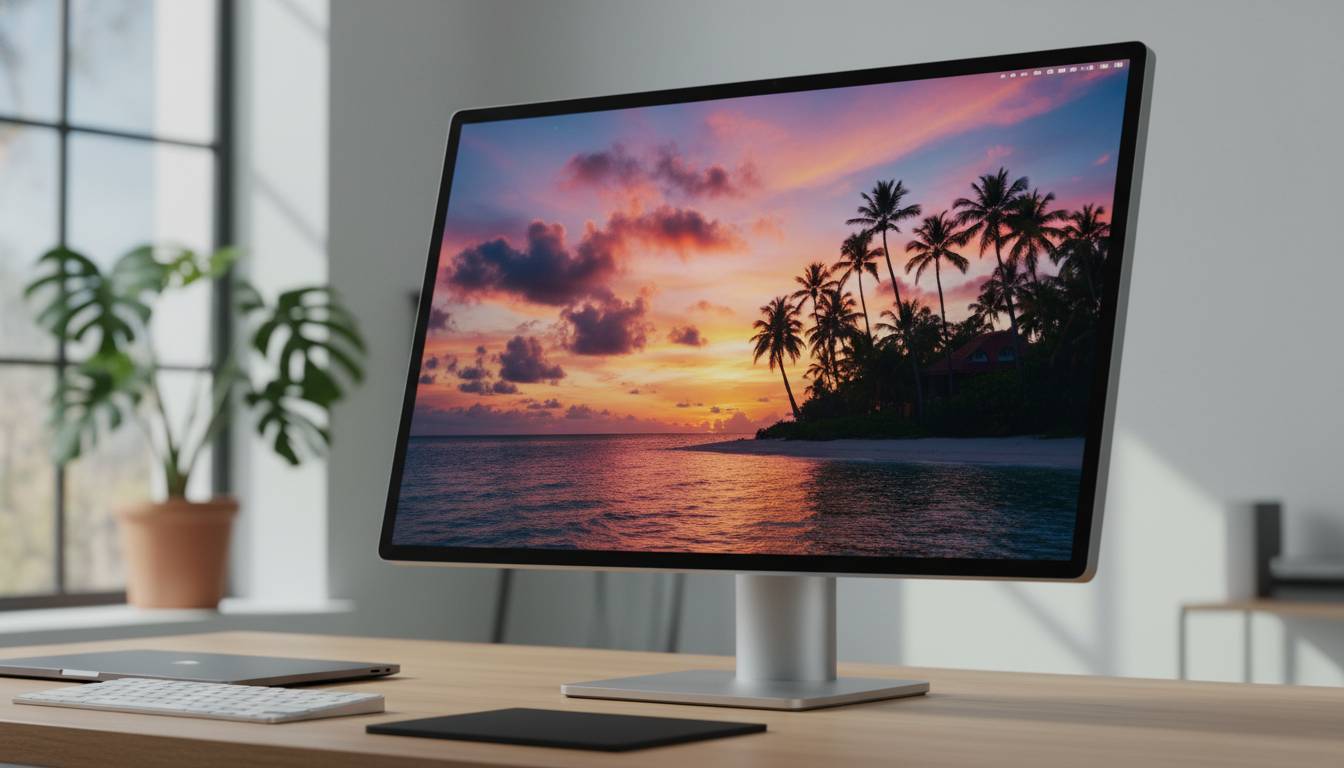
Apple has expanded its desktop display lineup with the new Studio Display XDR, a 27-inch 5K Retina XDR monitor that brings mini-LED backlighting, higher brightness, a 120Hz refresh rate, and Thunderbolt 5 to a more compact pro display format. Announced on March 3, 2026, the product arrives as Apple continues to sharpen the line between standalone displays and all-in-one desktops. That distinction is exactly what makes this review compelling: the screen looks exceptional, but its design also revives a familiar question—why does Apple still not offer an iMac-class machine for users who want this level of display quality in a single desktop package?
A New Display With Premium Ambitions
The Studio Display XDR is Apple’s newest high-end monitor, positioned above the standard Studio Display and below or alongside the long-standing Pro Display XDR in a different use case. According to Apple, the new model features a 27-inch 5K Retina XDR panel with 5120-by-2880 resolution, an advanced mini-LED backlight, 2,304 local dimming zones, up to 1,000 nits of SDR brightness, 2,000 nits of peak HDR brightness, and a 1,000,000:1 contrast ratio. It also supports a 120Hz refresh rate and Adaptive Sync, features that immediately make it more modern than Apple’s earlier 27-inch Studio Display.
That specification sheet matters because Apple’s display strategy has often forced buyers into trade-offs. The original Studio Display, introduced in March 2022, delivered a sharp 27-inch 5K panel and strong industrial design, but it lacked true HDR-class performance and higher refresh rates. The Pro Display XDR, introduced in 2019, offered reference-grade brightness and a 32-inch 6K panel, but at a much higher price and with a more specialized audience in mind. The Studio Display XDR attempts to bridge that gap with a smaller footprint and a lower starting price of $3,299 in the U.S. with a tilt- and height-adjustable stand.
From a market perspective, that makes the product easier to understand than its name suggests. It is not simply a refreshed Studio Display. It is Apple’s attempt to bring XDR branding and pro-grade visual performance to a monitor that can sit on more desks, whether in a creative studio, a home office, or a premium enterprise setup.
Apple Studio Display XDR Review: It Looks So Good, I Wish It Were an iMac
The strongest reaction to the Studio Display XDR is visual. On paper, the jump from a standard 5K panel to a 5K Retina XDR panel with mini-LED and 2,000 nits peak HDR brightness is significant. In practice, those numbers point to a display that should offer deeper blacks, stronger highlight detail, and more convincing HDR performance than the 2022 Studio Display. Apple also says the display supports both P3 wide color and Adobe RGB, with more than 80% Rec. 2020 coverage for HDR video editing and color grading.
This is where the product becomes both impressive and frustrating. Apple has clearly built a display that many Mac users would want as the centerpiece of an all-in-one desktop. The 27-inch size, 5K resolution, integrated camera, microphones, speakers, and premium enclosure all echo the qualities that once made the larger iMac a standout product. Yet the Studio Display XDR remains a monitor first, requiring a separate Mac to complete the setup.
That matters for several groups of buyers:
- Creative professionals get a more capable compact reference-style display.
- Office and hybrid workers get a premium screen with integrated collaboration tools.
- Apple enthusiasts get another reminder that the 27-inch iMac category remains unfilled.
- Value-focused buyers face a much higher total cost once a Mac mini, Mac Studio, or MacBook is added.
According to John Ternus, Apple’s senior vice president of Hardware Engineering, the Studio Display XDR is “a huge leap forward for XDR technology,” with mini-LED, 2,000 nits peak HDR brightness, advanced color accuracy, and a 120Hz refresh rate. That statement aligns with Apple’s positioning of the product as a serious tool for filmmaking, design, print, 3D animation, and other demanding workflows.
Design, Connectivity, and Everyday Use
Apple has kept the broader Studio Display design language intact, and that is mostly a strength. The enclosure remains clean, minimal, and unmistakably Apple. Buyers can choose standard glass or nano-texture glass, and the display includes the same integrated camera and audio system found in the updated Studio Display family. Apple says that includes a 12MP Center Stage camera with Desk View support, a studio-quality three-microphone array, and a six-speaker system with Spatial Audio.
Connectivity is another major upgrade. The Studio Display XDR uses Thunderbolt 5, which Apple says is designed to simplify pro workflows and support high-speed accessories or daisy-chaining. The standard Studio Display now also uses Thunderbolt 5 and can daisy-chain up to four displays for nearly 60 million combined pixels. Apple further says the included Thunderbolt 5 Pro cable supports up to 96W of charging power, enough to fast-charge a 14-inch MacBook Pro.
For daily use, those features make the monitor more versatile than many competing premium displays. It is not just a panel. It is also a webcam, speaker system, microphone array, and docking point for a Mac-based workspace. That all-in-one convenience is part of why the product naturally invites comparison with an iMac, even though Apple sells it as a separate display.
Where the Value Debate Begins
The Studio Display XDR starts at $3,299, while the refreshed standard Studio Display starts at $1,599. Those prices place Apple firmly in the premium end of the monitor market, especially once buyers add a Mac. A Studio Display XDR paired with a Mac mini or Mac Studio can quickly move into workstation-level spending territory, even before storage or memory upgrades are considered.
That pricing does not automatically make the product poor value. For editors, colorists, designers, and photographers, display quality can justify a large share of a workstation budget. The combination of 5K sharpness, XDR brightness, Adobe RGB support, and 120Hz responsiveness gives the Studio Display XDR a clearer professional identity than the original Studio Display ever had.
Still, the broader consumer reaction is likely to be mixed. Many users do not need 2,000 nits peak HDR brightness or 2,304 local dimming zones. What they want is simpler: a beautiful 27-inch Apple desktop with a top-tier screen, strong speakers, a good camera, and Apple silicon inside. The Studio Display XDR proves Apple can build that front half of the experience. It just stops short of turning it into the all-in-one many buyers still want.
Why the Missing iMac Still Matters
Apple’s desktop lineup has become more modular over time. Users can pair a Mac mini, Mac Studio, or MacBook with a Studio Display, choosing performance and portability separately from the screen. That flexibility benefits professionals and businesses that want to upgrade components on different cycles. It also helps Apple segment its lineup more precisely.
But there is a trade-off. The all-in-one desktop remains one of the simplest and most elegant computing formats for many households, schools, and offices. The 24-inch iMac continues to serve that role, yet there is still no larger-screen equivalent in Apple’s current lineup. The Studio Display XDR, with its integrated camera, microphones, speakers, and premium industrial design, highlights that gap more than it closes it.
From a strategic standpoint, Apple may prefer the higher average selling prices and clearer upsell path created by separate Macs and displays. From a user standpoint, however, the appeal of a larger iMac remains obvious: fewer cables, less desk clutter, simpler purchasing decisions, and a more unified product identity. The Studio Display XDR is a reminder that Apple’s hardware design is fully capable of supporting that concept if it chooses to revisit it. This is an inference based on Apple’s current product positioning and the overlap in features between its displays and all-in-one desktops.
Final Verdict
The Studio Display XDR looks like one of Apple’s most compelling desktop displays in years. Its 27-inch 5K Retina XDR panel, mini-LED backlight, 120Hz refresh rate, Adobe RGB support, and Thunderbolt 5 connectivity give it a stronger professional case than the standard Studio Display. For users who prioritize image quality and want Apple’s latest display technology in a more compact format, it appears to be a serious and highly polished option.
Yet the product also underscores a lingering absence in Apple’s lineup. The Studio Display XDR has many of the ingredients of a dream all-in-one desktop, but Apple sells it only as a premium monitor. That makes it both desirable and slightly incomplete. It is a stunning screen, and for many buyers that will be enough. For others, it will feel like proof that the larger iMac idea still deserves another chapter.
Frequently Asked Questions
What is the Apple Studio Display XDR?
The Studio Display XDR is Apple’s new 27-inch 5K Retina XDR monitor announced on March 3, 2026. It features mini-LED backlighting, 2,304 local dimming zones, up to 2,000 nits peak HDR brightness, 120Hz refresh rate, Adaptive Sync, and Thunderbolt 5.
How much does the Studio Display XDR cost in the U.S.?
Apple says the Studio Display XDR starts at $3,299 in the U.S. with a tilt- and height-adjustable stand. It is available in standard or nano-texture glass options.
How is it different from the standard Studio Display?
The standard Studio Display offers a 27-inch 5K Retina display with 600 nits brightness, while the Studio Display XDR adds mini-LED, much higher HDR brightness, a 120Hz refresh rate, and broader pro-focused color capabilities including Adobe RGB support.
Is the Studio Display XDR an iMac?
No. It is a standalone monitor and requires a separate Mac, such as a Mac mini, Mac Studio, MacBook Pro, or another compatible Mac.
Why do some reviewers say it should have been an iMac?
Because the product combines a premium 27-inch display, integrated camera, speakers, microphones, and Apple’s signature design language—features that closely resemble the strengths of an all-in-one desktop. That naturally leads some users to wish Apple offered a larger iMac built around the same screen concept.
Who is the Studio Display XDR best for?
It is best suited to professionals and advanced users who need high brightness, HDR performance, accurate color, and a premium Apple-centric desktop setup. Buyers focused mainly on general productivity may find the standard Studio Display or other monitors more practical.

View 0 comments