

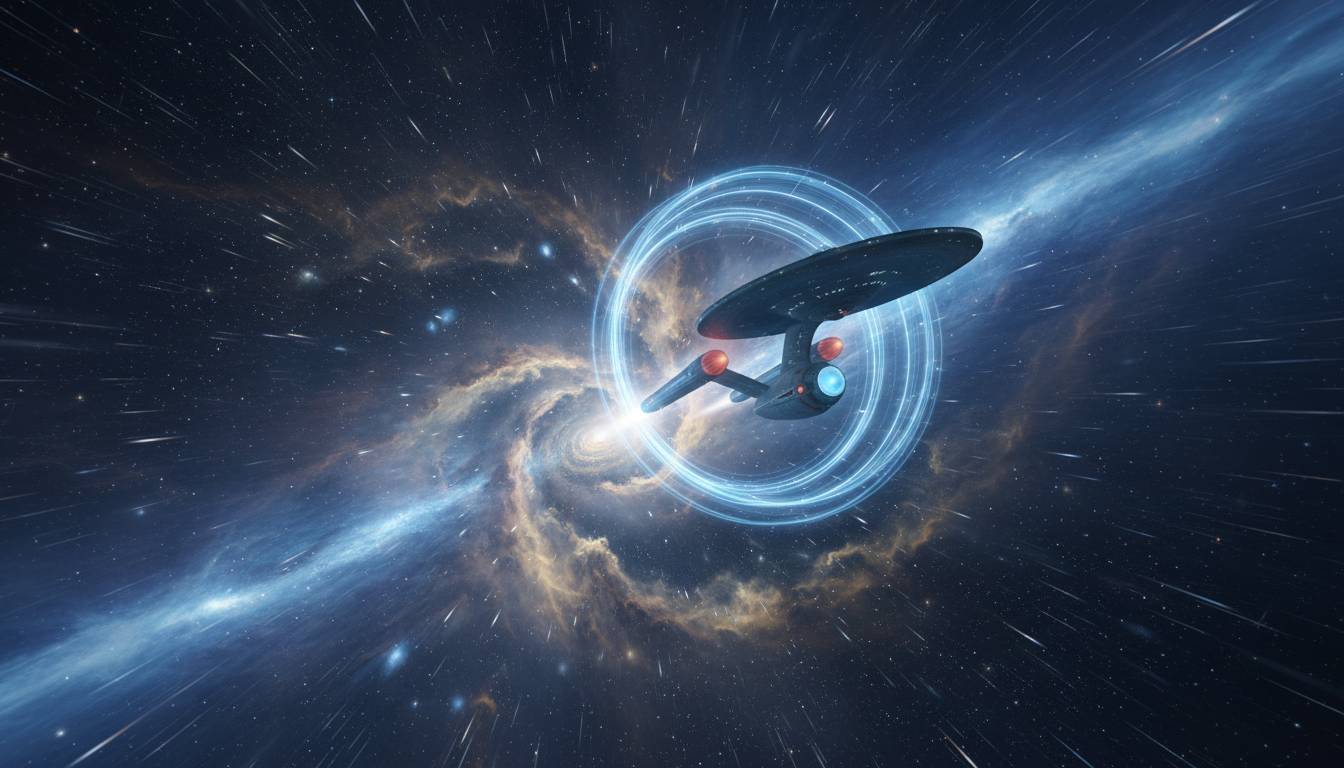
Star Trek makes interstellar travel look routine. Real physics does not. Still, the franchise gets more right than many viewers assume, especially about distance, energy, communication delays, and the brutal limits imposed by relativity. To test that idea against actual science, I compared Star Trek’s core ship concepts with publicly documented astrophysics and propulsion research from NASA and related scientific literature. The result is not a verdict of “possible” or “impossible.” It is more interesting than that: some Trek ideas are wildly speculative, while others are surprisingly grounded in how space travel really works.
Why interstellar travel is so hard in the first place
The central problem is distance. NASA states that Voyager 1, the most distant human-made object, reached interstellar space in August 2012 and is traveling away from the solar system at about 3.5 astronomical units per year. One astronomical unit is roughly 93 million miles, the average Earth-Sun distance. That sounds fast until you compare it with the gulf between stars. Proxima Centauri, the nearest known star to the Sun, is about 4.24 light-years away. At Voyager-like speeds, a trip there would take tens of thousands of years.
That is the first thing Star Trek gets right: interstellar travel requires a fundamentally different scale of propulsion than ordinary planetary missions. The show treats crossing between star systems as a civilization-defining capability, not just a bigger version of going to Mars. That framing matches astrophysics. Chemical rockets are excellent for escaping Earth and navigating the solar system, but they are nowhere near enough for practical interstellar voyages.
Another point Trek handles well is communication latency. NASA notes that signals from Voyager 1 take many hours to reach Earth, and that is only across the outer edge of our own solar neighborhood. Between stars, even light-speed messages take years. So when Star Trek compresses travel and communication into a single dramatic framework, it is smoothing over a real physical barrier that astrophysicists think about constantly: information cannot outrun light in ordinary spacetime.
What Star Trek’s warp drive gets right, and where it breaks
Warp drive is the obvious headline concept. In Star Trek, ships do not simply accelerate through space in the conventional sense. They distort spacetime itself. That sounds like fantasy, but it is not pure nonsense. In 1994, physicist Miguel Alcubierre proposed a mathematical solution to Einstein’s field equations in which spacetime could, in principle, contract in front of a spacecraft and expand behind it. The ship inside that “bubble” would not locally break the speed of light, even if it appeared to move faster than light relative to distant observers.
That is the part Trek gets surprisingly right. The idea that faster-than-light travel might require manipulating spacetime, rather than flooring a giant engine, is exactly the kind of move modern relativity pushes physicists toward. If you ask an astrophysicist what is more plausible in theory, “a ship just goes faster than light” or “spacetime geometry changes,” the second answer is the one with an actual mathematical lineage.
But the problems are severe. Alcubierre-style warp concepts appear to require exotic conditions, including negative energy density or forms of matter not known to exist in usable amounts. Later theoretical work has tried to reduce the energy demands or reformulate the geometry, including research published on arXiv in 2021 on “physical warp drives,” but none of that comes close to an engineering blueprint. So the astrophysicist’s answer here would be blunt: Star Trek is directionally smarter than most science fiction, but warp drive remains speculative physics, not technology on the horizon.
Impulse engines are closer to reality than warp engines
If warp drive is Trek’s glamorous idea, impulse propulsion is its more realistic one. The franchise often depicts ships using sublight engines for maneuvering within star systems, reserving warp for long-distance travel. That division makes sense. Real spacecraft also rely on different propulsion regimes for different mission phases.
Modern space agencies already use high-efficiency electric propulsion, including ion and Hall-effect thrusters, for some missions. These systems produce low thrust but can operate for long periods, gradually building very high speeds compared with chemical propulsion. They are not “impulse engines” in the Star Trek sense, but the underlying logic is familiar: once you are in space, sustained efficient thrust matters more than dramatic launch-style power.
An astrophysicist would likely give Trek credit here for understanding that interstellar-capable civilizations would not use one engine mode for everything. The show’s separation between sublight travel and spacetime-bending travel reflects a real engineering instinct. Different environments demand different tools. That part is not just cinematic convenience. It is good systems thinking.
Artificial gravity and inertial damping are the biggest cheats
Some Star Trek technologies are less defensible. Artificial gravity is one of them. The series treats gravity plating as standard ship infrastructure, with crew members walking normally in every corridor. In real spacecraft design, gravity is a serious unsolved habitability problem for long missions. The most plausible known method is rotation, which creates apparent gravity through centripetal acceleration. That is why rotating habitats show up so often in harder science fiction.
Star Trek usually skips that. It also skips the ugly consequences of acceleration. If a ship could accelerate hard enough for rapid interstellar travel, the crew would face crushing inertial forces unless some additional mechanism canceled them out. Trek calls that inertial damping. Real physics does not offer a working version of that technology. So if an astrophysicist were ranking Trek concepts by plausibility, inertial dampers and gravity plating would land much lower than the broad idea of warp geometry.
Deflectors, shielding, and navigation are more realistic than they look
One underappreciated area where Star Trek does well is hazard management. Space is not empty in the practical sense. At very high speeds, dust grains, gas particles, and radiation become major threats. Trek’s navigational deflectors and shields are dramatized, of course, but they reflect a real problem. Any craft moving at a meaningful fraction of light speed would need extraordinary protection against impacts and radiation exposure.
This is where the franchise shows an astrophysicist’s instinct, even if not the exact solution. Interstellar travel is not just about propulsion. It is also about surviving the medium between stars. That medium is thin, but over light-years it adds up. A ship would need shielding, redundancy, autonomous repair capability, and precise navigation. Trek consistently treats those as mission-critical systems. That is good science-fiction judgment.
Could anything in development resemble Star Trek travel?
The nearest real-world analogue is not warp drive. It is beamed propulsion. Breakthrough Starshot, a research initiative backed by scientists and technologists, has explored the idea of using powerful Earth-based lasers to push ultralight sails to around 20 percent of light speed. That would still be unmanned, tiny, and extraordinarily difficult to execute. But it matters because it shows how astrophysicists and engineers think when they get serious about interstellar travel: minimize mass, externalize the energy source, and accept that human passengers make everything harder.
That last point is crucial. Star Trek is about crews, diplomacy, and exploration by people. Real near-term interstellar concepts are about probes. An astrophysicist would almost certainly say that robotic missions come first by a very wide margin. Humans require life support, radiation protection, food, redundancy, and return-on-investment logic that is far tougher than sending instruments.
What the franchise ultimately understands about the universe
Star Trek’s biggest scientific strength is not a single engine. It is the worldview behind the ships. The series understands that the universe is vast, that travel between stars is a civilization-scale challenge, and that advanced propulsion would reshape politics, exploration, and culture. That is exactly how astrophysicists think about the stakes, even when they disagree with the machinery.
So what do Star Trek’s spaceships get right about interstellar travel? More than the jokes suggest. Warp drive borrows the right kind of physics language, even if it remains deeply speculative. Sublight propulsion logic is sensible. Shielding and navigation concerns are real. Communication delays and distance are foundational truths. Where Trek drifts furthest from known science is in gravity control, inertial damping, and the ease with which crews survive extreme travel conditions.
In other words, Star Trek is not a blueprint. It is a smart extrapolation. And from an astrophysicist’s point of view, that is a lot more impressive.
Frequently Asked Questions
Is warp drive scientifically possible?
There is no experimental evidence that a working warp drive is possible. However, general relativity does include theoretical spacetime solutions, such as the Alcubierre metric, that inspire the concept. The obstacle is that these ideas appear to require exotic conditions and energy regimes far beyond demonstrated engineering.
Has any spacecraft reached interstellar space?
Yes. NASA says Voyager 1 reached interstellar space in August 2012. Voyager 2 also entered interstellar space later. That does not mean either craft is close to another star. It means they have crossed beyond the Sun’s heliosphere into the space between stars.
What is the most realistic path to interstellar travel today?
For the foreseeable future, robotic probes are far more realistic than crewed starships. Concepts such as laser-driven light sails, including Breakthrough Starshot, are often discussed because they avoid carrying all propulsion energy onboard and can potentially reach a meaningful fraction of light speed.
Why can Star Trek ships ignore long communication delays?
Mostly because the story needs it. In real physics, signals are limited by the speed of light. Across interstellar distances, that creates delays measured in years. Star Trek often uses fictional subspace communication to bypass that limit.
What is the least realistic common technology in Star Trek ships?
Artificial gravity and inertial damping are among the least realistic because there is no established engineering path to either one. Real spacecraft would likely need rotating habitats for gravity and would still have to manage acceleration forces through careful mission design.


View 0 comments