

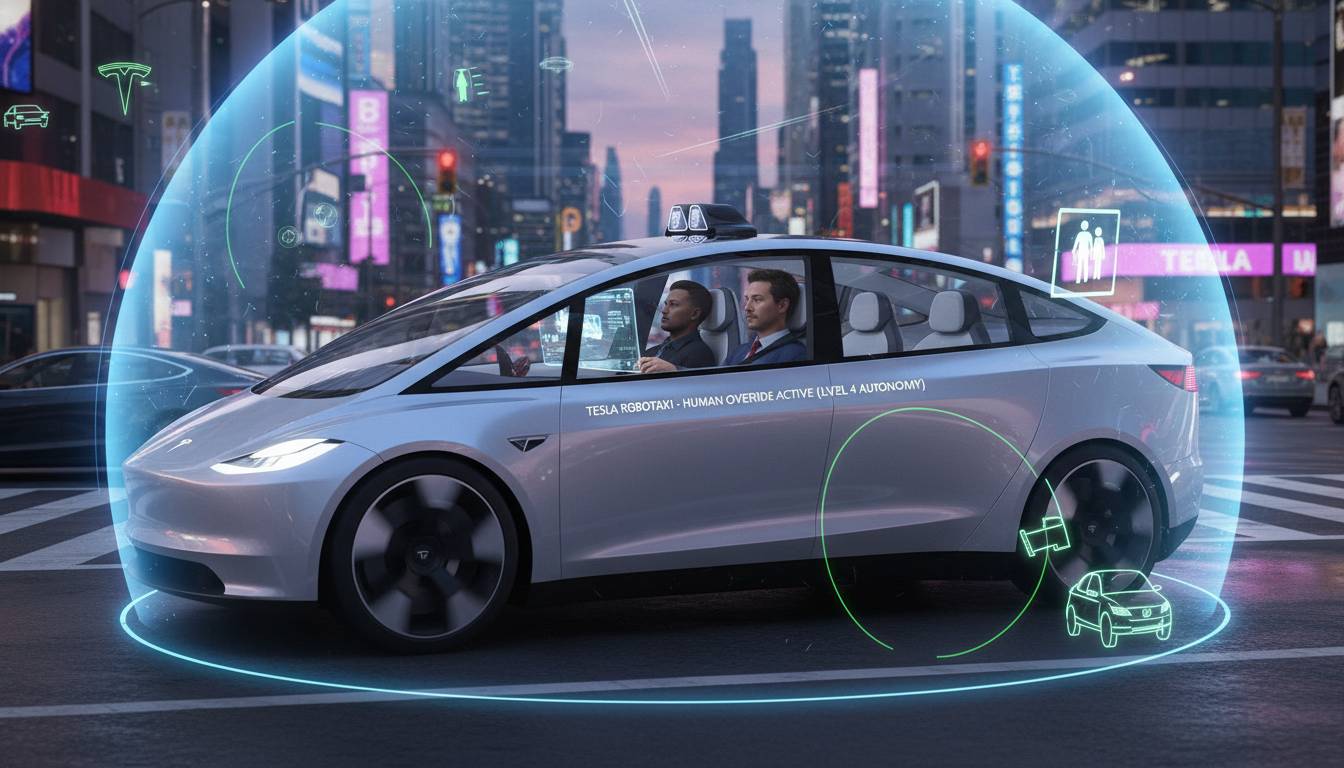
Tesla has now put in writing what critics, regulators, and close watchers of its autonomy claims have been arguing for years: parts of its robotaxi operation still depend on humans. The disclosure matters because it cuts through the marketing fog. Tesla’s public-facing robotaxi language leans hard on “driverless” and “autonomous,” yet its own legal, support, and service materials show a system that can involve human assistance, remote intervention, and in some cases supervised driving frameworks rather than true no-human-in-the-loop autonomy. That gap is the story.
Tesla’s own documents draw a sharper line than its branding
The clearest evidence comes from Tesla’s legal pages and support materials published on its own website. In the company’s Terms page, the section governing a Tesla rideshare vehicle operating with Full Self-Driving (Supervised) states that the vehicle runs “at SAE Level 2 with a safety driver,” and adds that SAE Level 2 “does not mean that the rideshare vehicle is autonomous.” That language appears in the legal text visible on Tesla’s site as of the version crawled in mid-March 2026.
That is not a minor wording tweak. SAE Level 2 means the automated system can handle steering and speed in limited conditions, but a human remains responsible for the driving task. In plain English, that is not a robotaxi in the Waymo-style sense most consumers would assume from the word. Tesla’s own support page, meanwhile, describes Robotaxi as a “driverless experience” in limited areas of Austin, Texas, and says the service operates from 6 AM to 2 AM Central Time. The same page says the initial fleet consists of Model Y vehicles and bars riders from the front-left seat, the seat normally used by a driver.
That contrast is the key tension. On one page, Tesla sells the experience as autonomous and driverless. On another, it explicitly distinguishes supervised Level 2 rideshare from autonomy. The company is not alone in using layered language around automation, but Tesla’s wording is unusually important because its chief executive has spent years promising fully self-driving capability on public roads. AP reported in June 2025 that U.S. regulators were already scrutinizing Tesla robotaxi incidents in Austin after videos showed problematic maneuvers, including one vehicle driving in an opposing lane.
Where the “fully human-controlled” issue actually shows up
The strongest public evidence is not that every Tesla robotaxi is secretly hand-driven all the time. It is that Tesla’s service architecture leaves room for humans to step in, guide, support, or directly manage parts of the ride when the software cannot cleanly finish the task on its own. Tesla’s support page says riders can tap “Support” during a trip and “someone will connect” through the vehicle touchscreen. If a ride stops unexpectedly, Tesla says a representative can assist and the rider can request the vehicle pull over to a safe location.
That alone does not prove direct joystick-style teleoperation. But it does establish an active human operations layer. CNBC reported ahead of Tesla’s Austin launch that Elon Musk said the company would be “watching” the vehicles in remote operations centers. Reuters Connect imagery published in March 2026 also described Tesla robotaxis being tested in Austin “with a driver” in anticipation of a later driverless launch.
Put those pieces together and the picture gets clearer. Tesla’s public robotaxi rollout appears to span at least three operational modes: supervised rideshare with a safety driver, nominally driverless rides in a geofenced Austin service area, and human support or intervention when something goes wrong. That is a far cry from the simple consumer impression that the cars are independently handling every trip end to end.
Why this matters more than a semantic fight
This is not just about whether Tesla’s marketing is aggressive. It goes to the heart of how the public, investors, and regulators understand risk. If a service can require human backup, then the economics, scalability, and safety case all change. A robotaxi network that needs remote operators, support staff, or fallback human control is still technologically significant, but it is not the same business model as a truly autonomous fleet with minimal human oversight.
That distinction has regulatory consequences too. CNBC reported in April 2024 that California regulators said Tesla then held only the lowest-level permit for autonomous testing in the state, one that allowed testing with human drivers present. More recently, outside reporting has argued Tesla still lacks the permits needed for a fully driverless commercial robotaxi deployment in California, though those claims vary by jurisdiction and permit category.
AP also reported in January 2026 that the National Highway Traffic Safety Administration had expanded scrutiny of Tesla’s Full Self-Driving feature after reports of red-light running, wrong-side driving, and crashes. That matters because any company trying to normalize the word “robotaxi” while still relying on supervised or fallback human control is operating under a much brighter regulatory spotlight than a typical ride-hailing platform.
The bigger issue Tesla critics say competitors missed
Most coverage of Tesla robotaxis has focused on launch dates, Austin geography, or whether the company can catch Waymo. The more revealing angle is operational honesty. Tesla’s own pages show that “driverless” is not the whole story. The company says riders may not always be delivered to their intended destinations, that rides can be modified or canceled at Tesla’s discretion, and that support staff can intervene during a trip. Those are not throwaway disclaimers. They are clues about where the system still needs human scaffolding.
There is also a pattern here. AP reported in late 2024 that U.S. safety regulators said Tesla’s public statements could imply its vehicles can drive themselves when they cannot, citing a mismatch between public messaging and internal or owner-facing warnings. That earlier criticism now looks less like a one-off and more like a recurring feature of Tesla’s autonomy communications.
To be fair, remote assistance is not unique to Tesla. Human oversight exists across the autonomous vehicle industry. The difference is disclosure and framing. When a company markets a service as autonomous while its own legal and support materials preserve broad room for human involvement, the burden shifts to Tesla to explain exactly when a robotaxi is truly driving itself and when a person is effectively taking over key parts of the operation.
What Tesla needs to clarify next
The obvious unanswered questions are operational, not philosophical. Under what conditions can a Tesla robotaxi receive remote guidance? Can a human operator merely suggest a path, or can that operator directly control steering, braking, or acceleration? How often do rides require intervention? How many support staff monitor each active vehicle? Tesla’s public materials, at least in the sources reviewed here, do not answer those questions directly.
Until Tesla provides those details, the safest factual reading is this: Tesla robotaxis are not a clean, fully autonomous black box. They are a layered service that blends automated driving, geofencing, customer support, and human fallback. That does not make the technology fake. It does make the branding less straightforward than the headline promise.
Frequently Asked Questions
Did Tesla actually admit its robotaxis are not fully autonomous?
Yes, in part. Tesla’s legal terms for one rideshare setup explicitly describe Full Self-Driving (Supervised) operating at SAE Level 2 with a safety driver and state that Level 2 does not mean the vehicle is autonomous. Tesla’s Robotaxi support page, however, separately describes Robotaxi as a driverless service in limited parts of Austin.
Does Tesla use human operators during robotaxi rides?
Tesla’s support materials show that human representatives can connect with riders through the vehicle touchscreen during a trip and assist when a ride stops unexpectedly. Public reporting also says Tesla monitors vehicles from remote operations centers. The reviewed sources do not fully spell out the exact limits of remote control authority.
Where is Tesla Robotaxi available?
Tesla says Robotaxi service is available in limited areas of Austin, Texas. Its support page says service hours are 6 AM to 2 AM Central Time and that the initial fleet uses Model Y vehicles.
Is Tesla’s robotaxi service the same as Waymo’s driverless service?
Not based on the materials reviewed here. Tesla’s documents preserve a role for supervised driving frameworks and human support, while Waymo’s public model is built around permitted driverless autonomous operations in multiple markets. The regulatory and operational structures are not the same.
Why is this disclosure important for consumers and investors?
Because human fallback changes the economics and the risk profile. A service that still needs safety drivers, remote operators, or active support staff is less scalable and less autonomous than the branding may suggest. It also matters for regulators evaluating whether Tesla’s public claims match the system’s real-world capabilities.

View 0 comments