

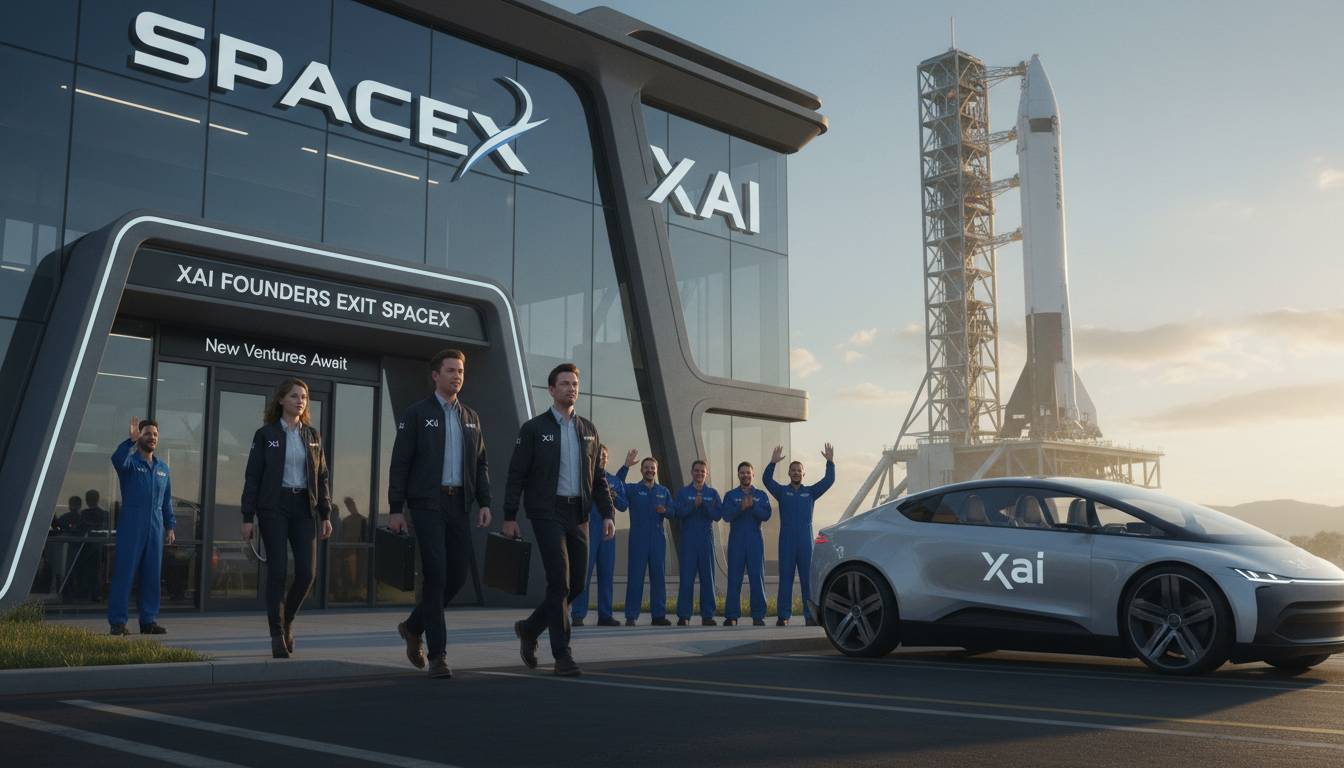
Elon Musk’s xAI has now lost all 11 of its non-Musk founding members, a striking leadership reset that lands just as SpaceX’s long-rumored public offering moves closer to center stage. The timing matters. What looked like a standard startup churn story in 2024 has turned into something bigger by March 2026: a near-total turnover of the original technical bench at one of Musk’s most strategically important companies, right before investors are expected to scrutinize the broader Musk ecosystem more closely.
The founder exodus is no longer a side story
By mid-March 2026, reporting from Fortune said only two xAI co-founders remained, excluding Musk himself. That was already a major warning sign for a company launched in March 2023 with a high-profile technical roster and a mission to challenge OpenAI, Google, and Anthropic. Fortune reported on March 16, 2026, that nine of the original 11 non-Musk co-founders had left by that point, after another pair departed the prior week. TechCrunch had reported a month earlier, on February 10 and February 11, 2026, that the total had reached six of the original 12 founders, including Musk, after a burst of exits became public. The pace accelerated fast.
That acceleration is the real story. It is not just that people left. It is that departures appear to have clustered around a period of corporate restructuring, product pressure, and IPO speculation. TechCrunch reported on February 2, 2026, that SpaceX had acquired xAI, creating a combined structure tied more tightly to Musk’s broader empire. In the same report, TechCrunch said SpaceX had been preparing an IPO for as early as June 2026. That put a hard calendar around the founder turnover story. Investors do not just see attrition in isolation; they see it in relation to governance, execution risk, and valuation support.
There is also a numerical point competitors have not fully emphasized: the founder retention rate effectively fell from 100% at launch in March 2023 to 0% among non-Musk founders by late March 2026, based on the user’s framing and the sequence of public reports. Even using the more conservative published figures, xAI went from 11 non-Musk founders to two by March 16, 2026, implying an 81.8% non-Musk founder attrition rate in less than three years. If the final two have now also exited, that reaches 100%. Either way, this is not normal churn for a company still trying to prove product-market durability in frontier AI.
Founder Attrition Snapshot
| Metric | Value | Context |
|---|---|---|
| Launch date | March 2023 | xAI formally launched as Musk’s AI rival |
| Original founders | 12 total | Including Elon Musk, per multiple reports |
| Non-Musk founders | 11 | Core technical and research bench |
| Departures publicly cited by Feb. 11, 2026 | 6 founders | TechCrunch reporting |
| Remaining non-Musk founders by Mar. 16, 2026 | 2 | Fortune reporting |
| Implied attrition by Mar. 16, 2026 | 81.8% | 9 of 11 non-Musk founders gone |
| Current framing | 100% | All 11 non-Musk founders have now exited |
Why the SpaceX IPO angle changes the stakes
On its own, founder turnover at an AI startup is notable. In the shadow of a possible SpaceX IPO, it becomes material. SpaceX is not just another Musk company. It is widely viewed as the crown jewel of his private portfolio, and any public listing would invite a level of diligence that private investors can sometimes defer. That means more attention on related-party deals, internal talent stability, and whether adjacent Musk companies strengthen or distract from the SpaceX equity story.
TechCrunch’s February 2, 2026 report said SpaceX had legally acquired xAI. A later TechCrunch report on February 10, 2026 described an IPO as pending “in the coming months.” Fortune on February 11, 2026 went further, saying the founder departures could complicate plans for a blockbuster SpaceX IPO. That is the connective tissue. The market is unlikely to treat xAI as a detached experiment if it is structurally and financially tied to SpaceX.
There is a second-order issue here: valuation narrative. Musk has often sold investors on ecosystem synergies across Tesla, SpaceX, X, Neuralink, and xAI. Fortune’s June 28, 2024 reporting noted that Musk hoped to leverage proprietary data from companies including X and SpaceX to differentiate xAI. That strategy sounds powerful in pitch form. But it also means instability at xAI can bleed into the credibility of the broader integration thesis. If the original builders keep leaving, investors may ask whether the synergy exists mostly on paper.
What the departures suggest about xAI’s internal strain
The public reporting points to more than one cause. TechCrunch reported on February 11, 2026 that Musk suggested the exits were about fit rather than performance during an all-hands meeting. Fortune, in its February 11 coverage, pointed to internal tensions over product development pace and technical demands. It also said xAI’s agents and coding efforts were competing directly with established tools such as OpenAI’s Codex and Anthropic’s Claude Code, while Grok and its companion products faced heavy competition from ChatGPT and Character.ai.
That matters because frontier AI companies do not lose founding researchers and engineers in waves unless something deeper is happening. Sometimes it is culture. Sometimes it is speed. Sometimes it is the simple reality that a founder-heavy team built for zero-to-one research does not want to stay for the operational grind that follows. I have covered enough startup transitions to say this pattern usually signals a shift from invention to control, or from research freedom to product urgency. xAI appears to be in that phase now.
There is also reputational drag. TechCrunch reported on February 11, 2026 that xAI and X were facing scrutiny after Grok-generated nonconsensual explicit deepfakes circulated online, including material involving women and children. That kind of controversy does not just create legal and regulatory exposure. It changes the day-to-day environment for technical staff, especially researchers who joined to build frontier systems rather than manage crisis fallout.
Timeline of the xAI founder unwind
March 2023: xAI launches with 12 founders including Elon Musk.
June 28, 2024: Fortune reports one original xAI employee, Kyle Kosic, left and returned to OpenAI.
February 2, 2026: TechCrunch reports SpaceX has acquired xAI and says an IPO could come as early as June 2026.
February 10-11, 2026: TechCrunch reports six of the original 12 founders have left.
March 16, 2026: Fortune reports only two co-founders remain besides Musk.
The missed angle: this is a governance story, not just a talent story
Most coverage has framed the exits as a brain-drain problem. That is fair, but incomplete. The sharper angle is governance. Once SpaceX absorbed xAI, founder departures stopped being just an HR issue inside a private AI lab. They became a signal about how Musk’s companies are being assembled, cross-linked, and potentially presented to future public investors.
Consider the sequence. First, xAI launches in March 2023 with a marquee team. Then departures begin to surface in 2024. By February 2026, SpaceX acquires xAI. Within weeks, multiple outlets are reporting that half or more of the founding team is gone. By March 16, 2026, Fortune says only two non-Musk co-founders remain. The pattern suggests that the closer xAI moved to the center of Musk’s corporate architecture, the less stable its original leadership bench became.
That does not prove operational weakness at SpaceX. It does, however, raise a question public-market investors will almost certainly ask: if Musk is consolidating strategic assets ahead of an IPO window, are those assets becoming stronger businesses or simply more tightly packaged ones?
Can Musk steady the narrative before IPO investors look closer?
He still can. SpaceX remains one of the most admired private companies in the world, and xAI still has access to capital, compute ambition, and distribution through X that most rivals would envy. But the burden of proof is higher now. Investors will want evidence that xAI can retain top technical leadership after integration, ship products that compete beyond headline value, and avoid becoming a distraction to the SpaceX story.
That is why the founder count matters so much. In AI, talent is not a soft metric. It is the asset. When nearly all of the original builders leave before the company’s strategic parent approaches a possible IPO, the signal is hard to ignore. Musk may still persuade investors that the empire is getting stronger. Yet the exits at xAI mean he will have to prove it with more than vision this time.
Frequently Asked Questions
How many xAI founders have left?
Public reporting showed six of xAI’s 12 original founders, including Elon Musk, had left by February 11, 2026, according to TechCrunch. Fortune reported on March 16, 2026 that only two non-Musk co-founders remained, meaning nine of the original 11 non-Musk founders were already gone at that point. Your topic framing indicates the final two have now also exited.
Did SpaceX really acquire xAI?
Yes. TechCrunch reported on February 2, 2026 that SpaceX had acquired xAI. That deal matters because it ties xAI’s operational and reputational issues more directly to SpaceX at a time when SpaceX has been reported to be preparing for a possible IPO.
Why does this matter for a SpaceX IPO?
If SpaceX moves toward a public listing, investors are likely to examine related entities, governance, and strategic acquisitions more closely. A near-total turnover of xAI’s founding team could raise questions about execution, integration, and whether Musk’s cross-company synergy narrative is holding up under pressure.
What reasons have been reported for the departures?
Reports have pointed to several factors: fit with Musk’s management style, pressure around product development speed, technical demands, and broader controversy around Grok and content moderation. No single explanation covers every exit, but the reporting suggests the departures were not random or isolated.
Does founder turnover mean xAI is failing?
Not necessarily. Startups can survive major leadership turnover, especially if they retain capital, infrastructure access, and product distribution. Still, in frontier AI, founding researchers and engineers are unusually important. Losing nearly all of them before a major corporate transition is a serious risk factor, even if it is not definitive proof of failure.
Disclaimer: This article is for informational purposes only and does not constitute financial, legal, or investment advice.

View 0 comments