

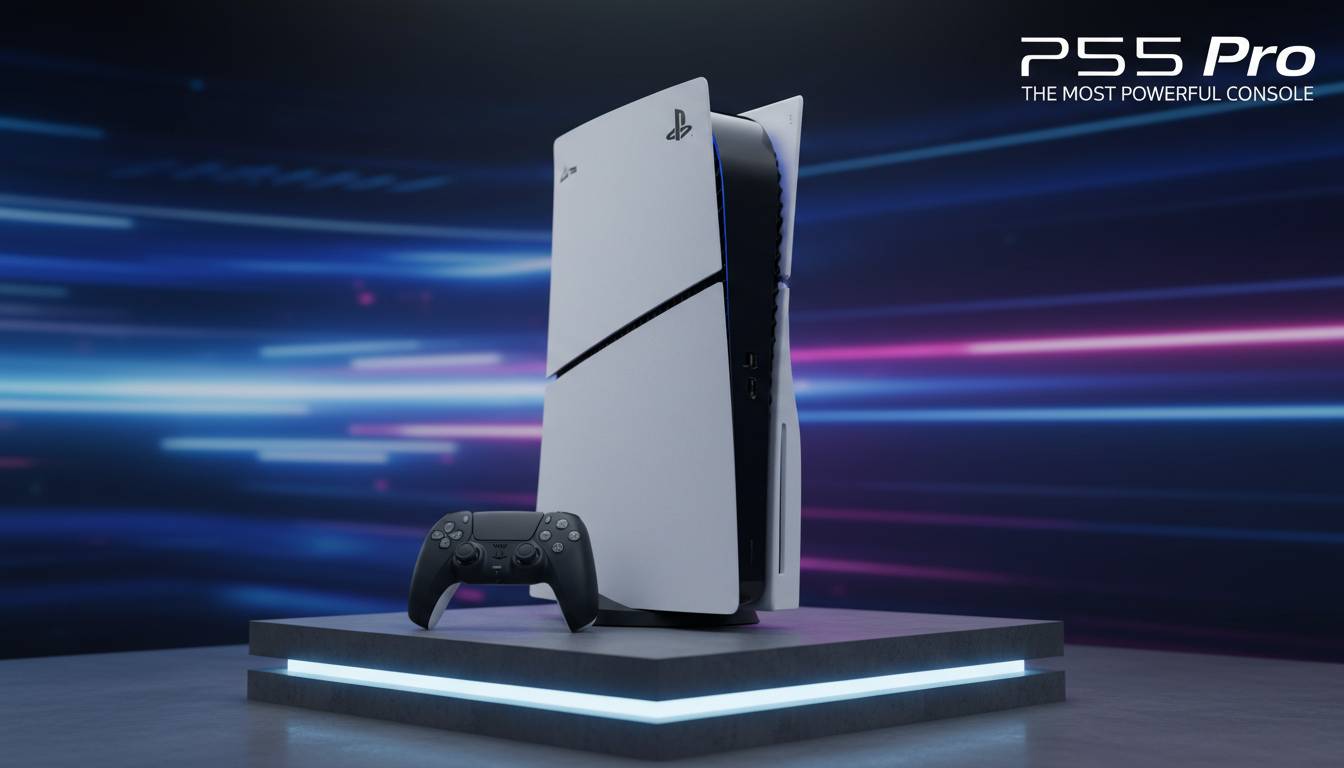
Sony’s PlayStation 5 Pro sits at the top of the console market on raw graphics ambition, but it also pushes harder than any mainstream console on price and modular upselling. Announced on September 10, 2024, and launched on November 7, 2024, the machine starts at $699.99 in the US, ships as an all-digital system, and asks buyers to pay extra for the disc drive and vertical stand. That combination makes the PS5 Pro easy to admire and harder to recommend broadly. Sony positions it as the most advanced PlayStation hardware to date, with an upgraded GPU, advanced ray tracing, PlayStation Spectral Super Resolution, Wi-Fi 7 support in supported territories, and a 2TB SSD. The result is a console that often delivers the cleanest image quality and the best “quality mode without the old compromises” experience available in living-room gaming, but only if you are willing to pay enthusiast pricing for a platform that still depends heavily on per-game patches and optional accessories.
PS5 Pro at a Glance
$699.99
MSRP for console only
2TB
Custom SSD included
Sold separately
Optional add-on costs $79
Sold separately
Optional accessory costs $29
50+
Sony said more would follow
Sources: Sony PlayStation Blog, PlayStation Direct, PS5 Pro safety guide
$699.99 on November 7, 2024 Put the PS5 Pro in a Different Class
The first fact that defines the PS5 Pro is not its GPU. It is the price. Sony said on September 10, 2024 that the console would launch on November 7, 2024 at an MSRP of $699.99 in the US, bundled with a 2TB SSD, a DualSense controller, and Astro’s Playroom pre-installed. Sony also made clear at announcement that the PS5 Pro is a disc-less console, with the disc drive offered separately rather than included. That single decision changes the buying equation immediately.
For a buyer who still uses physical media, the real entry price is not $699.99. Sony’s own PlayStation Direct listing for the compatible disc drive shows a $79 price, while the vertical stand listed alongside it is priced at $29. In practical terms, a buyer who wants a PS5 Pro with disc playback and the official stand is looking at $807 before tax. That is a very different proposition from the headline MSRP, and it is the clearest reason the machine feels piecemeal.
That modularity is not hidden. Sony states directly that the PS5 Pro is an all-digital console and that users can add a disc drive if they want to play PS5 or PS4 games on Blu-ray Disc or watch 4K Ultra HD Blu-ray movies. The company also notes that the vertical stand is sold separately across current PS5 hardware pages. The issue is not transparency; the issue is value perception. Buyers are paying the highest console entry price in PlayStation history while still being asked to assemble the full package through add-ons.
📊The PS5 Pro’s “real” enthusiast price is higher than the box suggests.
At Sony’s listed US prices, the $699.99 console rises to $778 with the disc drive and to $807 with both the disc drive and official vertical stand.
That matters because the PS5 Pro is not replacing the standard PS5 as the default mainstream option. Sony presents it as a premium tier above the regular system, and the pricing reinforces that. This is a console for players who already know why they want better image quality, stronger ray tracing, or a more stable high-frame-rate presentation. If you do not already care about those things, the cost structure is difficult to justify on paper.
16.7 TFLOPS and 2TB Storage Explain Why Sony Calls It Its Most Advanced Console
On specifications, the PS5 Pro makes a straightforward case for itself. Sony’s published safety guide lists an x86-64 AMD Zen 2 CPU with 8 cores and 16 threads, a 16.7-teraflop AMD Radeon RDNA-based graphics engine, 16GB of GDDR6 memory, an additional 2GB of DDR5, and a 2TB custom SSD. Sony’s launch messaging also centers on three pillars: an upgraded GPU, advanced ray tracing, and PlayStation Spectral Super Resolution, or PSSR.
Those details matter because the PS5 Pro is not trying to reinvent the PlayStation platform. It keeps the same ecosystem, the same user interface, and the same game library structure as the PS5. Instead, Sony is selling a better rendering target inside the same generation. That means the benefits show up less in exclusives and more in how existing and upcoming games are tuned.
PSSR is especially important to the machine’s identity. Sony describes it as an AI-driven upscaling approach designed to sharpen image quality while preserving performance. In plain terms, it is part of Sony’s attempt to reduce the old console trade-off between a crisp image and a smooth frame rate. The PS5 generation trained players to choose between “quality” and “performance” modes. The PS5 Pro’s pitch is that, in supported games, the gap between those modes narrows.
Core PS5 Pro Hardware Points Sony Publishes
| Component | PS5 Pro | Why It Matters |
|---|---|---|
| GPU | 16.7 TFLOPS | Higher graphics ceiling for image quality and effects |
| System memory | 16GB GDDR6 + 2GB DDR5 | Supports rendering and system tasks |
| Storage | 2TB custom SSD | Doubles capacity versus the original 825GB-era baseline |
| Wireless | Wi-Fi 7 support | Future-facing networking in supported territories |
Source: Sony PS5 Pro safety guide and PlayStation Blog | Published September-November 2024
The 2TB SSD is one of the least flashy but most useful upgrades. Modern PS5 games are large, and storage pressure is a constant annoyance on the base hardware. By shipping with 2TB built in, Sony removes one of the most common pain points for heavy users. That does not erase the premium price, but it does mean part of the cost is tied to a practical upgrade rather than marketing language alone.
More Than 50 Enhanced Games at Launch Show the Strength and the Limitation
Software support is where the PS5 Pro becomes both impressive and uneven. Sony said on November 4, 2024 that more than 50 games would feature PS5 Pro enhancements at launch on November 7. That is a healthy opening slate for a mid-generation refresh, and it gives the hardware immediate relevance instead of forcing early adopters to wait months for visible gains.
But the same announcement also reveals the machine’s central limitation: the PS5 Pro is only as transformative as the patch strategy around it. Sony’s own language emphasizes that enhanced features vary by game. Some titles use the extra power for cleaner image quality. Others push ray tracing. Others target higher or steadier frame rates. There is no single universal uplift that applies evenly across the catalog.
This is why the console can feel piecemeal in use, not just in hardware packaging. The experience depends on whether a game has a Pro patch, what that patch prioritizes, and how well the developer implements Sony’s tools. In one title, the PS5 Pro may deliver a “best of both worlds” mode that genuinely improves the experience. In another, the gains may be modest, situational, or mostly visible to players using large 4K displays and scrutinizing image stability.
Sony’s developer-focused materials underline that variation. In its September 24, 2024 PlayStation Blog post, the company highlighted how different studios were using the hardware in different ways. Gran Turismo 7, for example, was presented as using PSSR on 4K sources for more detail while adding ray tracing during races, something the standard PS5 could not previously do in that scenario. That is a meaningful showcase, but it is also highly title-specific.
PS5 Pro Rollout Sequence
Sony reveals the console, confirms $699.99 US pricing, 2TB storage, and a November 7, 2024 launch date.
Sony opens preorders directly through PlayStation and later through participating retailers.
Sony says 50-plus enhanced games are available at launch, with more updates to follow.
PS5 Pro launches worldwide with upgraded GPU, advanced ray tracing, PSSR, and Game Boost messaging.
That patch-dependent reality does not negate the PS5 Pro’s strengths. It simply defines them. This is not a new generation with a hard baseline reset. It is a premium rendering upgrade inside an existing ecosystem, and the benefits arrive title by title.
Why the “Best Console” Label Depends on Your TV, Library, and Tolerance for Add-Ons
Calling the PS5 Pro the best console you can buy is defensible if “best” means the highest ceiling for console graphics and the strongest chance of getting improved image quality without sacrificing responsiveness. Sony’s own positioning is explicit: this is the most visually impressive way to play games on PlayStation. The company also says PS5 Pro Game Boost can apply to more than 8,500 backward-compatible PS4 games playable on the system, with the potential to stabilize or improve performance in supported PS4 and PS5 titles.
That broad compatibility matters. A premium console is easier to justify when it improves not just a handful of future releases but a large existing library. Enhanced image quality for select PS4 games and Game Boost support for thousands of backward-compatible titles give the PS5 Pro a wider practical footprint than a simple “wait for next-gen exclusives” machine would have.
Still, the best-case scenario is not universal. The PS5 Pro makes the most sense for players with 4K displays, especially larger panels where image reconstruction quality, aliasing cleanup, and ray-traced effects are easier to notice. It also makes more sense for players who spend heavily on visually ambitious single-player games or who revisit enough titles to benefit from patches and Game Boost. If your setup is a smaller display, your library leans toward competitive games that already target high frame rates, or you mostly buy a few annual releases, the value proposition weakens.
The machine’s “best” status is therefore technical, not democratic. It is the best console for enthusiasts who want the top console version of multiplatform and first-party PlayStation releases without moving to a gaming PC. It is not automatically the best buy for the average console owner.
ℹ️The PS5 Pro is easiest to justify as a display-driven upgrade.
Its advantages are most visible in enhanced games on 4K setups where image clarity, ray tracing, and frame-rate stability are easier to see than on smaller or older screens.
How Sony’s Piecemeal Design Turns a Premium Console Into a Modular Purchase
The word “piecemeal” fits the PS5 Pro because the product is sold as a premium centerpiece while key parts of the traditional console package are optional. The console itself is all-digital. Physical media support requires a separate purchase. The official vertical stand is separate. Even the broader promise of the hardware arrives in layers: Game Boost for some titles, Pro patches for others, and varying implementation quality across the catalog.
There is a logic to Sony’s approach. Digital distribution is now central to the console business, and not every buyer wants a disc drive. Selling the drive separately avoids forcing all customers to subsidize hardware they may never use. The same argument applies, to a lesser extent, to the stand. From a manufacturing and retail standpoint, modularity can be defended.
But consumer logic is different from platform logic. A $699.99 flagship console invites a completeness test. Buyers expect the premium option to feel definitive out of the box. Instead, the PS5 Pro can feel like a high-end base unit that still asks follow-up questions: Do you want discs? Do you want the stand? Does your favorite game have the right patch? Does that patch prioritize the improvement you care about?
That is the tension at the heart of the product. Sony has built a machine that is easier to praise for engineering than for packaging. The PS5 Pro is coherent as a technical upgrade and less coherent as a consumer bundle. It is the strongest console hardware proposition in the market, but it is also the one that most obviously fragments the ownership experience into optional layers.
November 2024 Framed the PS5 Pro as a Mid-Cycle Upgrade, Not a New Generation
The fairest way to judge the PS5 Pro is to compare it with what a mid-generation refresh is supposed to do. It is not here to reset the market in the way the jump from PS4 to PS5 did. It is here to improve the quality of the same generation’s games, extend the premium end of the PlayStation ecosystem, and give developers a stronger target for visual ambition before the next full hardware cycle arrives.
By that standard, Sony largely succeeds. The company launched with a meaningful enhanced-game slate, clear technical messaging, and a hardware package that includes a useful 2TB SSD rather than just a graphics bump. It also preserved compatibility and continuity, which reduces friction for existing PS5 owners. Those are real strengths.
Where the PS5 Pro falls short is not capability but simplicity. The machine asks buyers to understand rendering trade-offs, patch support, accessory choices, and display context before the value becomes obvious. That is normal in PC gaming. It is less normal in consoles, where the traditional promise is straightforwardness.
So the verdict is narrow but clear. The PS5 Pro is the most powerful mainstream console available, and for the right buyer it is the best console experience on the market. It is also the priciest and most modular major console purchase in its class. Those facts are not contradictory. They are the product.
Conclusion
The PS5 Pro earns its place at the top of the console stack on technical ambition, image quality potential, and a stronger attempt to merge fidelity with performance in supported games. Sony backs that pitch with a 2TB SSD, upgraded graphics hardware, advanced ray tracing, PSSR, and a launch slate of more than 50 enhanced titles. Yet the same machine also arrives with a $699.99 starting price, no built-in disc drive, and a separate stand, making the full premium experience more expensive than the headline suggests. For enthusiasts with a 4K display and a library that benefits from Pro patches, the PS5 Pro is the clearest “best version” console. For everyone else, it is a luxury upgrade whose compromises are less about power than about packaging and value.
Frequently Asked Questions
Is the PS5 Pro more powerful than the standard PS5?
Yes. Sony markets the PS5 Pro as its most advanced PlayStation hardware to date. Official materials cite an upgraded GPU, advanced ray tracing, PSSR, and a 2TB SSD, while the published safety guide lists a 16.7-teraflop RDNA-based GPU and 16GB of GDDR6 memory.
How much does the PS5 Pro cost in the US?
Sony announced a US MSRP of $699.99 for the PS5 Pro on September 10, 2024. That price covers the console, 2TB SSD, DualSense controller, and Astro’s Playroom, but not the optional disc drive or vertical stand.
Does the PS5 Pro include a disc drive?
No. Sony states that the PS5 Pro is an all-digital console. Buyers who want to play PS5 or PS4 games on disc, or watch Blu-ray and DVD media, need to purchase the compatible disc drive separately. Sony’s PlayStation Direct listing shows that accessory at $79.
How many PS5 Pro enhanced games were available at launch?
Sony said on November 4, 2024 that more than 50 games would have PS5 Pro enhancements at launch on November 7, 2024. The company also said more enhanced titles would follow after launch.
Is the PS5 Pro worth buying if you already own a PS5?
That depends on how much you value image quality, ray tracing, steadier frame rates, and storage. The PS5 Pro is easiest to justify for players with 4K displays and a strong interest in enhanced titles. If you are satisfied with the standard PS5, the upgrade is optional rather than essential.
Why do some people call the PS5 Pro piecemeal?
The label comes from how the premium package is split across separate purchases and game-by-game benefits. The console starts at $699.99, but the disc drive and vertical stand are sold separately, and the biggest visual gains depend on whether individual games receive strong PS5 Pro patches.
Disclaimer: This article is for informational purposes only and is based on publicly available Sony product materials and launch information. Product availability, retailer stock, and accessory pricing can change.

View 0 comments