

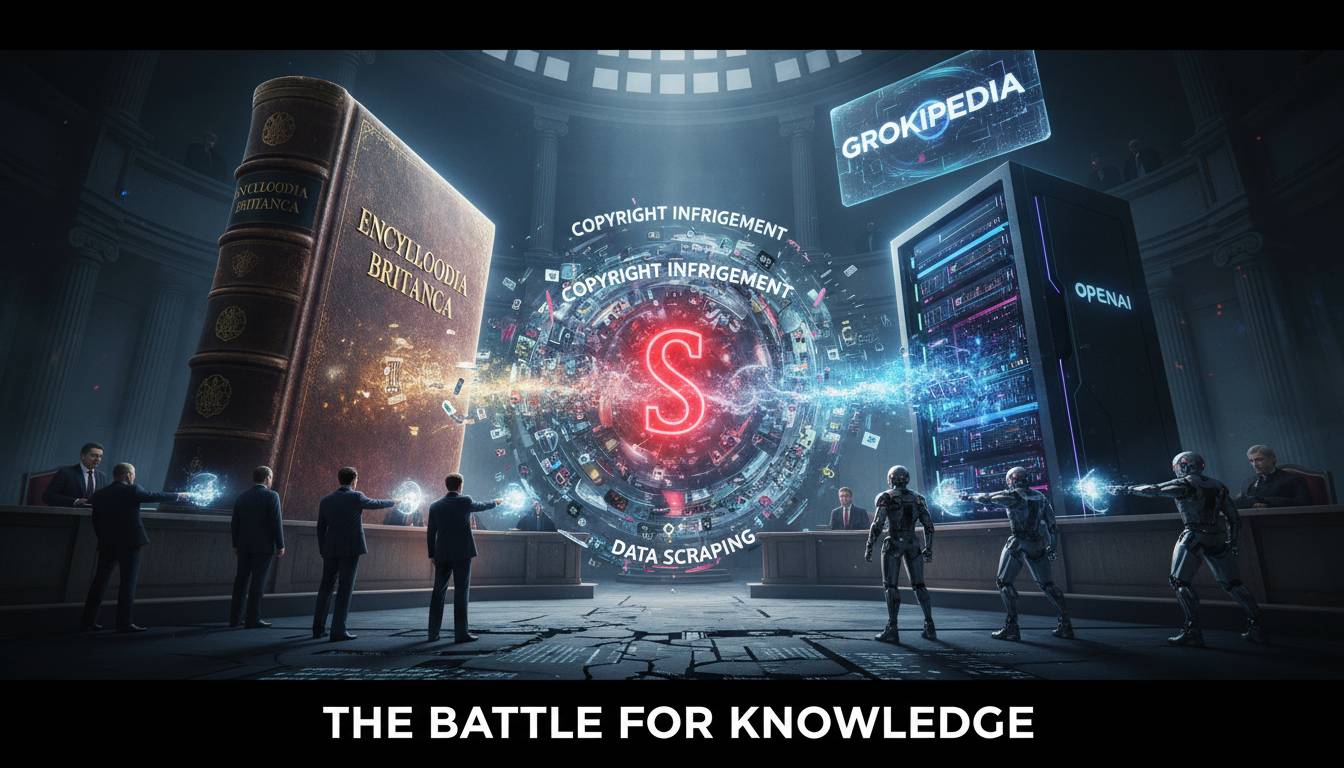
A new wave of legal pressure is building around how artificial intelligence companies collect and use online information. The phrase “Encyclopedia Britannica Sues OpenAI Over AI Training Data. Is Grokipedia Next?” captures a broader question now facing the AI industry: who owns the knowledge that powers large language models, and what happens when publishers, reference brands, and AI rivals all claim a stake in it? While public reporting confirms Britannica has already taken legal action against Perplexity, not OpenAI, the wider dispute over AI training data is intensifying across the sector.
The issue matters because AI systems increasingly depend on vast datasets scraped, licensed, or otherwise collected from the web. Publishers argue that this process can copy and monetize their work without permission. AI companies counter that training on publicly available material can qualify as lawful use under existing rules, though courts have not fully settled that question. At the same time, newer products such as xAI’s Grokipedia are drawing scrutiny over whether AI-generated knowledge platforms could become the next legal battleground.
What Actually Happened
Despite the keyword framing, currently available public reporting does not show Encyclopaedia Britannica filing a lawsuit against OpenAI. Instead, multiple reports indicate that Britannica and Merriam-Webster sued Perplexity in September 2025 over alleged unauthorized use of their content in AI-generated answers. The complaint, as described in coverage, focuses on crawling, scraping, and the use of Britannica and Merriam-Webster material in a way the companies say diverts traffic and undermines their business.
That distinction is important. OpenAI is already facing a growing list of lawsuits over training data and copyright from authors, publishers, and other rights holders, but Britannica’s publicly reported case is against Perplexity, not OpenAI. Bloomberg Law reported in July 2025 that another group of authors sued OpenAI over alleged use of copyrighted works in model training, adding to a broader pile of litigation involving OpenAI, Microsoft, and other AI firms.
So why is OpenAI part of the conversation? Because the legal theories being tested against one AI company could affect the entire market. If courts accept arguments that scraping and ingesting protected reference content for AI systems violates copyright or related rights, the consequences would likely extend far beyond a single defendant. That is why the question “Encyclopedia Britannica Sues OpenAI Over AI Training Data. Is Grokipedia Next?” resonates even if the first half is not supported by current reporting.
Encyclopedia Britannica Sues OpenAI Over AI Training Data. Is Grokipedia Next?
The more accurate version of the headline is this: Britannica has already shown it is willing to litigate against AI companies over content use, and Grokipedia could face similar questions if its operations rely on protected material or if its outputs create confusion about source authority. Public reporting from the Associated Press says Elon Musk’s xAI launched Grokipedia as an AI encyclopedia competitor after announcing the project in September 2025.
That launch places Grokipedia in a sensitive category. Encyclopedias, dictionaries, and reference databases are built around structured, curated, and often commercially valuable knowledge. If an AI product reproduces that value without licensing, rights holders may argue that it is free-riding on years of editorial investment. Coverage of the Britannica-Perplexity case suggests that this is exactly the kind of concern reference publishers are now raising.
There is also a second layer of risk. Tom’s Hardware reported in January 2026 that ChatGPT had been found citing Grokipedia for some obscure queries, based on reporting attributed to The Guardian. If AI systems increasingly cite or learn from AI-generated encyclopedic content, the industry could face a feedback loop in which machine-produced material becomes both source and output. That may not itself trigger a lawsuit, but it sharpens concerns about provenance, reliability, and whether original human-created sources are being displaced.
Why Training Data Lawsuits Matter
The legal fight over AI training data is about more than copyright damages. It goes to the heart of how generative AI products are built and monetized. Large language models need enormous volumes of text to learn patterns, facts, style, and structure. For years, much of that material was gathered from the open web, books, forums, and archives. Rights holders now argue that “open” does not mean “free to ingest and commercialize.”
For publishers and reference companies, the stakes are practical:
- Loss of web traffic when AI answers summarize source material directly
- Reduced subscription or licensing value for premium content
- Brand confusion when AI outputs are inaccurate but appear linked to trusted names
- Weaker bargaining power if AI companies train first and negotiate later
For AI developers, the stakes are just as high:
- Higher costs if more content must be licensed
- Slower model development if data access narrows
- Greater legal exposure across multiple jurisdictions
- Pressure to prove what data was used and when it was collected
One unresolved issue is transparency. WIRED reported in late 2024 on a dispute in The New York Times’ lawsuit over OpenAI training data, highlighting how difficult it can be for plaintiffs to inspect and trace what was used in model development. That problem remains central to many AI copyright cases.
The Grokipedia Question
Is Grokipedia next? No public lawsuit identified in the reporting reviewed here shows Britannica or another major reference publisher suing Grokipedia as of March 17, 2026. But there are clear reasons analysts and publishers are watching it closely. xAI’s product sits at the intersection of two contested trends: AI-generated knowledge repositories and the reuse of web-scale information to build commercial AI services.
The risk is not only about direct copying. A future case could focus on several possible claims, depending on facts that are not yet public:
- Training-data claims if protected content was ingested without authorization.
- Output claims if generated entries reproduce protected expression too closely.
- Trademark or passing-off concerns if users are misled about source authority.
- Unfair competition theories if AI summaries substitute for the original product.
Whether any of those claims succeed would depend on evidence, jurisdiction, and how courts interpret fair use, text-and-data mining, and platform liability. At this stage, saying Grokipedia is definitely “next” would go beyond the available facts. But saying it is exposed to the same legal climate is well supported.
A Broader Industry Reckoning
The Britannica-Perplexity case fits into a much larger pattern. Press Gazette reported in March 2026 that publishers continue to split between licensing deals and litigation, while new lawsuits against AI companies keep emerging. That means the market is moving on two tracks at once: courtroom confrontation and commercial negotiation.
OpenAI remains one of the central targets because of its scale and market influence. But the legal pressure is no longer limited to one company. Perplexity, xAI, Google, and others are increasingly part of the same debate over whether AI systems should pay for the information ecosystems they rely on. In that sense, the question behind “Encyclopedia Britannica Sues OpenAI Over AI Training Data. Is Grokipedia Next?” is less about one lawsuit and more about a structural shift in digital publishing and AI economics.
What Comes Next
Several developments will determine where this story goes next. Courts may clarify whether training on copyrighted text is transformative enough to qualify as fair use in the United States. More publishers may choose licensing over litigation if AI firms offer meaningful compensation. And AI companies may respond by tightening data provenance controls, disclosing more about sources, or relying more heavily on licensed and synthetic datasets. Those are forward-looking inferences based on the direction of current disputes.
For now, the most defensible conclusion is straightforward: Britannica has publicly been reported suing Perplexity, not OpenAI; OpenAI still faces multiple training-data lawsuits from other parties; and Grokipedia is not currently known to be a defendant in a comparable case, though it operates in a space that is attracting growing legal scrutiny.
Conclusion
The headline “Encyclopedia Britannica Sues OpenAI Over AI Training Data. Is Grokipedia Next?” captures a real anxiety in the AI market, even if the underlying facts need precision. Britannica’s reported lawsuit against Perplexity shows that reference publishers are prepared to defend their content aggressively. OpenAI’s existing legal battles show that training-data disputes are far from settled. And Grokipedia’s emergence shows that AI-generated knowledge products are likely to face the same questions about ownership, attribution, and trust.
The next phase will likely be shaped by court rulings, licensing deals, and the industry’s ability to prove where its knowledge comes from. Until then, the legal future of AI encyclopedias remains open, but no longer theoretical.
Frequently Asked Questions
Did Encyclopaedia Britannica sue OpenAI?
Current public reporting reviewed here does not show Britannica suing OpenAI. Reports indicate Britannica and Merriam-Webster sued Perplexity in September 2025.
Why is OpenAI still part of this discussion?
OpenAI faces other lawsuits over alleged use of copyrighted material in AI training, so any major ruling in this area could affect it directly.
What is Grokipedia?
Grokipedia is an AI encyclopedia project from xAI that was publicly reported by the Associated Press in late 2025.
Has Grokipedia been sued?
No public lawsuit was identified in the reporting reviewed here showing Grokipedia as a defendant as of March 17, 2026.
Why do training-data lawsuits matter so much?
They could determine whether AI companies must license more of the text, images, and reference material used to build models, which would affect costs, competition, and product design across the industry.
Could more reference publishers sue AI companies?
Yes. Based on current litigation trends, that is a plausible outcome, though each case will depend on the facts, the content involved, and the legal claims asserted.





View 0 comments