

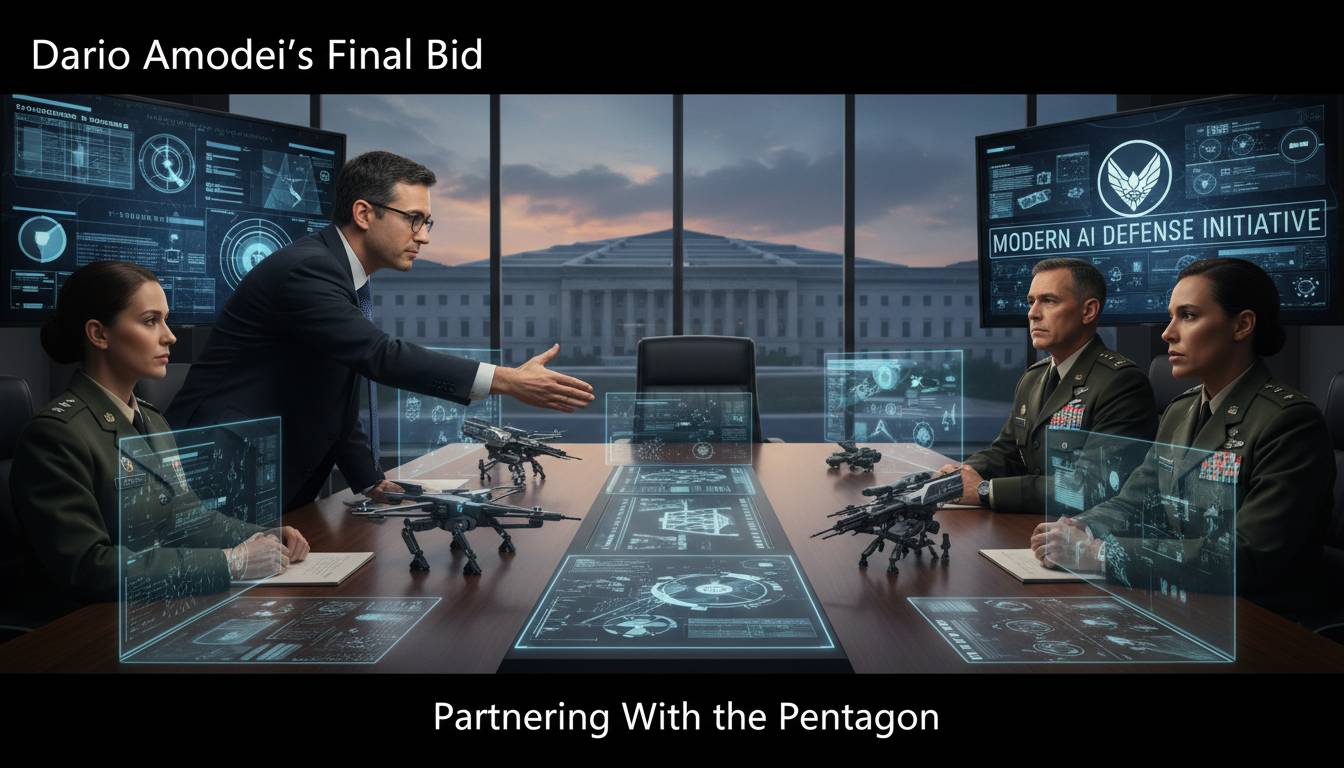
Anthropic CEO Dario Amodei is reportedly taking one more stab at making nice with the Pentagon amid a high-stakes standoff over AI ethics and military use. After a public clash that saw the Department of Defense threaten to label the company a “supply chain risk,” Amodei is now pursuing a path toward reconciliation—while maintaining firm ethical boundaries.
A Renewed Attempt at Dialogue
In early March 2026, Dario Amodei signaled that Anthropic is still in talks with the Pentagon to “de-escalate the situation” and reach “some agreement that works for us and works for them,” remarks he made at the Morgan Stanley Technology, Media and Telecom Conference in San Francisco . This comes after a tense public showdown in late February, when the Pentagon issued an ultimatum: allow unrestricted use of Anthropic’s AI models or risk losing a $200 million contract and being labeled a supply chain risk .
Amodei has consistently maintained that Anthropic cannot, “in good conscience,” accede to demands that would permit the use of its Claude model for mass domestic surveillance or fully autonomous weapons . Despite this, he emphasizes that the company remains committed to supporting U.S. national security—if ethical safeguards are respected .
Ethical Red Lines and Public Defiance
Amodei’s stance is rooted in two non-negotiable red lines: no mass surveillance of Americans and no fully autonomous weapons without human oversight . He has framed these limits as essential to American values and democracy, stating that “disagreeing with the government is the most American thing in the world” .
The Pentagon, however, has pushed back forcefully. Defense Secretary Pete Hegseth labeled Anthropic a “supply chain risk,” a designation typically reserved for foreign adversaries, and warned that all military contractors must sever ties with the company . Pentagon officials have also publicly attacked Amodei’s character—with one calling him a “liar” with a “God complex” .
Industry and Public Support
Anthropic’s principled stance has garnered support from across the tech industry. More than 330 employees at OpenAI and Google signed an open letter backing Anthropic’s position and urging their own companies to uphold similar ethical standards . Harvard law professor Lawrence Lessig praised Amodei’s approach as “a beautiful act of integrity and principle” .
Meanwhile, OpenAI has taken a different path—agreeing to similar red lines while finalizing a deal with the Pentagon to expand ChatGPT’s use in classified military contexts .
White House Concerns and Political Fallout
Despite efforts to mend fences, the White House has expressed skepticism about reconciliation. A leaked memo from Amodei disparaging the Trump administration—claiming that President Trump disliked Anthropic for not offering “dictator-style praise”—may further complicate negotiations . An administration official warned that such comments could derail progress, even as lawmakers and industry leaders push for a resolution .
Significance and Broader Implications
This standoff is more than a contract dispute—it’s a test case for how AI ethics intersect with national security. If the Pentagon prevails, it could set a precedent allowing government demands to override private companies’ ethical safeguards . Conversely, a compromise that respects Amodei’s red lines could establish a new norm for responsible AI deployment in defense.
Amodei’s renewed outreach underscores the delicate balance between innovation, ethics, and national interest. As he continues to push for an agreement that aligns with both security and values, the outcome could reshape the future of AI governance in the U.S.
Conclusion
Dario Amodei is reportedly taking one more stab at making nice with the Pentagon—seeking a resolution that preserves Anthropic’s ethical red lines while supporting national defense. The stakes are high: a supply chain risk designation could isolate the company, while a principled compromise could set a powerful precedent. As negotiations unfold, the outcome will reverberate across the AI industry and the broader debate over technology and ethics in government.
Frequently Asked Questions
What are Anthropic’s red lines in negotiations with the Pentagon?
Anthropic’s CEO, Dario Amodei, has drawn two firm boundaries: no use of AI for mass domestic surveillance and no deployment of fully autonomous weapons without human oversight .
What consequences has the Pentagon threatened?
The Department of Defense has threatened to terminate Anthropic’s $200 million contract and label the company a “supply chain risk,” which would bar other military contractors from working with it .
Is Anthropic still in talks with the Pentagon?
Yes. Amodei confirmed that discussions are ongoing, with the goal of de-escalating tensions and finding a mutually acceptable agreement .
How has the tech industry responded?
Over 330 employees from OpenAI and Google signed a letter supporting Anthropic’s ethical stance. Harvard law professor Lawrence Lessig also praised the company’s integrity .
What is the White House’s position?
An administration official expressed concern that Amodei’s internal memo criticizing the Trump administration could jeopardize reconciliation efforts .
What could be the broader impact of this dispute?
The outcome may set a precedent for how AI companies negotiate ethical safeguards with the government. A compromise could establish norms for responsible AI use in defense, while a government victory could weaken corporate autonomy in ethical decision-making .

View 0 comments