

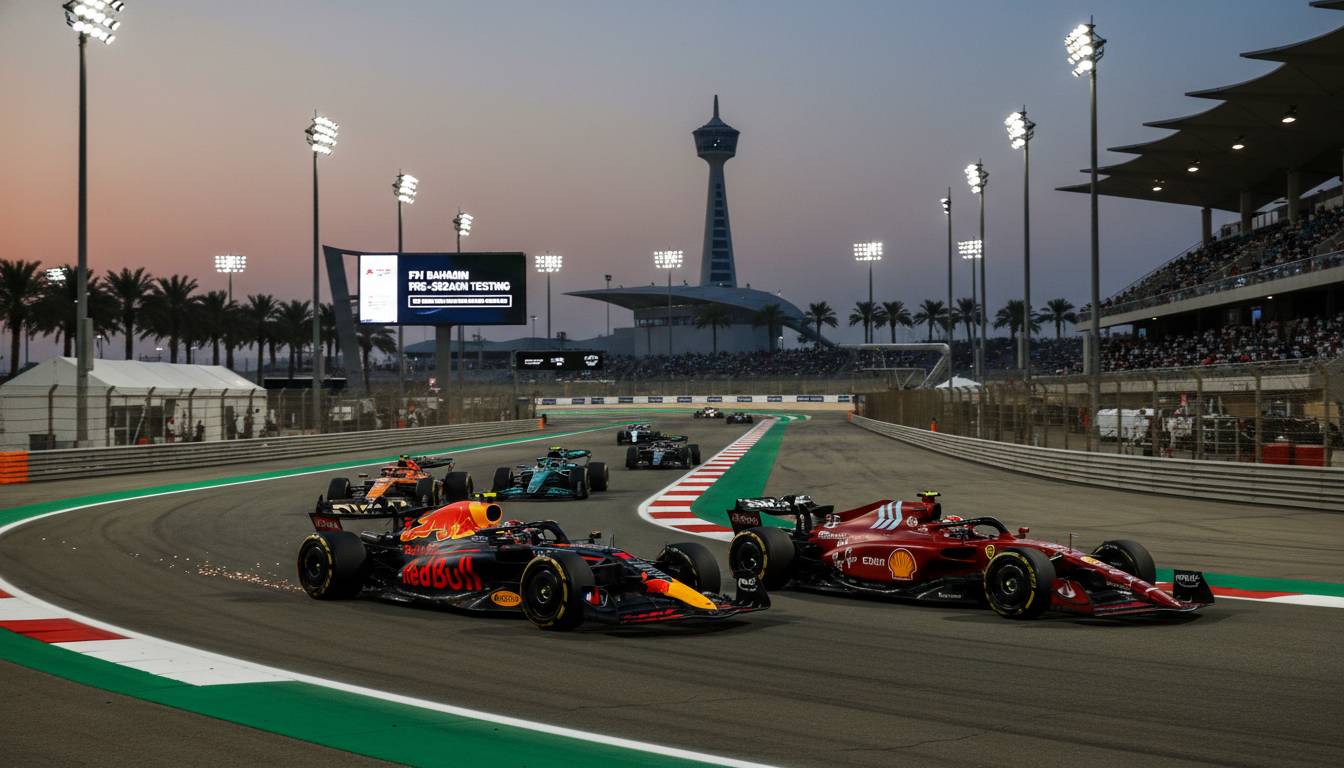
The F1 Bahrain Pre‑Season Testing gives a clear early look at how teams stack up under the new 2026 regulations and aircraft‑speed power units — and yes, that’s exactly what this article unpacks. Right from day one, McLaren nudged ahead of Red Bull, setting the fastest lap with Lando Norris, while Red Bull’s Max Verstappen logged the most mileage. We’ll break down the key insights, standout performances, reliability issues, and what these clues hint at for the season ahead.
Testing Schedule and Significance
Bahrain is hosting two full official F1 pre‑season tests for 2026, from February 11–13 and again February 18–20, totaling six days of on‑track action . This marks the biggest testing window in years — and the debut of game‑changing technical rules and an eleventh team, Cadillac .
Teams will run one car per day and share driving duties, giving each driver about 12 hours behind the wheel per session . It’s more than a reality check; it’s where baseline data, reliability, and performance trends are first put under the microscope.
Day One Highlights: Pace and Performance
McLaren led the charge on day one: Oscar Piastri set a solid morning benchmark before Lando Norris nailed the fastest lap at 1:34.669s while doing more than a full race distance in one day .
Verstappen wasn’t far behind in second place with 136 laps—the highest of the field—and clocked a fastest lap of 1:34.798s . Ferrari’s Charles Leclerc wasn’t far behind in pace but played it more steady with 80 laps .
At Mercedes, George Russell posted a time 1.439s off Norris with 56 laps, while Antonio Kimi Antonelli logged 30 laps on hard Pirellis and sat further back . Aston Martin struggled early, managing just 36 laps due to a “data anomaly” tied to their Honda power unit .
Williams surprised positively: Carlos Sainz ran 77 laps, Alex Albon 68, more laps than they had in Barcelona . Audi debuted a new sidepod design, with Gabriel Bortoleto doing 49 laps before Nico Hülkenberg’s breakdown brought out a red flag. Hülkenberg ultimately completed 73 laps .
Alpine saw a brief stall with Franco Colapinto, but after fixes, they reached a healthy 28 laps . Cadillac hit the track too — Bottas did 49 laps, Perez added 58 . The full scene: evolving regulations, new teams, rookie drivers — Bahrain’s already delivering.
Reliability and Mileage Trends
Lap counts offer more insight than finishing order at this stage. Mercedes-powered teams combined for 355 laps, with Ferrari-powered teams close behind at 338 laps . Red Bull Powertrains (Ford) managed 206 laps, Audi 69, and Honda logged only 36 — highlighting serious early reliability gaps for some .
Haas, Williams, and Audi stood out in separate ways. Haas’s Esteban Ocon tackled over 100 laps with consistency. Williams crushed it with 145 laps by Sainz and Albon without a hiccup. Audi, meanwhile, lost track time due to Hülkenberg’s red‑flag incident .
“In a test where reliability is paramount and every kilometre counts, this kind of setback cannot be overlooked.” — Elena Rossi, on Aston Martin’s early issues .
Interpreting Team Signals and Strategy
Midfield and top teams are revealing their hand with subtle clues. McLaren’s pace and reliability suggest early maturity in their package. Red Bull, while completing mileage, seemed busy experimenting with aero and configs — not yet dialed in .
Mercedes appears stable, balanced, and improving — they’ve checked off many of their weaknesses from last season . Ferrari’s strong traction and straight-line speed come with balance issues, though — a mixed bag .
Williams is the real surprise — Carlos Sainz set a headline time, Albon followed, and reliability looks excellent . Haas focused on race distance running, though they had bodywork trouble. Racing Bulls and Sauber lagged; Sauber in particular looked stiff and narrow in setup range .
Context: Verstappen and the Rule Reshuffle
Adding context, Max Verstappen conceded that no one really knows the 2026 regulations yet, expecting more garage time than time on track — especially as Red Bull debuts its in-house power unit . That cautious tone underlines why early tests are so critical.
What It All Means for the 2026 Season
- Reliability will be a survival advantage. Mercedes and McLaren kicked off well.
- Red Bull still needs setup clarity but remains a threat if it irons out issues.
- Ferrari’s speed is encouraging; balance work is pivotal.
- Williams may be quietly resurging as midfield players.
- Teams like Aston Martin, Sauber, Haas, Racing Bulls have ground to make up.
- Cadillac’s debut adds wildcard potential if they find pace and reliability.
Conclusion
The Bahrain testing season has kicked off with a bang. McLaren leads in early pace, Red Bull shows consistency if not outright speed, and Mercedes quietly impresses with structure. Williams is a story to watch, while others are still troubleshooting. Reliability — more than lap times — is the early yardstick.
Next steps? Watch how teams utilize the second Bahrain session (Feb 18–20) to refine race simulations and integrate learnings. The Australian GP opener looms in March — but the clues of who’ll shine are already emerging.
FAQs
What makes Bahrain testing especially important in 2026?
Bahrain offers two three-day sessions where teams run under the all-new regulations. It’s the first real chance to test 2026 cars, new power units, and strategies under real conditions .
Which team topped day one in Bahrain?
McLaren did. Lando Norris delivered the fastest lap (1:34.669), and Oscar Piastri added solid mileage too, giving them an early edge .
How did Red Bull perform in comparison?
Red Bull completed the most laps (136) but were still chasing pace. Verstappen’s time was close behind, showing consistency more than outright top speed .
Any surprising performers?
Williams impressed significantly with Sainz and Albon combining for 145 reliable laps. Reliability outshone headline times here .
What are the biggest concerns from testing so far?
Aston Martin logged just 36 laps due to power unit issues. Reliability gaps among some teams — notably Honda and Audi — could hamper early-season performance .
When’s the season opener after Bahrain?
The F1 season kicks off with the Australian Grand Prix in Melbourne a few weeks later. Bahrain testing is pivotal in laying groundwork for that first race.

View 0 comments