

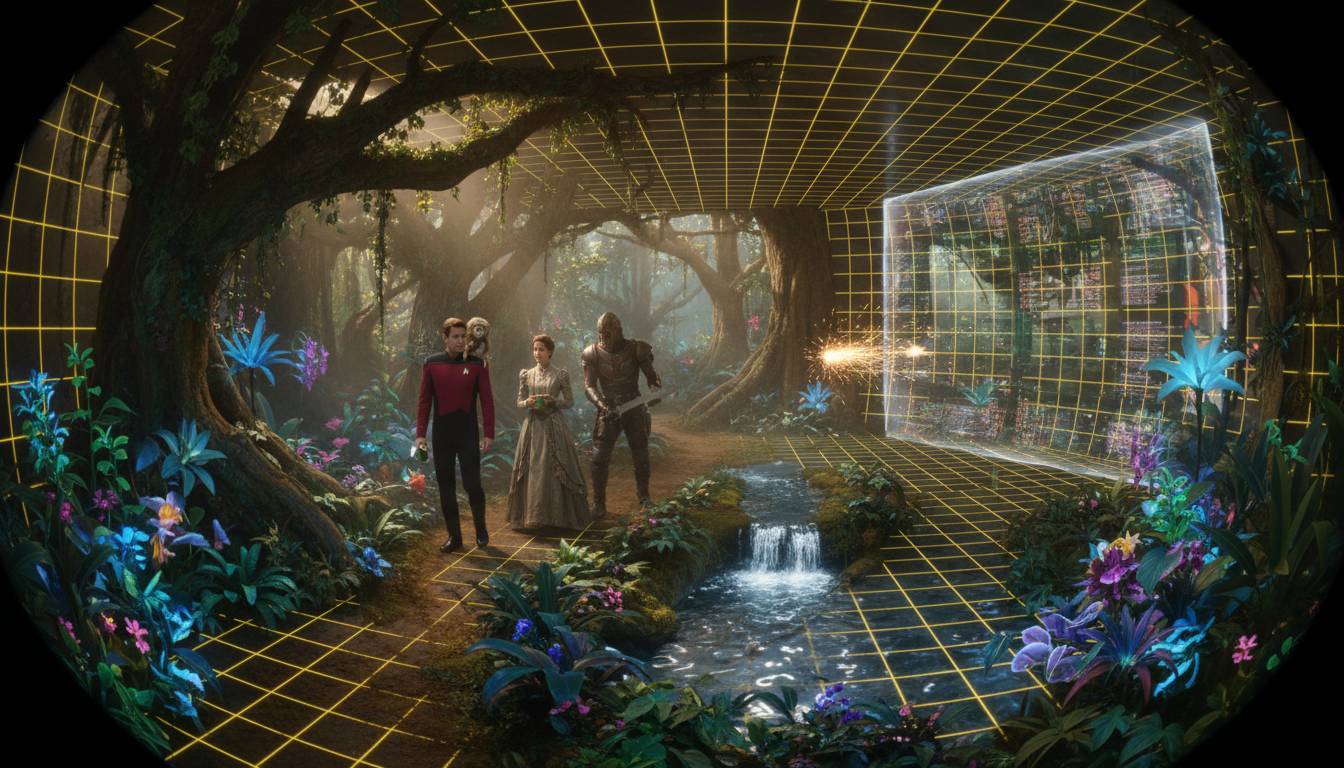
Star Trek’s holodeck is one of science fiction’s smartest ideas because it feels impossible and oddly practical at the same time. Step inside, and a blank room becomes a forest, a detective novel, a battlefield, or a jazz club. The trick, at least in Star Trek canon, is that the holodeck is not just a projector. It blends holograms, force fields, sensors, computer modeling, and sometimes replicated matter to create an environment that looks real, feels solid, and can even leave you wet on the way out.
What the holodeck actually is in Star Trek
In simple terms, the holodeck is a programmable simulation room used for training, recreation, research, and problem-solving. It appears most famously in Star Trek: The Next Generation, though related holographic systems show up across the franchise, from early battle simulators to Deep Space Nine holosuites and Voyager’s heavily used holodecks. By 2364, Starfleet had advanced enough to install fully functional holodecks aboard ships such as the Enterprise-D, according to canon summaries collected by Memory Alpha. That matters because the technology is presented not as a magic trick but as a mature system integrated into ship operations.
The room itself is lined with holoemitters. Those emitters generate images and, more importantly, shape force fields that give holograms apparent solidity. Memory Alpha’s holodeck entry explains that users can see landscapes that seem to stretch for miles even though they are still inside a finite chamber. That is the core illusion: the room is physically limited, but the simulation is dynamically adjusted so the user perceives a much larger world.
Star Trek also makes clear that the holodeck is not one single invention. It is a stack of technologies working together. Visual projection handles what you see. Audio systems handle what you hear. Environmental controls and simulation logic help create wind, temperature, and smell. Force fields simulate surfaces and resistance. Replicator systems can add real matter when the program needs something physical that can persist outside the room. That hybrid approach is why the holodeck feels more convincing than a standard hologram.
Why people can touch things that are not really there
This is the part that makes the holodeck more than a fancy movie screen. In Star Trek canon, holograms can be paired with force beams or force fields so objects feel solid. A chair can support your weight. A wall can stop your hand. A book can sit in your palm. Memory Alpha notes that the computer uses large magnetic or containment-field effects to simulate surfaces and textures rather than building every fake object molecule by molecule. In other words, the holodeck often creates the sensation of matter without actually manufacturing all of it.
That explains why a holodeck sword can clash, why a simulated table can hold a drink, and why characters can wrestle with holographic opponents. The computer is constantly tracking bodies, positions, and expected interactions, then updating the force fields fast enough to preserve the illusion. If that sounds computationally absurd, that is because it is. Star Trek solves the problem with future computing power and highly responsive emitters embedded throughout the room.
There is also a useful distinction in canon between energy-based simulations and replicated matter. Most holodeck objects are temporary constructs that exist only inside the active environment. But some things are made real through replicator technology. Memory Alpha cites several famous examples: Wesley Crusher leaves the holodeck wet after falling into water, Data carries a drawing out into the corridor, and a snowball exits the holodeck and hits Captain Picard. Those moments tell viewers something important. If an object needs to survive outside the room, the system can switch from illusion to actual matter.
How the room seems bigger on the inside
This is the wildest part of the concept, and it is the one fans ask about most. How can someone walk through a countryside when the room is still just a room? Star Trek’s answer is a mix of moving treadmills, perspective management, and adaptive simulation logic, even if the franchise does not always spell out every engineering detail on screen.
The canon idea is that users do not usually walk in straight lines across a giant hidden warehouse. Instead, the holodeck subtly redirects them, adjusts the environment around them, and keeps different participants separated or coordinated as needed. If two people appear to be far apart in a simulation, the computer can preserve that illusion by changing what each person sees and by using force fields to manage relative positioning. The walls project scenery that appears distant, while the floor and local objects remain tactile.
Memory Alpha also notes that the walls can be revealed if someone takes an unexpected action the program does not compensate for quickly enough, such as throwing an object in a way that exposes the room boundary. That detail is crucial because it shows the illusion is active, not passive. The holodeck is always correcting, predicting, and reframing the user’s experience.
Replicators are the secret sauce most explanations skip
Many casual descriptions say the holodeck is just holograms plus force fields. That is incomplete. The better explanation is holograms plus force fields plus replicated matter. That third piece solves a lot of practical problems. Food and drink are the clearest examples. If a character orders a meal in a holodeck restaurant, Star Trek strongly implies the edible parts are replicated, not merely projected. Memory Alpha states that food consumed on the holodeck is replicated, which fits the franchise’s broader logic about matter synthesis.
This also explains why some props can leave the room while others cannot. A replicated glass, napkin, or sheet of paper is real matter. A projected lamp, fake skyline, or simulated stranger is not. The holodeck chooses the cheapest and most efficient method for each object. If it only needs to look and feel real for a few minutes, force fields and light may be enough. If it needs to be eaten, carried away, or physically altered in a lasting way, replication makes more sense.
That hybrid model is probably the most realistic part of the whole concept. Even in speculative future tech, it would be wasteful to build every leaf, brick, and teacup as true matter if a convincing field effect would do the job.
How holodeck characters can talk, react, and improvise
The holodeck is not only a physical simulator. It is also an AI-driven narrative engine. Programs can generate responsive characters, adapt to user choices, and reconstruct historical settings from large databases. Memory Alpha notes that holodecks had access to extensive archives and could recreate scenes with remarkable fidelity, sometimes down to incidental conversations. That means the system is doing more than rendering scenery. It is modeling behavior.
Some episodes push this into dangerous territory. Characters such as Professor Moriarty become self-aware enough to challenge the limits of the simulation. The Doctor on Voyager goes even further, functioning as a holographic person with continuity, memory, and agency. Those stories suggest the holodeck’s real breakthrough is not visual immersion but the fusion of simulation with advanced artificial intelligence.
There is even an “objective mode” in canon, described by Memory Alpha as a setting where users can observe events without interacting and can pass through solid objects. That feature reveals how flexible the system is. Solidity is not fixed. It is a rule the computer can turn on or off depending on the program’s purpose.
Could anything like a holodeck exist in real life?
Not in the full Star Trek sense. Not yet. Modern virtual reality can handle immersive visuals and sound. Robotics and haptics can simulate limited touch. Projection mapping can transform rooms. AI can generate dialogue and reactive characters. Treadmills can fake locomotion. But no existing technology combines all of that into a seamless room where landscapes feel infinite, objects become selectively real, and physical interactions remain safe and convincing.
The closest real-world lesson from the holodeck is not one device but a convergence path. If advanced VR, room-scale tracking, haptic feedback, generative AI, environmental simulation, and matter fabrication keep improving, the holodeck starts to look less like one impossible machine and more like a very ambitious systems-integration problem. A ridiculous one, sure. Still, a systems problem.
Why the holodeck remains such a powerful sci-fi idea
The holodeck endures because it is not just cool technology. It is a storytelling machine. It lets Star Trek explore memory, identity, addiction, ethics, training, grief, and the blurry line between simulation and reality. Technically, the best canon explanation is that the holodeck works through holoemitters, force fields, sensor feedback, computer prediction, and replicator support. Dramatically, it works because it turns imagination into architecture.
That is why the concept still lands. The holodeck is not merely a room that shows you things. It is a room that negotiates with your senses, your body, and sometimes your emotions until fiction feels physical.
Frequently Asked Questions
Is the holodeck just a hologram projector?
No. In Star Trek, it is more advanced than a visual hologram system. It combines projected imagery with force fields, environmental simulation, sensor tracking, and sometimes replicated matter. That is why users can touch objects, feel surfaces, and interact with characters as if they were physically present.
How can holodeck objects feel solid?
Star Trek explains this through force fields or force beams that give holographic objects shape and resistance. A simulated chair can hold a person because the system creates a supportive field where the chair appears to be. The image and the physical sensation are generated together.
Why can some things leave the holodeck?
Because some items are replicated as real matter rather than simulated as pure energy. Food, paper, water, or props may be made physically real when needed. That is why characters have occasionally carried objects out of the holodeck or remained wet after leaving.
How does the holodeck seem bigger than the room?
The franchise implies that the system constantly adjusts perspective, movement, and user positioning to preserve the illusion of distance. The room is finite, but what each person sees is dynamically managed. Walls can appear far away even when they are physically close.
Can holodeck characters become self-aware?
In several Star Trek stories, yes. Most holodeck characters are programmed simulations, but some become unusually sophisticated or self-aware because of complex instructions, adaptive computing, or narrative accidents. Moriarty and Voyager’s Doctor are the best-known examples.
Is the holodeck scientifically plausible?
Partly. Some ingredients already exist in primitive form, including VR, haptics, AI dialogue, and room tracking. The full Star Trek version remains speculative because it would require extraordinary computing, precise force-field control, and matter-generation capabilities far beyond present technology.

View 0 comments