

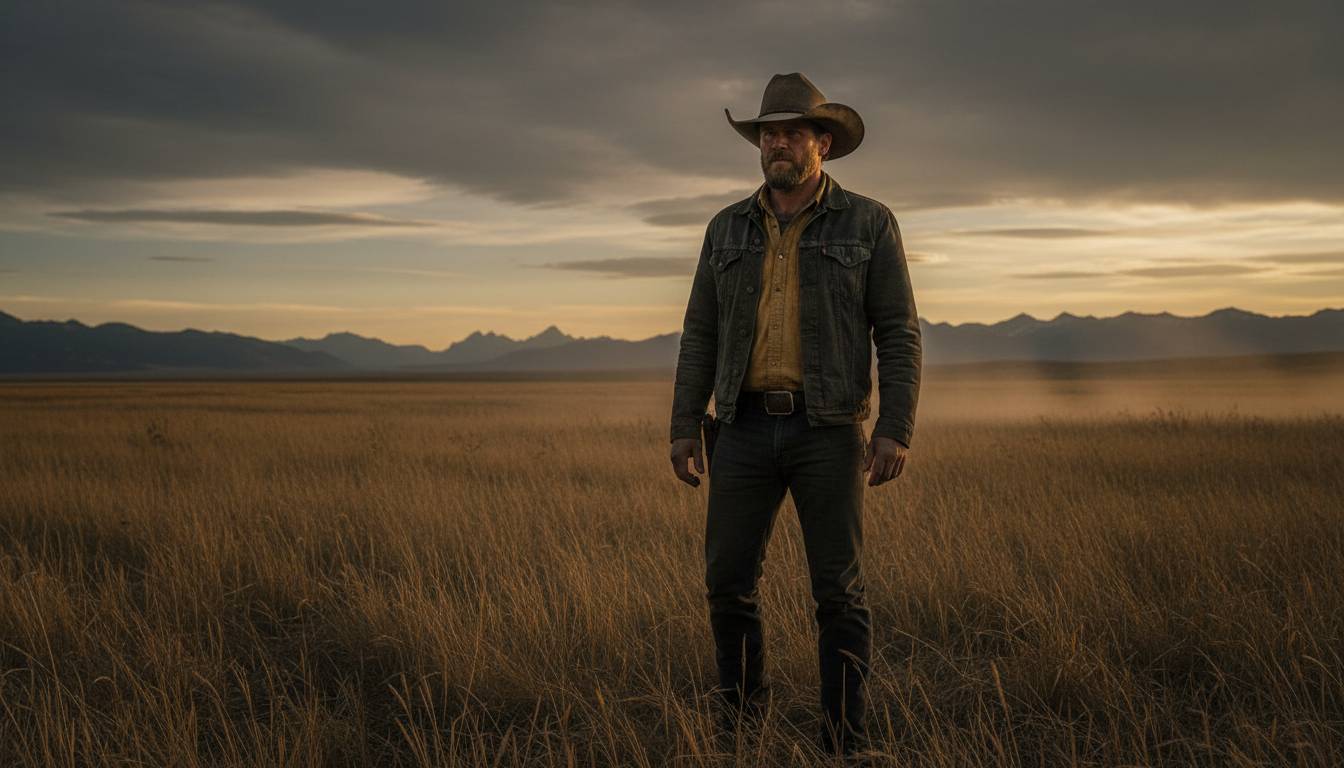
Marshals Episode 8 does not just give Kayce Dutton another hard day on the job. It turns his entire character inside out. The hour pushes him into a hostage crisis tied to violence from earlier in the season, and in doing so, it makes something plain: no one in the Yellowstone universe carries pain the way Kayce does. Beth is explosive, Jamie is broken, and John was burdened by legacy, but Kayce keeps suffering in silence. That is what makes Episode 8 hit harder than almost anything Yellowstone has done with him before.
Episode 8 finally stops treating Kayce’s pain as background texture
One of Marshals’ biggest strengths has also been one of its frustrations. The series has always understood that Kayce is haunted, but for much of the season it has used that grief as atmosphere rather than as the main dramatic engine. Episode 8 changes that. Based on coverage of the episode’s central plot, the story revolves around a kidnapping involving Andrea Cruz after enemies target Kayce and his team for what happened earlier in the season. That setup matters because it is not random danger. It is consequence. Kayce is not simply chasing crime anymore; he is living with the blowback of every violent choice around him.
That distinction is why the episode feels heavier than a standard procedural hour. A case-of-the-week structure can flatten a character like Kayce if the show is not careful. He becomes the stoic lawman, the guy who tracks, shoots, and stares into the distance. Episode 8 refuses that simplification. It forces the audience to see that Kayce’s life is not divided into clean chapters called Yellowstone and Marshals. The trauma followed him. It always was going to.
That has been the hidden truth of the character since the original series. Kayce never fit comfortably at the ranch, never fit fully away from it, and never escaped the damage done by his family’s world. He was the Dutton most likely to imagine another life, which is exactly why his suffering lands so hard. He can picture peace. He just never gets to keep it.
Monica’s death changed the emotional math of the character
The single most devastating choice Marshals made in its premiere was confirming Monica’s death. Reports around the launch of the series made clear that Kayce begins this story grieving his wife and raising Tate alone. That decision instantly reframed everything about him. In Yellowstone, Kayce was often torn between two identities: Dutton son and family man. Monica was not just his partner; she was the moral center that kept him oriented toward a life beyond inherited violence.
Without her, Kayce is not merely sad. He is unmoored.
That is why Episode 8 works so well as a statement on who he has become. The hostage plot is tense on its own, but the deeper wound is that every crisis now reaches a man who has already lost the person who made survival meaningful. In another show, that kind of backstory might feel manipulative. Here, it feels tragically consistent. Kayce has always been the character who pays for violence twice: once in the moment, and again later in memory.
Luke Grimes has long played him with a kind of inward collapse, as if Kayce is forever bracing for the next blow. Episode 8 uses that quality better than most previous installments. Instead of asking whether Kayce can solve the problem, it quietly asks what solving anything even means for him now. He can save someone and still go home empty. He can win the day and lose more of himself in the process.
What makes Kayce more tortured than Beth, Jamie, or even John
That is a big claim, so it needs a real comparison. Beth is arguably the franchise’s most visibly damaged character. Jamie is consumed by shame and self-hatred. John spent years carrying the burden of land, bloodline, and control. But Kayce’s pain is different in a way that makes it more tragic.
Beth weaponizes her trauma. Jamie internalizes his. John rationalizes his. Kayce absorbs his.
That pattern has defined him from the start. He served in combat. He killed. He returned home to a family that used loyalty as a form of pressure. He loved Monica, but that relationship was repeatedly strained by the Dutton orbit. He tried to be a father to Tate while navigating violence that kept finding his doorstep. Even when Yellowstone gave him moments of grace, they never felt stable. They felt borrowed.
Episode 8 sharpens that idea by showing that Kayce’s suffering is not theatrical. It is cumulative. He does not get Beth’s monologues or Jamie’s spectacular implosions. He gets endurance. He gets the burden of being capable, decent, and dangerous all at once. That combination is brutal because it means he understands the cost of what he does, yet he keeps being placed in situations where violence is still required.
There is no relief in that. Only repetition.
Marshals is at its best when it remembers Kayce cannot outrun consequence
Some criticism of Marshals has focused on its procedural format, with detractors arguing that the Yellowstone spinoff can feel too conventional compared with the flagship series. Episode 8 is strong evidence that the show works best when it uses weekly cases to expose old wounds rather than distract from them. The kidnapping storyline appears to do exactly that. It ties present danger to prior bloodshed and makes Kayce confront the fact that his actions do not stay neatly in the past.
That has always been the core tragedy of the Yellowstone universe. Violence is never isolated. It spreads through families, communities, and memory. Kayce may be wearing a badge now, but the moral logic of his world has not changed. Every act leaves residue. Every rescue has a cost. Every enemy has a relative, ally, or survivor ready to answer back.
Episode 8 understands that better than several earlier installments. It does not pretend Kayce’s new role has cleansed him. If anything, it suggests the badge has only given his pain a more official shape. He is still the same man who has spent years trying to protect people while being formed by systems that demand brutality from him.
Why this episode feels like the clearest thesis statement for Kayce Dutton
If Yellowstone was about inheritance, Marshals is becoming a story about aftermath. Episode 8 may be the clearest articulation yet of what Kayce represents in that larger universe. He is the cost of trying to remain human inside a world built on force. He is not the loudest Dutton or the cruelest or the most power-hungry. He is the one most aware of what all this damage means, and that awareness is its own kind of curse.
That is why the episode lands with such force. It is not simply darker because bad things happen. Bad things always happen in this franchise. It is darker because it strips away the illusion that Kayce might someday be rewarded for enduring them. Marshals Episode 8 suggests that endurance is the story. Survival is the burden. And for Kayce, every new chapter seems to demand that he carry old grief into fresh violence.
In a universe full of wounded people, that makes him the most tortured of them all. Not because he suffers the most loudly, but because he keeps suffering with full knowledge of what it is doing to him. Episode 8 proves that Marshals finally understands this. More importantly, it proves that Kayce Dutton’s tragedy was never a side note in Yellowstone. It was one of the franchise’s deepest stories all along.
Frequently Asked Questions
What happens in Marshals Episode 8?
Episode 8 centers on a kidnapping storyline that appears to target Andrea Cruz as retaliation connected to earlier violence in the season. The plot raises the stakes for Kayce because the danger is personal, not just professional.
Why is Kayce Dutton considered the most tortured Yellowstone character?
Kayce carries military trauma, family conflict, moral guilt, and profound personal loss. Unlike Beth or Jamie, he rarely externalizes that pain in dramatic ways, which makes his suffering feel more constant and deeply internalized.
How important is Monica’s death to Marshals?
It is essential. Monica’s death reshapes Kayce’s entire emotional arc in the spinoff. She was his anchor in Yellowstone, so losing her turns every later conflict into something heavier and more isolating.
Does Marshals Episode 8 connect strongly to Yellowstone?
Yes. The episode reinforces that Kayce cannot separate his present from his past. Even in a new job and a new format, the emotional and moral consequences of Yellowstone still define him.
Is Marshals better when it focuses on Kayce’s trauma?
Absolutely. The series becomes more compelling when weekly cases reveal character rather than replace it. Episode 8 stands out because it uses action and danger to deepen Kayce instead of just moving the plot along.

View 0 comments