

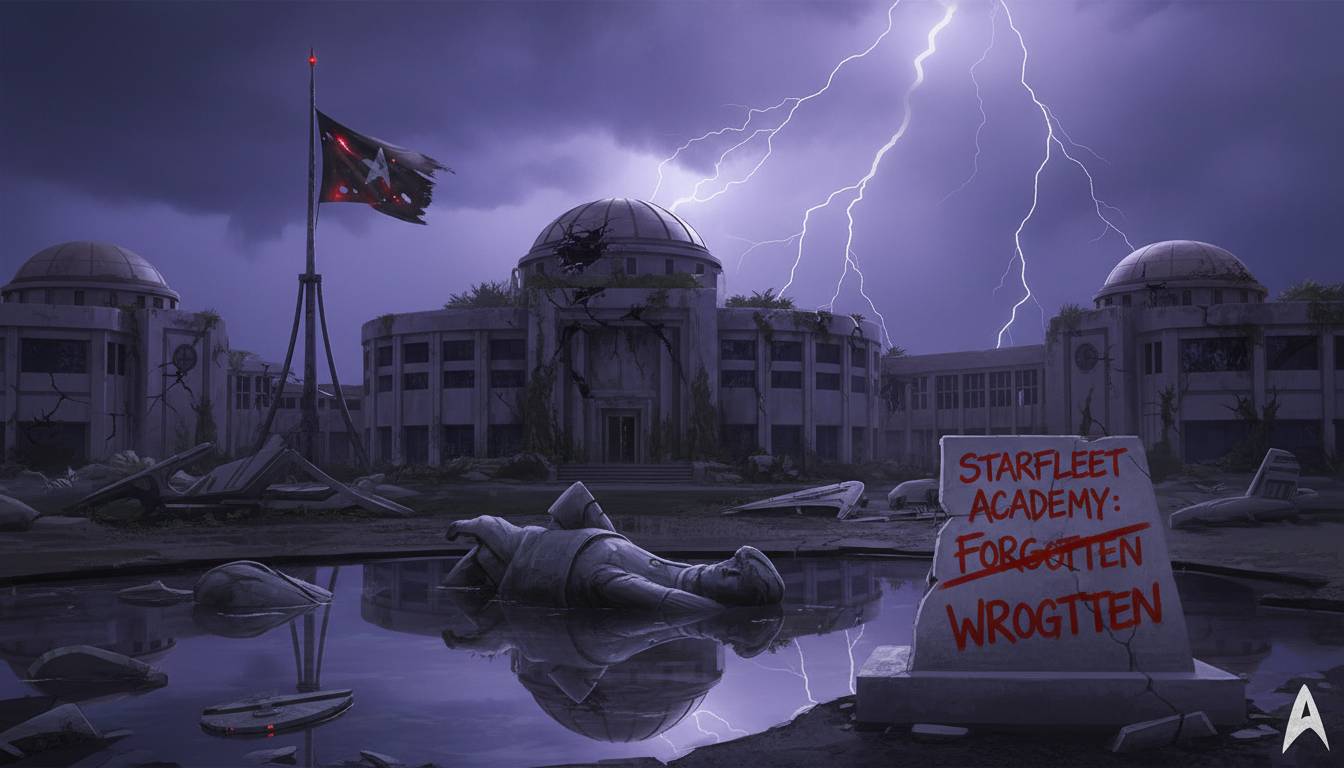
“Star Trek: Starfleet Academy” arrived with franchise weight, a younger-skewing premise, and a January 15, 2026 Paramount+ debut, yet the conversation around it quickly shifted from the show itself to distribution, review-bombing claims, and audience fragmentation. That matters because the series did not launch into a neutral environment: it entered a crowded streaming market, a polarized fandom, and a platform strategy that shaped perception as much as the episodes did. This article examines what went wrong using verifiable release, ratings, and reception data already in public view.
ℹ️
The core problem was not one single metric.
Publicly available evidence points to a combination of platform reach, polarized audience scoring, and a difficult franchise handoff after earlier “Star Trek” series. Paramount+ premiered the series on January 15, 2026, with two episodes, according to Space.com and franchise reference site Memory Alpha.
January 15, 2026 Launch Put the Series in a Narrower Funnel
“Star Trek: Starfleet Academy” premiered on Paramount+ on Thursday, January 15, 2026, with a two-episode launch, according to Space.com’s release coverage and Memory Alpha’s season page. That release structure is standard for streaming, but it also limited the show to a subscription ecosystem that remains smaller than the broadest entertainment platforms. In plain terms, a franchise trying to reset its image did so behind a paywall with less casual discovery than a major broadcast or wider third-party rollout would provide.
The timing also mattered. GamesRadar’s January coverage framed 2026 as a major “Star Trek” anniversary year, with “Starfleet Academy” arriving ahead of more established franchise entries. That created a high-expectation environment. A new show centered on cadets, younger characters, and a different tonal mix was always likely to be judged against legacy series rather than on its own launch curve.
Verified Early Release Facts
| Metric | Value | Named source |
|---|---|---|
| Premiere date | January 15, 2026 | Space.com; Memory Alpha |
| Launch format | Two-episode premiere | Space.com |
| Season 1 finale date | March 12, 2026 | Wikipedia episode listing for “Rubincon” |
| Season length | 10 episodes | Wikipedia episode listings; Memory Alpha season page |
Source: Space.com, Memory Alpha, and episode listings | accessed March 24, 2026
That 10-episode run from January 15 to March 12, 2026 gave the show roughly eight weeks to build momentum. For a new branch of a legacy science-fiction property, that is not much time to overcome first-impression problems. If the opening discourse turns negative, the release calendar can lock that narrative in place before broader word of mouth has time to catch up.
What Drove the Backlash in the First 72 Hours?
One of the clearest public signals came from user-score volatility. The Wikipedia entry for the series, citing Forbes reporting from January 16, 2026, says the show had an IMDb user rating of 4.9 out of 10 one day after premiere and that the gap between critic and user response was presented as an example of review-bombing. That does not prove every negative review was illegitimate. It does show that the reception environment became politicized almost immediately.
Separate media coverage reinforced that point. The Daily Beast reported on January 16 and January 19, 2026 that White House Deputy Chief of Staff Stephen Miller publicly attacked the show, while William Shatner later mocked that criticism. Those stories moved the conversation away from writing, pacing, or character construction and toward culture-war framing. Once that happens, audience scoring becomes harder to read as a pure measure of viewer satisfaction.
Reception Timeline
January 7, 2026: Red-carpet world premiere held in New York, according to Memory Alpha.
January 15, 2026: Paramount+ releases the first two episodes, according to Space.com.
January 16, 2026: Forbes-referenced IMDb user score cited at 4.9/10 on the series page, amid review-bombing discussion.
January 19, 2026: The Daily Beast reports William Shatner publicly mocked political attacks on the series.
March 12, 2026: Season 1 finale “Rubincon” releases, according to episode listings.
The result was a distorted launch window. A new series usually needs viewers to debate whether it works. “Starfleet Academy” instead spent its opening days being used as a proxy fight over what “Star Trek” should be. That is a difficult position for any freshman show, especially one already trying to introduce a new ensemble and a school-based structure within a franchise known for command crews and exploration missions.
10 Episodes vs Legacy Expectations: Why Format Shaped the Outcome
The show’s structure also created friction. Public episode records show a serialized first season with weekly releases through March 2026. Reviews and commentary indexed in search results suggest a recurring complaint: too many characters competing for limited runtime. A Yahoo-linked entertainment piece about the finale argued the season improved when fewer characters dominated the screen. That is criticism of execution, not ideology, and it points to a practical issue.
Ten episodes can be enough for a focused drama. It is less forgiving when a series must establish a new institution, define multiple cadets, connect to franchise lore, and satisfy long-time fans expecting the philosophical density of earlier “Star Trek.” In that sense, the problem may have been less that the concept was wrong and more that the runway was short.
💡
A school-setting “Star Trek” needed more onboarding than a veteran-crew series.
A cadet ensemble requires repeated character beats, hierarchy-building, and world explanation. A 10-episode season from January 15 to March 12, 2026 left limited room for that development.
There is also a branding issue. “Starfleet Academy” carries one of the most recognizable institutions in the franchise, but the title may have raised expectations for a specific kind of aspirational, exploratory storytelling. If the actual tone leaned more toward youth drama rhythms, some viewers were always going to see a mismatch between brand promise and delivered format.
Critics vs Users: The Gap Became Part of the Story
By March 2026, online discussion around the show increasingly focused on divergence rather than consensus. Search-indexed references to Rotten Tomatoes and Metacritic user pages show that critics and users did not move in lockstep. Reddit discussions, while not authoritative for ratings, repeatedly framed the series as more successful on certain streaming surfaces than its loudest detractors suggested. Those posts should be treated cautiously, but they do indicate a split between visible online outrage and at least some evidence of sustained viewing interest.
Where the Narrative Broke Down
| Factor | What is publicly verifiable | Why it mattered |
|---|---|---|
| Platform | Paramount+ exclusive launch on January 15, 2026 | Reduced casual reach versus broader distribution |
| Reception | IMDb 4.9/10 cited on January 16, 2026 | Early user-score narrative hardened fast |
| Politics | High-profile political criticism reported by The Daily Beast | Shifted discourse away from the episodes |
| Format | 10-episode season ending March 12, 2026 | Limited room for ensemble development |
Source: Space.com, series and episode listings, The Daily Beast, Forbes-referenced series page | accessed March 24, 2026
That split is important because it suggests the show’s failure, if one uses that term, was not cleanly creative or commercial in the public record. It was narrative failure in the media sense: too many people encountered the argument about the show before they encountered the show itself.
What Went Wrong Was Distribution, Framing, and Timing
The strongest evidence supports a layered answer. First, Paramount+ gave the series a narrower discovery path than a broader release might have offered. Second, the launch was rapidly engulfed by politically charged review discourse. Third, the 10-episode structure gave the show limited time to stabilize audience opinion. Finally, the burden of carrying the “Starfleet” name meant every tonal deviation was magnified.
None of that proves the series was creatively flawless. It does support the narrower claim in the headline: “Starfleet Academy” likely deserved a cleaner test than the one it got. A freshman series built around new cadets, released on January 15, 2026 and wrapped by March 12, 2026, entered a conversation shaped by platform economics and online polarization as much as by storytelling.
Frequently Asked Questions
When did “Star Trek: Starfleet Academy” premiere?
The series premiered on Paramount+ on January 15, 2026, with a two-episode launch, according to Space.com. Memory Alpha’s season page also lists January 15, 2026 as the debut date for season one.
How many episodes were in the first season?
Public episode listings indicate season one ran for 10 episodes, beginning January 15, 2026 and ending with “Rubincon” on March 12, 2026. That relatively short run limited how much ensemble development the show could fit into its first season.
Was the show actually review-bombed?
There is public reporting and reference material indicating that review-bombing was part of the discussion. The series page cites Forbes noting an IMDb user rating of 4.9/10 on January 16, 2026 and framing the critic-user gap as evidence of review-bombing. That does not invalidate all negative reviews, but it does confirm the issue was widely reported.
Did politics affect the show’s reception?
Yes, at least in the public conversation. The Daily Beast reported in January 2026 that Stephen Miller publicly attacked the series and that William Shatner later mocked those attacks. That coverage shows political commentary became part of the show’s reception almost immediately after launch.
What is the clearest reason the show struggled?
No single public metric proves one cause, but the strongest documented factors are the Paramount+ exclusive release, the rapid emergence of polarized user scoring, and the challenge of introducing a new cadet ensemble in a 10-episode season. Those factors are all verifiable from release records and contemporaneous coverage.
Conclusion
“Starfleet Academy” did not launch under ordinary conditions. Its January 2026 debut was shaped by a smaller streaming funnel, immediate culture-war attention, and the structural challenge of building a new ensemble quickly. The public record does not support a simple verdict that the show failed on content alone. It supports a more precise conclusion: the series was judged through platform and political filters before it had much chance to define itself on screen.
Disclaimer: This article is for informational purposes only. Information may have changed since publication. Always verify information independently and consult qualified professionals for specific advice.

View 0 comments