

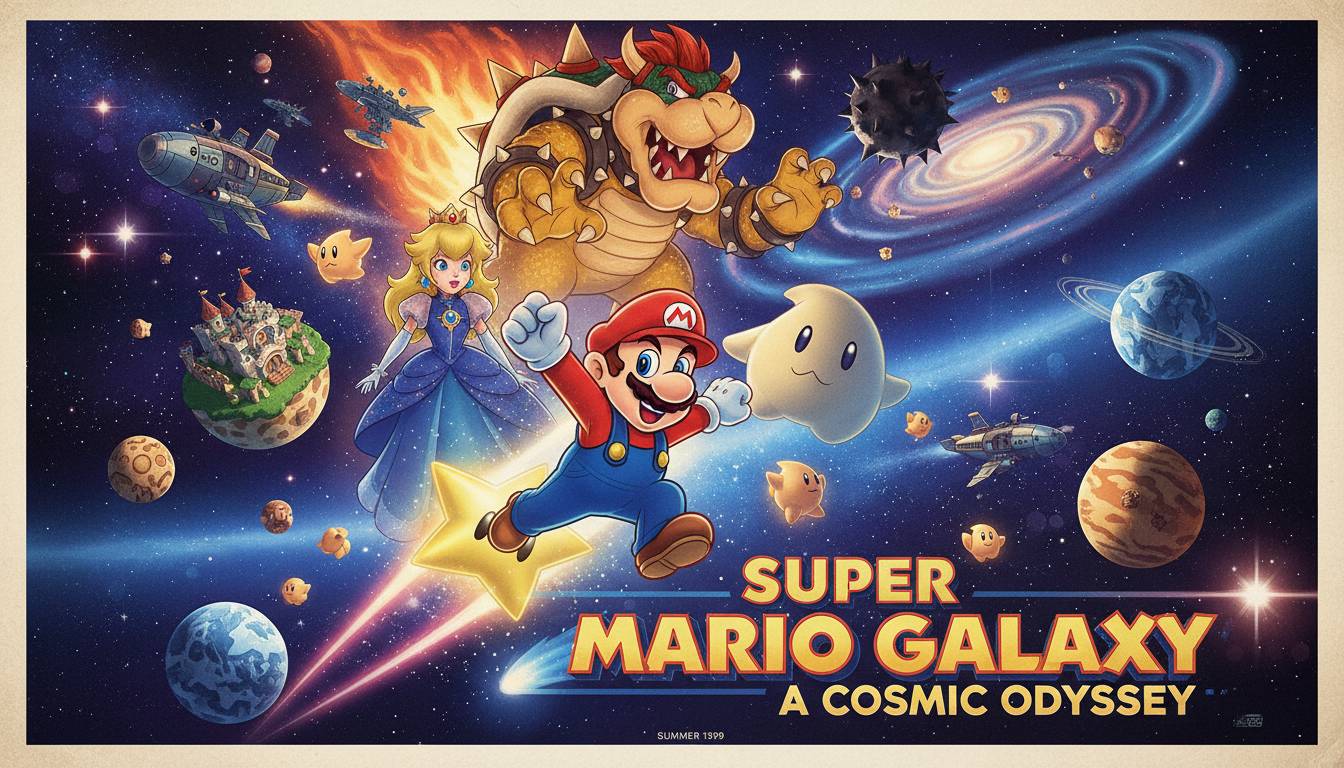
The box office for The Super Mario Galaxy Movie says one thing clearly: Nintendo and Illumination do not have a one-hit movie brand. They have a repeatable theatrical franchise. That distinction matters. A single breakout can be luck, timing, or novelty. A second global hit, especially one opening near the level of a $1.3 billion predecessor, points to durable audience demand, stronger sequel confidence, and a much wider runway for spin-offs, release scheduling, and long-term franchise planning.
A second hit changes the conversation
The strongest signal is not simply that The Super Mario Galaxy Movie opened big. It is that it opened at a scale close to the first film, which is the harder trick in Hollywood. Variety reported on April 6, 2026, that the film launched to $372.5 million worldwide, including $182.4 million internationally. Variety also noted that this start was roughly equal to the 2023 opening frame for The Super Mario Bros. Movie, which debuted to $375 million worldwide and later finished with $1.3 billion globally. That comparison is the core story. Sequels often drop when the first film benefits from novelty. Mario did not meaningfully collapse. It held its audience base.
By April 20, 2026, the picture had become even clearer. Variety reported that The Super Mario Galaxy Movie added $35 million in its third weekend and had reached $355.2 million domestically and $747.5 million worldwide. That made it the highest-grossing film of 2026 at that point. Box Office Mojo separately listed the film at $317.6 million domestic, $321.4 million international, and $639.0 million worldwide on one tracked release page, showing that totals were still updating across reporting windows and territories. Even with that variance, the direction is obvious: the movie is not just front-loaded. It is sustaining.
That matters because franchise futures are built less on opening-weekend headlines than on staying power. A strong debut can justify one sequel. Strong legs can justify a slate.
What the numbers suggest about Nintendo’s film strategy
Nintendo has historically been careful with its characters, and the Mario films fit that pattern. The first movie proved the company could translate its flagship brand into a broad four-quadrant theatrical event. The second suggests Nintendo can expand the world without losing the family audience that made the first one so massive. Variety reported that Galaxy cost $110 million to produce, not including global marketing. Against a worldwide gross already approaching three-quarters of a billion dollars by April 20, that is an extremely favorable commercial profile for a modern studio tentpole.
There is another important detail in the opening data. Variety said Galaxy opened in 80 overseas markets and highlighted top territories including Mexico at $29 million, the United Kingdom and Ireland at $19.7 million, Germany at $15 million, and France at $12 million. That spread shows the Mario brand is not dependent on North America alone. It travels. Franchises with that kind of geographic balance are easier to scale because studios can support sequels, spin-offs, and premium-format releases with more confidence.
Premium screens also matter. Variety reported that the film earned $22.2 million in IMAX globally, topping the $21.4 million IMAX debut of The Super Mario Bros. Movie. That is not just a vanity metric. It suggests audiences accepted Mario as an event title, not merely a family matinee option. Event status gives Universal and Nintendo more flexibility on release dating, merchandising tie-ins, and future format expansion.
Why this likely means more than just another Mario sequel
The obvious next step is another Mario movie. But the box office points to something bigger: a Nintendo cinematic universe that grows carefully around Mario rather than away from it. When one title becomes a phenomenon, studios often rush to multiply output. When two titles perform at this level, the smarter move is controlled expansion. Mario is now the anchor brand. That gives Nintendo room to test adjacent characters and settings while keeping the core audience engaged.
The first clue is creative elasticity. According to Variety, Galaxy moves Mario and Luigi into outer space and adds characters including Yoshi and Bowser Jr. That matters because it shows the franchise can widen its visual and narrative palette without abandoning recognizability. If audiences accepted a cosmic setting at this scale, Nintendo and Illumination have evidence that the brand can support different sub-worlds, tones, and character combinations.
That opens the door to several possibilities. A direct third Mario film is the safest bet. A Yoshi-led or Luigi-centered spin-off becomes easier to justify if Nintendo wants to broaden the bench. A crossover strategy also becomes more plausible over time, though Nintendo is unlikely to move too fast. The company tends to protect brand value by limiting overexposure. The box office gives it permission to expand, but Nintendo’s history suggests it will still do so selectively.
The real takeaway competitors often miss: repeatability
Most box office coverage focuses on raw grosses, records, and whether a film will hit $1 billion. Those are useful benchmarks, but they miss the more strategic point. The most valuable thing The Super Mario Galaxy Movie may have proven is repeatability. The first film could be explained as pent-up demand for a beloved game icon finally getting a broadly appealing animated adaptation. The second film weakens that explanation. This is now a recurring theatrical habit for audiences.
That distinction affects everything. It strengthens licensing leverage. It improves consumer-products planning. It supports theme-park synergy with Super Nintendo World. It also gives Nintendo more negotiating power in how quickly, and in what form, its characters move to film. A franchise that can open to $372.5 million worldwide and climb to $747.5 million globally within three weekends is not chasing relevance. It is setting terms.
There is also a calendar advantage. Variety said Galaxy and Project Hail Mary were positioned to dominate much of April before major competition intensified later in the month. That suggests Universal gave Mario a release corridor where family demand could compound. If that strategy continues, future Nintendo films may be treated as seasonal event anchors rather than crowded into overly competitive windows.
What could limit the franchise from here
Success does not remove risk. It changes the kind of risk. The biggest threat now is not whether audiences care. It is whether Nintendo and Illumination expand too quickly or too predictably. Franchises usually weaken when studios mistake brand familiarity for infinite elasticity. Mario has a huge advantage because the games offer decades of settings, characters, and mechanics. But adaptation still requires discipline. Repetition, tonal drift, or excessive spin-offs could dilute the event feeling that helped both films break out.
Another challenge is expectation inflation. Once a franchise posts a $1.3 billion global hit and follows it with a sequel that reaches $747.5 million worldwide by its third weekend, anything less than giant numbers can be framed as disappointment, even when it is still highly profitable. That is a perception issue, not a business issue, but it shapes headlines and investor sentiment.
Bottom line for the franchise future
The Super Mario Galaxy Movie’s box office means the franchise has moved beyond proof of concept. Mario is now one of the few modern animated brands that looks capable of delivering repeated global event-level theatrical results. The first film established the ceiling. The second established the floor. That is a powerful combination. It suggests Nintendo and Illumination can keep building, likely with another core Mario installment first, then with carefully chosen expansions around the edges. If the current trajectory holds, the future of the franchise is not in doubt. The only real question is how wide Nintendo wants the Mushroom Kingdom to become on screen.
Frequently Asked Questions
How much has The Super Mario Galaxy Movie made so far?
Variety reported on April 20, 2026, that the film had reached $355.2 million domestically and $747.5 million worldwide by its third weekend. Box Office Mojo listed lower running totals on one release page, which suggests some reporting windows were still catching up, but both sources show a major global hit.
How does its opening compare with The Super Mario Bros. Movie?
Very closely. Variety reported that Galaxy opened to $372.5 million worldwide, while The Super Mario Bros. Movie opened to $375 million worldwide in 2023. That near-match is one of the strongest signs that the franchise has durable audience demand.
Does this make another Mario movie likely?
Yes, based on the box office alone, another Mario movie looks highly likely. A reported $110 million production budget against hundreds of millions in global ticket sales gives Nintendo and Universal a strong financial case for continuing the series.
Could Nintendo make spin-offs from this success?
It is plausible. The scale of the sequel’s performance suggests audiences are open to a broader Mario world, not just one film. That said, Nintendo has historically been selective with its characters, so expansion would likely be measured rather than rushed.
Why is the international box office important here?
Because it shows Mario is a global theatrical brand. Variety highlighted strong starts in Mexico, the United Kingdom and Ireland, Germany, and France. That kind of overseas support makes long-term franchise building much safer for studios.
This article is based on publicly available box office reporting and industry coverage as of April 20, 2026. Box office totals can change as studios and tracking services update estimates.

View 0 comments