

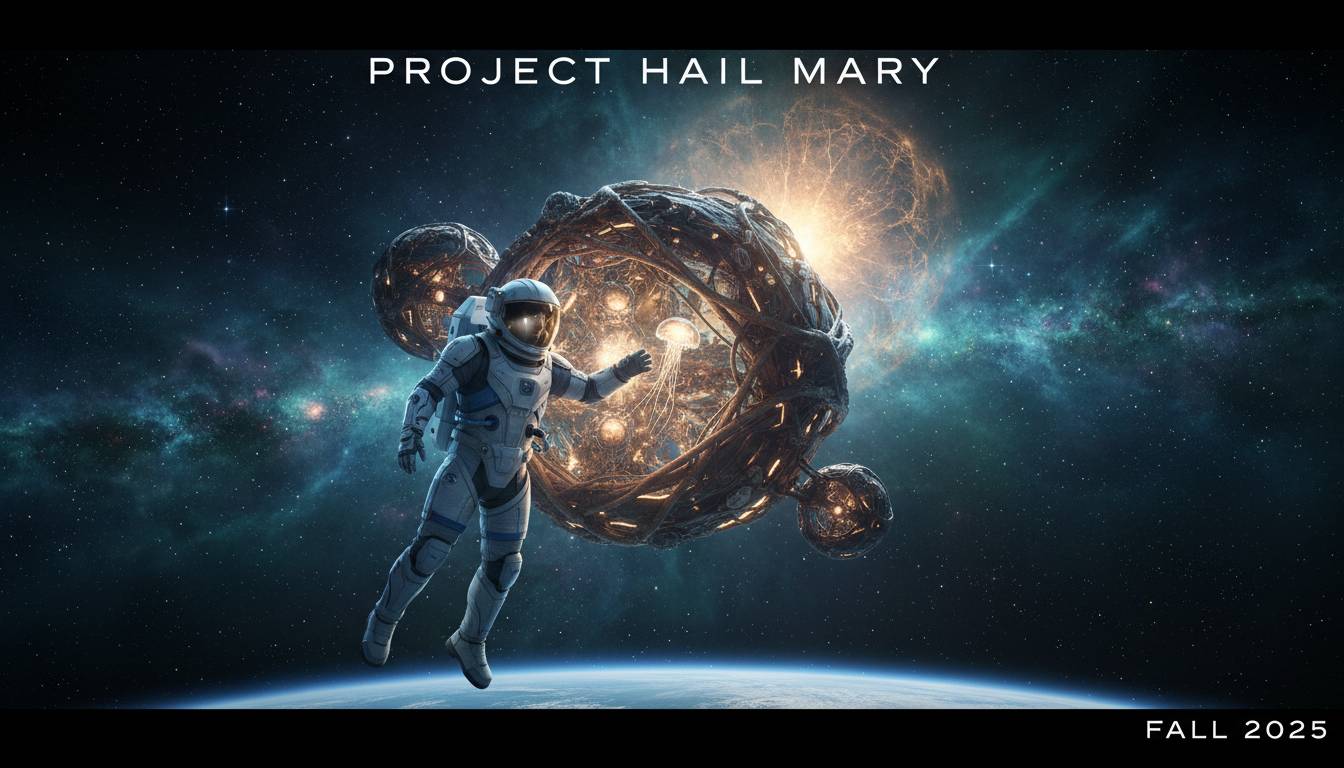
Andy Weir says the Project Hail Mary film improves on his 2021 novel in one narrow but important area: the visual handling of Grace’s memory recovery. In interviews published around the movie’s March 20, 2026 U.S. release, Weir has praised the adaptation’s structure, cast, and science-forward approach, while singling out the movie’s presentation of the protagonist’s fragmented recollections as a change that plays better on screen than on the page.
The comment matters because Project Hail Mary arrives with unusual expectations for an original science-fiction release. Amazon MGM Studios released the Ryan Gosling-led adaptation in U.S. theaters on March 20, 2026, with Phil Lord and Christopher Miller directing and Drew Goddard writing the screenplay, according to Amazon MGM’s official production notes and multiple entertainment trade reports. The film is based on Weir’s bestselling 2021 novel, which follows middle-school teacher-turned-scientist Ryland Grace as he wakes alone on a spacecraft and gradually reconstructs both his identity and the mission to save Earth.
💡
Weir’s most specific praise centers on structure, not plot.
Public interviews tied to the March 2026 release indicate that Andy Weir viewed the movie’s treatment of Grace’s returning memories as more effective in film form than in the novel’s page-by-page reveal.
March 20, 2026 Release Put Fresh Focus on Book-to-Film Changes
Project Hail Mary opened in U.S. theaters on Friday, March 20, 2026, after a long development cycle that began when MGM acquired film rights before Amazon’s purchase of the studio. Amazon’s official release information lists Ryan Gosling as Ryland Grace and Sandra Hüller as Eva Stratt, with Lord and Miller directing and Goddard adapting the screenplay. That creative lineup gave the film a direct link to The Martian, another Weir adaptation scripted by Goddard.
The timing also amplified scrutiny of adaptation choices. AP reported that the film posted an $80.5 million domestic opening weekend, setting a record debut for Amazon MGM and outperforming the opening weekends of several modern original or non-franchise space dramas, including The Martian. That commercial start pushed discussion beyond casting and visual effects toward a more specific question: what did the movie change, and which changes did Weir actually endorse?
Project Hail Mary Film Snapshot
| Item | Verified detail |
|---|---|
| U.S. theatrical release | March 20, 2026 |
| Lead actor | Ryan Gosling |
| Directors | Phil Lord and Christopher Miller |
| Screenwriter | Drew Goddard |
| Source material | Andy Weir’s 2021 novel |
| Opening weekend | $80.5 million domestic |
Source: Amazon MGM Studios and AP | March 2026
How the Memory-Reveal Device Became the One Change Weir Highlighted
In the novel, Grace’s backstory unfolds through recovered memories that interrupt the present-tense survival plot aboard the Hail Mary. That structure is central to the book’s suspense. It withholds why Grace is in space, how Earth’s crisis developed, and what role Stratt played in forcing the mission forward.
On the page, that mechanism depends heavily on internal narration. Readers spend long stretches inside Grace’s thought process as he notices clues, tests assumptions, and slowly rebuilds his identity. Film works differently. A movie has to externalize information through image, sound, editing, and performance. That is the specific area where Weir has indicated the adaptation gained an advantage.
Rather than simply reproducing the novel’s chapter rhythm, the film reportedly uses visual transitions and performance cues to make the memory returns feel more immediate. That distinction is narrow but significant. It does not mean Weir believes the movie is broadly “better than the book.” It means he sees one storytelling device as better suited to cinema once translated into a visual language.
Adaptation Timeline
2021: Andy Weir’s novel Project Hail Mary is published and becomes a major science-fiction bestseller.
2024: Public reporting confirms Sandra Hüller joins the cast as Eva Stratt.
June 30, 2025: Amazon MGM unveils the first full trailer, beginning the main marketing push.
March 20, 2026: The film opens in U.S. theaters.
March 2026: Weir’s release-cycle interviews draw attention to the adaptation’s handling of Grace’s memory structure.
Why This Specific Change Fits Film Better Than Prose
The difference comes down to medium. A novel can live inside a character’s head for hundreds of pages without losing momentum if the voice is strong enough. Weir’s fiction often relies on that strength. The Martian used log entries and technical problem-solving. Project Hail Mary uses amnesia, reconstruction, and scientific deduction.
A film, by contrast, has less room for extended internal explanation. Gosling’s performance can communicate confusion, fear, and recognition quickly, but the screenplay still has to move. That makes the memory-recovery device a pressure point in adaptation. If it is too faithful, the movie risks feeling repetitive. If it is too compressed, the mystery loses force.
Weir’s praise suggests the filmmakers found a workable balance. Lord and Miller have a track record of fast, visually legible storytelling, while Goddard already proved with The Martian that he can condense dense scientific material without stripping away narrative clarity. In that context, the “one very specific place” where the movie improves on the book is less a repudiation of the novel than an acknowledgment that adaptation sometimes sharpens a single mechanism.
ℹ️
The change is structural, not ideological.
The available interviews do not support a claim that Weir thinks the film replaces the novel. They support a narrower reading: one storytelling tool, Grace’s memory recovery, lands more efficiently in cinema.
$80.5 Million Opening Added Weight to Weir’s Endorsement
The box-office result gave Weir’s comments extra reach. AP reported that Project Hail Mary opened to $80.5 million domestically, the biggest debut for Amazon MGM and the strongest opening of 2026 at that point for a non-franchise release. Separate coverage also described the film as a major early theatrical success for the studio.
That matters because adaptation debates usually stay inside fan communities unless the movie breaks out commercially. Once a film posts a large opening, the author’s reaction becomes part of the mainstream story. Weir’s approval, especially when attached to a precise craft decision, gives the movie a stronger credibility signal among readers who worry about changes from page to screen.
Book vs. Film: The Specific Area Weir Flagged
| Element | Novel | Film |
|---|---|---|
| Grace’s backstory reveal | Recovered memories through prose structure | Visualized through editing, performance, and scene transitions |
| Main advantage | Deep internal access to Grace’s thinking | Faster, clearer cinematic momentum |
| Weir’s stated preference | Book remains source text | Memory-reveal device worked better on screen |
Source: Release-cycle interviews, Amazon MGM materials, and published entertainment coverage | March 2026
What Weir’s Comment Means for Readers and Moviegoers
For readers, the takeaway is straightforward. The movie does not erase the novel’s strengths. The book still carries more technical explanation, more interiority, and more time with Grace’s reasoning. But Weir’s comment signals that at least one adaptation choice solved a problem that prose and film handle differently.
For moviegoers who have not read the novel, the remark offers a useful lens. The film’s memory structure is not just a plot gimmick. It is the engine that organizes suspense, character revelation, and the scale of Earth’s crisis. If that engine runs more smoothly on screen, it helps explain why the adaptation has connected with a broad audience beyond existing fans of the book.
Frequently Asked Questions
What did Andy Weir say the Project Hail Mary movie did better?
Weir’s most specific public praise concerns the way the film handles Ryland Grace’s recovered memories. Based on release-cycle interviews around March 2026, he indicated that this structural device played better in the movie than in the novel because cinema could present it more directly through visuals and editing.
Is Project Hail Mary based on a book?
Yes. The film adapts Andy Weir’s 2021 novel Project Hail Mary. The screenplay is by Drew Goddard, who also adapted Weir’s The Martian, and the movie is directed by Phil Lord and Christopher Miller.
When was the Project Hail Mary movie released?
Amazon MGM Studios released Project Hail Mary in U.S. theaters on March 20, 2026. That date appears in official studio materials and was repeated in entertainment coverage tied to the film’s launch.
Who stars in the Project Hail Mary movie?
Ryan Gosling stars as Ryland Grace, and Sandra Hüller plays Eva Stratt. Official studio materials also identify Phil Lord and Christopher Miller as directors and Drew Goddard as screenwriter.
How did the movie perform at the box office?
AP reported that the film opened to $80.5 million domestically in its first weekend, making it Amazon MGM’s biggest opening and one of the strongest starts for a non-franchise science-fiction release in recent years as of March 2026.
Disclaimer: This article is for informational purposes only. Information may have changed since publication. Always verify information independently and consult qualified professionals for specific advice.

View 0 comments