

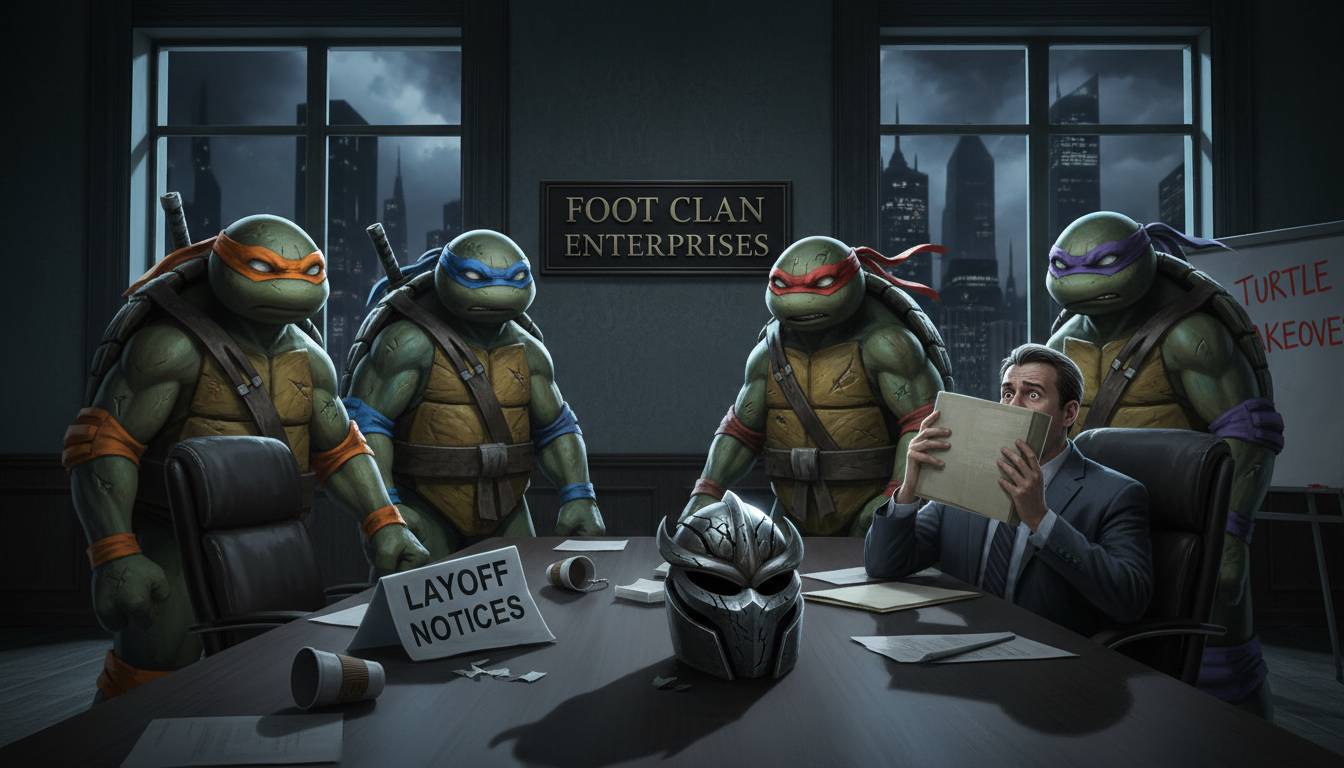
The 1990 Teenage Mutant Ninja Turtles movie has always carried a rougher edge than many children’s franchises of its era, but a newly resurfaced anecdote shows that concern existed inside the production itself. According to a report published by AOL on April 26, 2026, actor Robbie Rist said a Golden Harvest executive worried during post-production that the film was “too dark” and might scare younger viewers. That fear now reads like a revealing footnote in the history of one of the most successful comic-book adaptations of its time.
A backstage comment that explains the movie’s tone
The fresh detail comes from Robbie Rist, the voice of Michelangelo in the 1990 film. In comments cited by AOL from SFX Magazine’s January 2026 issue, Rist recalled overhearing a studio executive for Golden Harvest, the film’s financier, expressing concern that the movie was too dark for children and could put off younger audiences. It is a small anecdote, but it lands because it confirms something viewers have debated for decades: the first live-action TMNT film was noticeably moodier, more intense, and more emotionally grounded than the cartoon brand many kids knew at the time.
That tension mattered. By 1990, Teenage Mutant Ninja Turtles was already a merchandising force and a television phenomenon, so there was a built-in expectation that a movie version would lean broad, colorful, and toy-friendly. Instead, the film delivered shadow-heavy cinematography, urban grit, family conflict, and a version of the Foot Clan that felt more threatening than playful. Even without graphic content, the atmosphere was serious. That is likely what triggered the executive’s concern in the first place.
Rist’s recollection also adds credibility because he was there, in the room, during recording. It is not secondhand internet folklore. It is an eyewitness memory tied to a specific production moment, and it helps explain why the first movie feels so different from many later TMNT adaptations.
Why the 1990 film felt darker than kids expected
Anyone who revisits the original movie can see why the concern came up. The film drew heavily from the Mirage comics, which were much darker in tone than the animated series that exploded in popularity in the late 1980s. While the cartoon emphasized catchphrases, bright colors, and slapstick energy, the movie kept more of the comic’s street-level seriousness. Splinter’s origin and separation from the Turtles carried emotional weight. Raphael’s anger simmered through much of the story. The Foot Clan was presented less like a goofy gang and more like a youth-crime pipeline operating out of a grim hideout.
That tonal choice was not accidental. The 1990 movie arrived at a moment when studios were still figuring out how to adapt comic properties without flattening them into pure children’s entertainment. In that sense, Teenage Mutant Ninja Turtles sat in an unusual middle ground. It was accessible to families, but it did not talk down to them. It had jokes, yes, but it also had bruises, fear, conflict, and loss. For younger viewers, that made the experience feel bigger. For executives, it probably made the risk harder to measure.
The irony is that the darkness may have helped the film endure. A lighter, safer version might have blended into the era’s pile of disposable toy-based movies. The one audiences got had texture. It felt lived in. That is why so many fans still treat it as the definitive live-action TMNT film.
The box office result proved the fear was misplaced
If the studio side worried that the tone would alienate children, the commercial outcome suggests the opposite. The 1990 film grossed $202 million worldwide on a reported $14 million budget, according to widely cited historical box-office summaries. It also became the highest-grossing independent film up to that point, a remarkable outcome for a project that did not have the kind of institutional confidence usually attached to major franchise launches.
That success matters because it reframes the executive’s anxiety as understandable but ultimately incorrect. The movie did not fail because it was moodier than expected. It broke through because it offered something stronger than a feature-length cartoon commercial. Kids still showed up. Families still bought in. Fans of the comics and cartoon both found enough to latch onto. In hindsight, the tonal balancing act looks less like a mistake narrowly avoided and more like the exact reason the film worked.
There is another layer here. The first movie’s darker tone also influenced what came next. Teenage Mutant Ninja Turtles II: The Secret of the Ooze noticeably softened the violence and leaned harder into comedy. That tonal shift has long been discussed by fans as a response to criticism of the first film’s intensity. The newly highlighted anecdote from Rist does not prove a direct line on its own, but it fits neatly into that broader history. The concern was not invented after the fact. It was present during the making of the first film.
What the anecdote reveals about franchise filmmaking
This story is bigger than one executive’s nerves. It shows the constant push and pull inside franchise filmmaking, especially when a property has to satisfy children, parents, licensors, and longtime fans all at once. TMNT was never just one thing. It began as a comic-book parody with a sharper edge, then became a mainstream cartoon sensation, then had to be translated into live action for a mass audience. Something was always going to give.
What makes the 1990 film stand out is that it did not fully surrender to the safest version of the brand. It kept enough grit to feel distinct. It trusted atmosphere. It let scenes breathe. It allowed the Turtles to be funny without turning everything into a joke. That balance is hard to pull off, and it is probably why the movie still gets discussed 36 years later.
The anecdote also underlines how often executives misread what younger audiences can handle. Children do not always reject darker material. Often, they remember it more vividly because it feels emotionally real. The first TMNT movie was not traumatizing mass entertainment. It was simply more serious than the toy aisle suggested. That difference gave it staying power.
Why fans still connect with the first movie
For many viewers, the original film remains the gold standard because it respected the material’s contradictions. It was silly and sincere. Commercial and handmade. Kid-friendly, but not weightless. The Jim Henson Creature Shop suits gave the characters physical presence, and the practical effects helped the world feel tangible in a way later digital versions sometimes struggled to match. Add in the film’s urban mood and earnest emotional core, and you get a movie that feels more personal than its premise should allow.
That is why Rist’s recollection resonates now. It confirms that the quality fans still praise was once seen, at least by someone in the financing chain, as a possible liability. Instead, it became the movie’s identity. The darkness was not a flaw to be corrected. It was part of the formula.
Frequently Asked Questions
Who said the first Teenage Mutant Ninja Turtles movie was too dark for kids?
Robbie Rist, who voiced Michelangelo in the 1990 film, recalled overhearing a Golden Harvest executive express concern that the movie was too dark and might scare younger children. The anecdote was reported by AOL and attributed to SFX Magazine’s January 2026 issue.
Which Teenage Mutant Ninja Turtles movie is this about?
This refers to the original live-action Teenage Mutant Ninja Turtles film released in 1990, not the 2007 animated movie or the later Michael Bay-produced reboot series.
Why did the 1990 TMNT movie feel darker than the cartoon?
The film drew more heavily from the Mirage comics, which had a grittier tone than the animated series. Its lighting, urban setting, emotional conflict, and more threatening portrayal of the Foot Clan all made it feel more serious.
Did the darker tone hurt the movie at the box office?
No. The film was a major commercial success, grossing about $202 million worldwide against a reported $14 million budget. It became the highest-grossing independent film at the time.
Did later TMNT movies change tone because of that reaction?
Many fans believe so. The 1991 sequel, The Secret of the Ooze, was noticeably lighter and more comedic, with less intense action. The newly resurfaced anecdote supports the idea that tonal concerns existed early.
Why is the first TMNT movie still so popular?
It balanced humor, action, and emotion in a way that felt authentic. Fans still praise its practical effects, grounded atmosphere, and willingness to treat the characters seriously without losing their charm.


View 0 comments