

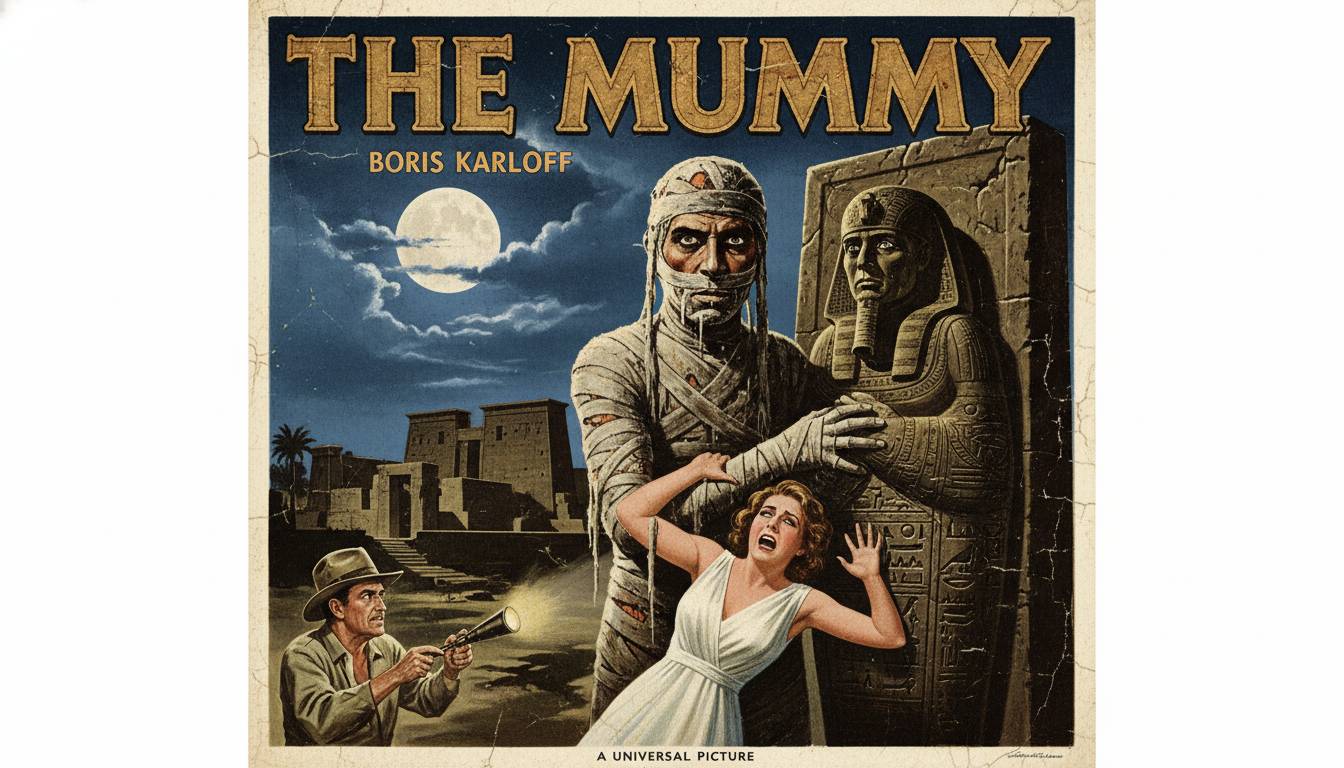
Lee Cronin’s The Mummy opened with a softer-than-franchise-launch domestic debut, and that matters because this property has never been just another horror title. It is one of Hollywood’s oldest monster brands, one that studios keep trying to reshape for new audiences. The early numbers suggest Cronin’s film may have found a lane as a lower-risk horror play rather than a four-quadrant blockbuster engine. That distinction could decide whether The Mummy expands, reboots again, or settles into a smaller, more sustainable model.
Lee Cronin’s The Mummy Starts Small, but the Cost Structure Changes the Story
According to The Numbers, Lee Cronin’s The Mummy earned $13.515 million domestically through its opening weekend after launching wide on April 17, 2026, in 3,304 theaters, with previews contributing $1.5 million on April 16, 2026. The same source lists $20.5 million internationally and $34.015 million worldwide so far, against a reported $22 million production budget. That is the first key point. The raw opening is modest. The underlying economics are not.
On a per-theater basis, the film opened to about $4,090, based on The Numbers’ theater count and weekend gross. That is not breakout territory. It also posted a domestic share of 39.7% of worldwide revenue, which implies the overseas market is already doing meaningful support work. Daily grosses show $5.24 million on Friday, $4.935 million on Saturday, and $3.34 million on Sunday, including a 32% Saturday-to-Sunday drop. Those are decent but not electric holds for a horror launch.
Still, the budget changes the interpretation. A $34.015 million worldwide start equals roughly 1.55 times the reported $22 million production cost, using The Numbers’ figures. That does not mean the movie is profitable after marketing and exhibitor splits. It does mean the film is not carrying the kind of burden that sank the 2017 version as a franchise starter. In plain English: this movie does not need superhero-level legs to avoid becoming a disaster.
Why This Opening Looks Weak Next to Past Mummy Movies
The brand history is brutal. Box Office Mojo shows 2017’s The Mummy opened to $31.688 million domestically in 4,035 theaters and finished with $80.228 million domestic and $409.232 million worldwide. That film was widely viewed as a disappointment anyway because its reported budget hit $125 million and it was supposed to launch Universal’s Dark Universe. The lesson is simple: bigger gross does not always mean healthier franchise prospects.
Older franchise entries opened much higher. Box Office Mojo’s franchise showdown page lists a $43.37 million opening for 1999’s The Mummy, $68.139 million for 2001’s The Mummy Returns, and $40.458 million for 2008’s The Mummy: Tomb of the Dragon Emperor. Against those figures, Cronin’s $13.515 million debut is not close. On pure opening-weekend comparison, it is the weakest modern Mummy launch by a wide margin.
That sounds ugly because it is. But it is also incomplete. Those earlier films were sold as adventure spectacles. Cronin’s version, as Variety reported when the trailer launched on January 13, 2026, was positioned as a “gory thriller,” not a swashbuckling effects-heavy tentpole. That genre shift matters. A lower opening can still support future films if the studio sees the property working better as a contained horror brand than as a mega-budget cinematic universe.
The Real Franchise Signal Is Not the Gross, It Is the Strategy Pivot
This is the angle a lot of fast box office coverage misses. The future of The Mummy franchise may not depend on whether Cronin’s film matches Brendan Fraser-era numbers. It probably cannot. The more important question is whether the property has finally found a scale that fits modern audience demand.
Variety’s opening-weekend report placed Lee Cronin’s The Mummy between two recent monster-movie reference points from the same creative ecosystem: 2020’s The Invisible Man, which grossed $144.5 million worldwide, and 2025’s Wolf Man, which grossed $35.2 million worldwide. That comparison is useful because it reframes success. If Cronin’s film finishes much closer to The Invisible Man than to Wolf Man, executives can justify more stand-alone monster reinterpretations. If it stalls near Wolf Man, the brand remains unstable.
There is already one hard signal that the studio landscape has changed: this film was released by Warner Bros. via New Line, not Universal, according to The Numbers, even though The Mummy is historically tied to Universal’s classic monster library. Variety also noted that Blumhouse and Atomic Monster produced the film. That means the franchise is no longer being treated strictly as a giant in-house universe play. It is being treated as filmmaker-led horror IP. That is a very different bet.
What the Opening Weekend Suggests About Audience Demand
The weekend pattern points to curiosity, not urgency. The film ranked No. 2 on Friday with $5.24 million, then No. 3 on Saturday and Sunday, according to The Numbers. Its opening weekend represented 100% of its domestic total so far, with a listed legs figure of 1.00 because the run has just begun. More revealing is the scale of release: 3,304 theaters is a full nationwide push. The studio did not platform this cautiously. Audiences simply did not turn it into an event.
That likely limits one outcome: a rapid expansion into an interconnected Mummy universe built around this specific version. Franchises usually need either a huge opening, exceptional legs, or major international overperformance to trigger aggressive sequel planning. At $34.015 million worldwide after opening weekend, the movie has work to do.
But it does not kill the property. Horror franchises survive on lower thresholds. If the film can show durable holds over the next two weekends and push worldwide revenue well beyond its production cost multiple, the takeaway in Hollywood will be that The Mummy still has value, just not in the old blockbuster format.
The Brendan Fraser Factor Complicates the Future
There is another wrinkle. Variety reported on February 11, 2026, that The Mummy 4 with Brendan Fraser and Rachel Weisz received a May 19, 2028 release date from Universal Pictures. If that project remains on track, Cronin’s film may function less as the franchise’s definitive future and more as a parallel experiment. That changes the stakes.
In that scenario, Cronin’s movie does not need to become the sole path forward. It only needs to prove there is room for multiple Mummy interpretations: one nostalgia-driven adventure line and one darker horror line. Studios love that kind of optionality. It lets them segment audiences instead of forcing one tone to serve everyone.
The risk is brand confusion. General audiences already lived through the 2017 reset attempt. If one Mummy film underperforms while another version is being prepared for 2028, the franchise can start to look fragmented rather than revitalized. That is why the final worldwide total matters more than the opening headline. A respectable multiplier from here would support the idea that the brand is flexible. A collapse would suggest audiences are selective about which Mummy they want.
What the Box Office Means for the Franchise Going Forward
Right now, the clearest conclusion is this: Lee Cronin’s The Mummy has not relaunched The Mummy as a blockbuster franchise, but it may have helped redefine it as a manageable horror property. That is not the same thing, and it is not a consolation prize. In the post-Dark Universe era, smaller and smarter may be the only viable route.
If the film finishes with strong legs relative to its opening and clears a healthy worldwide multiple of its $22 million budget, expect more filmmaker-driven monster movies with controlled spending. If it fades quickly, the franchise’s center of gravity likely shifts back to the Fraser-led 2028 film. Either way, opening weekend already tells us something important: The Mummy brand still attracts attention, but not every version commands event-level demand. The future now depends on precision, not scale.
Frequently Asked Questions
How much did Lee Cronin’s The Mummy make on opening weekend?
The Numbers reports that the film earned $13.515 million domestically on its opening weekend ending April 19, 2026. It also had $20.5 million internationally for a $34.015 million worldwide start.
Is that a good opening for a Mummy movie?
Compared with earlier Mummy films, no. It is well below the domestic openings of the 1999, 2001, 2008, and 2017 entries. Compared with its reported $22 million production budget, though, it is more defensible than those franchise comparisons make it look.
Why does the budget matter so much here?
Because franchise potential is tied to profitability, not just gross revenue. A $13.515 million domestic opening looks modest, but a $22 million production budget gives the movie a much lower break-even hurdle than the $125 million 2017 version faced.
Does this mean there will not be another Mummy movie?
No. In fact, Variety reported that Universal dated The Mummy 4 with Brendan Fraser and Rachel Weisz for May 19, 2028. Cronin’s film may influence whether darker stand-alone Mummy stories continue alongside that separate continuity.
What is the biggest takeaway from the box office so far?
The biggest takeaway is strategic. Lee Cronin’s The Mummy looks less like a failed tentpole launch and more like a test of whether The Mummy works better as mid-budget horror than as a giant cinematic universe brand.

View 0 comments