

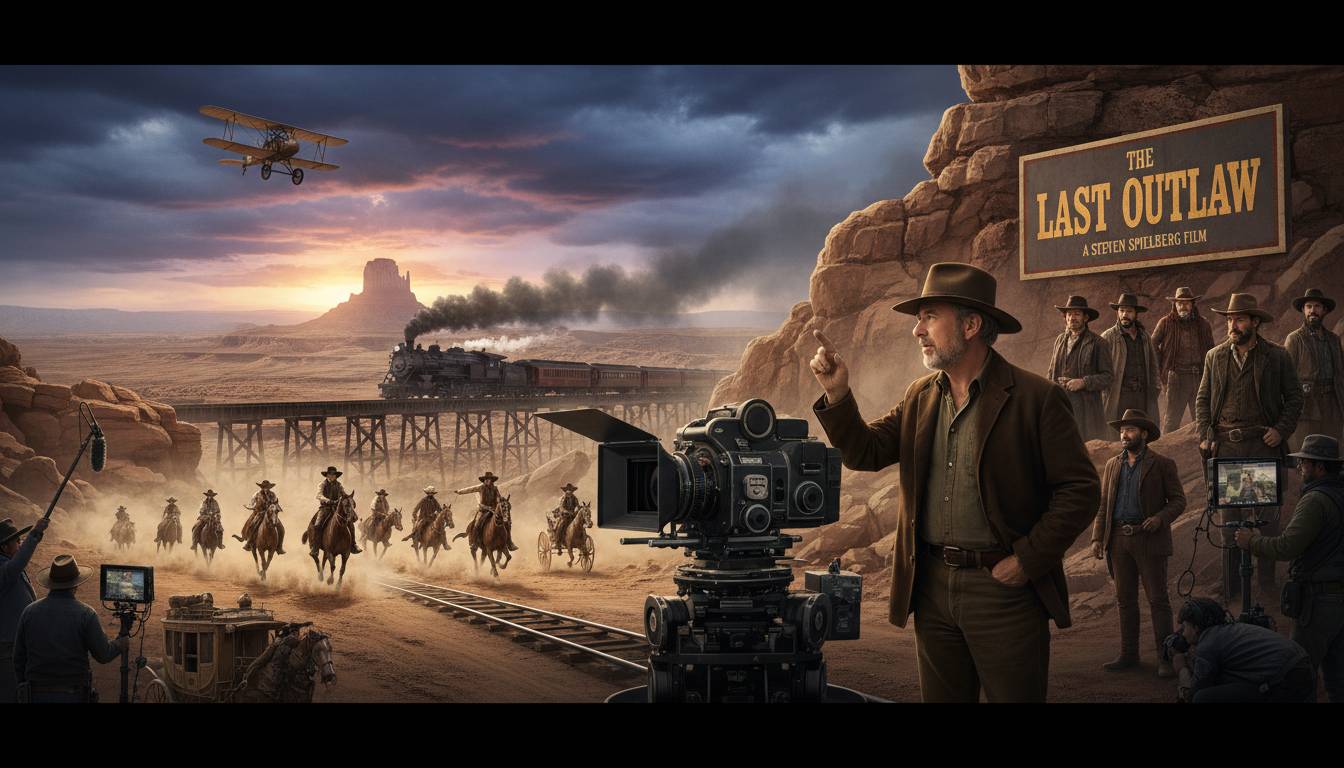
Steven Spielberg has directed shark thrillers, war epics, science-fiction landmarks, historical dramas, adventure serials, and even a full-scale movie musical. Yet one classic Hollywood form has remained missing from his directing résumé: the Western. That gap has stood out for years because Spielberg has openly admired the genre and has borrowed from its visual language more than once. The simple reason, based on his own comments and the shape of his career, is not dislike. It is that the right Western never arrived at the right moment.
A major genre gap in one of Hollywood’s broadest filmographies
Spielberg’s career is unusually wide-ranging. His filmography includes Jaws, Close Encounters of the Third Kind, Raiders of the Lost Ark, E.T. the Extra-Terrestrial, Schindler’s List, Saving Private Ryan, Minority Report, Munich, Lincoln, Bridge of Spies, The Post, West Side Story, and The Fabelmans. Across those films, he has moved between spectacle and intimacy with unusual ease. That is exactly why the absence of a straight Western has always felt so noticeable.
It is not because Spielberg has ignored the American frontier in every form. He has circled it. He produced the 2005 TNT miniseries Into the West, a large-scale frontier drama that showed clear interest in Western themes without placing him in the director’s chair. Long before that, he also made amateur films as a child, including a small Western project, which shows the genre was part of his imagination early on. Even so, when people talk about the genres Spielberg has not fully tackled as a feature director, the Western is usually the first one mentioned.
That matters because Spielberg is not a filmmaker who stayed in one lane. He has repeatedly taken on genres that carry heavy audience expectations. He made a war film that became a benchmark. He made a dinosaur blockbuster that reshaped studio filmmaking. He made a musical after decades in the business. So the question has never really been whether he could make a Western. It has been why he has not.
Spielberg’s own explanation is surprisingly straightforward
The clearest answer comes from Spielberg himself. In interviews tied to West Side Story and later public appearances, he said the Western was the one genre he had not really tackled and described it as something that had “eluded” him for decades. That wording is revealing. He did not frame the genre as uninteresting, outdated, or beneath him. He framed it as unfinished business.
That is the simple reason in plain English: Spielberg never directed a Western because he never found one he wanted to make enough to interrupt everything else he was making.
That sounds almost too obvious, but it fits the pattern of his career. Spielberg tends to direct films when there is a strong personal, emotional, or formal hook. Schindler’s List carried historical and moral urgency. Saving Private Ryan let him confront war with visceral realism. The Fabelmans was deeply autobiographical. West Side Story was tied to a long-standing love of classic movie musicals. His best-known projects usually come with a visible internal engine. They are not just assignments. They are commitments.
A Western, by contrast, appears to have remained more of an ambition than an inevitability. He admired the form, but admiration alone is not enough to sustain a Spielberg production. For a director with his level of control and choice, the deciding factor is often whether a story feels essential. For decades, other stories won.
His love of Westerns may actually explain the delay
There is a second layer here, and it makes the first answer even more convincing. Spielberg’s respect for the Western may have made him more cautious about entering it. He has long been associated with filmmakers shaped by classical Hollywood, and John Ford’s influence on American cinema hangs over any serious conversation about Westerns. The famous ending of The Fabelmans, which features Ford as a symbolic artistic presence, made that connection even more explicit.
When a director reveres a genre, the bar can get higher, not lower. A casual filmmaker might dabble. Spielberg is not casual. If he were going to make a Western, it would have to justify itself against decades of genre history and against the giants who defined it. That is a tougher standard than simply saying yes to a good script.
In that sense, the Western may have been a victim of Spielberg’s seriousness. He has spent much of his career making films that either reinvent genre or engage directly with history, memory, family, and national identity. The Western can do all of those things, but it also comes with baggage: mythmaking, violence, race, expansion, and the legacy of old stereotypes. A modern Spielberg Western would almost certainly need to address those issues head-on. That is a bigger creative burden than making a horse-and-gun adventure for nostalgia’s sake.
Why the timing never quite worked
Timing matters in any long directing career. Spielberg came up during the New Hollywood era, when the traditional studio Western had already lost some of its old dominance. By the 1970s and 1980s, the genres pulling the strongest commercial energy were thrillers, science fiction, action-adventure, and high-concept event films. Spielberg did not create that shift by himself, but he became one of its defining figures.
That meant his momentum carried him elsewhere. Jaws changed the summer movie business. Raiders helped revive and modernize serial adventure. E.T. became a cultural phenomenon. Jurassic Park pushed visual effects into a new era. Even when Spielberg turned toward prestige historical drama, he was still moving into areas that felt urgent for him at the time. The Western kept slipping down the list.
There is also the practical side. A Spielberg film is never a small undertaking. He has often balanced directing with producing, studio relationships, awards campaigns, and large-scale development work. In a career like that, some ambitions stay on the shelf simply because they are not the one project that wins the scheduling battle. That does not mean the desire disappears. It just means it never becomes the next film.
He may finally be ready to change that
What makes this topic more interesting now is that Spielberg has recently sounded more open than ever about making a Western. In public comments reported over the last few years, he has said the genre still appeals to him, and newer reports suggest he has discussed Western ideas in development. That does not guarantee a finished movie, of course. Development is full of projects that never happen. Still, the tone has shifted from abstract admiration to something closer to active interest.
If that happens, the long delay will probably make more sense in retrospect. Spielberg did not avoid Westerns because he lacked the skill or because the genre meant nothing to him. He avoided directing one because he had not yet found the version that felt necessary, personal, and distinct enough to deserve his time. For a filmmaker with nothing left to prove commercially, that kind of selectiveness is not hesitation. It is method.
Conclusion
So why has Steven Spielberg never directed a Western movie? The simplest answer is still the best one: he wanted to, but the right project never fully came together before other films took priority. His own remarks suggest the genre has lingered as an unrealized goal rather than a rejected one. In other words, it is not a mystery of taste. It is a matter of timing, standards, and story. And if Spielberg does finally make a Western, that long wait may end up being part of what makes it worth watching.
Frequently Asked Questions
Has Steven Spielberg ever made any kind of Western project?
He has not directed a traditional feature Western, but he has been connected to the genre. Most notably, he served as an executive producer on Into the West, the 2005 TNT miniseries. He also made amateur films in his youth that included Western elements.
Did Spielberg ever explain why he had not directed a Western?
Yes. In public comments, Spielberg has said the Western is the one genre he has not really tackled and described it as something that has “eluded” him for decades. That suggests the issue is not lack of interest, but the absence of the right project at the right time.
Does Spielberg like Westerns?
Everything about his comments and influences suggests that he does. His admiration for classic American filmmaking, especially figures like John Ford, points to a real respect for the genre. That admiration may actually be one reason he has been careful about approaching it.
Could some Spielberg movies be considered Westerns in disguise?
Some viewers argue that a few of his films borrow Western structure or imagery. Duel, Jaws, and even parts of Raiders of the Lost Ark have been discussed that way because of their frontier-style conflicts, lone-hero dynamics, and pursuit narratives. Still, they are not Westerns in the formal genre sense.
Is Spielberg working on a Western now?
Recent reports indicate that he has spoken about Western ideas in development, including comments suggesting he is interested in finally tackling the genre. However, development talk does not always lead to production, so nothing should be treated as final until a project is officially announced.
Why would a Spielberg Western be such a big deal?
Because it would close one of the last obvious genre gaps in the career of one of America’s most influential directors. It would also invite comparisons with the filmmakers and traditions that helped shape his visual storytelling in the first place.


View 0 comments