

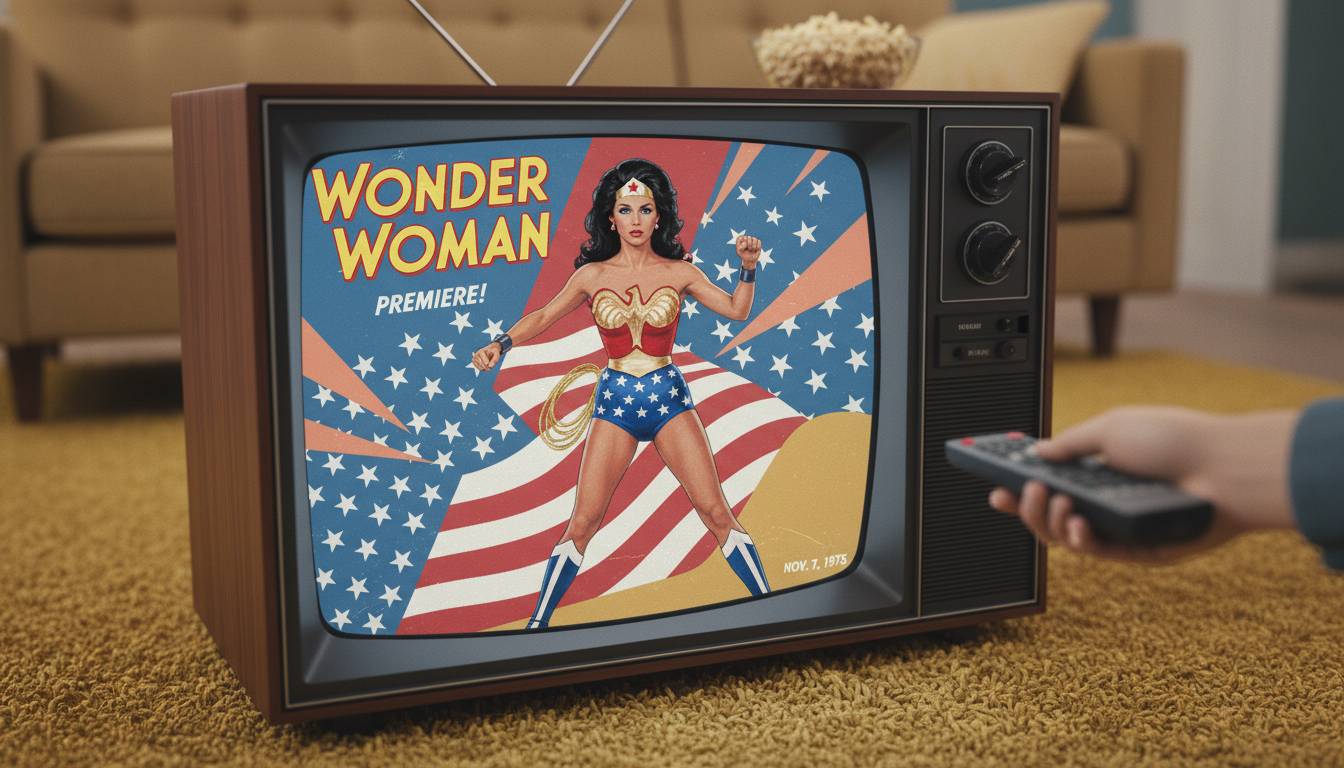
Most fans trace Wonder Woman’s screen history to Lynda Carter in 1975 or to Super Friends in 1973. That is not where it starts. Her first television appearance came earlier, and in a much stranger place: The Brady Kids, Filmation’s animated Saturday-morning spin-off of The Brady Bunch. It is one of those pop-culture footnotes that sounds made up until you follow the production trail, and once you do, it says a lot about how superhero TV was evolving in the early 1970s.
The odd truth behind Wonder Woman’s first TV appearance
Wonder Woman’s first broadcast television appearance is widely identified as the 1972 The Brady Kids episode “It’s All Greek to Me.” Multiple reference sources point to that episode as her earliest TV outing, predating both the live-action Wonder Woman project associated with Lynda Carter and the character’s better-known animated team appearances in Super Friends. IMDb’s episode notes describe it as the first appearance of Wonder Woman on broadcast television, while broader franchise summaries for Super Friends note that Superman and Wonder Woman had already guest-starred on The Brady Kids before Hanna-Barbera’s DC team-up series launched in 1973.
That alone is a fun bit of trivia. The weirder part is the setting. The Brady Kids was not a superhero show. It was an animated extension of The Brady Bunch, produced by Filmation and aired on ABC beginning in 1972. The series took the Brady children out of suburban sitcom territory and dropped them into broad cartoon adventures, complete with fantasy plots, musical interludes, and talking animal sidekicks. In other words, Wonder Woman did not enter television through a DC-branded showcase. She arrived through one of the strangest side roads imaginable: a cartoon spun off from a family sitcom.
That contrast matters. By 1972, Wonder Woman had already been a major comic-book figure for decades, yet television had not figured out what to do with her. A 1967 attempt to bring the character to TV did not result in a full series, and her eventual live-action breakthrough was still years away. So when Filmation folded her into a Brady Kids episode built around ancient Greece, it was not just random camp. It reflected a transitional moment when superhero properties were still being tested in whatever format networks thought might work.
Why The Brady Kids was such a strange launchpad
On paper, the pairing makes almost no sense. The Brady Bunch was a live-action family sitcom that premiered in 1969. The Brady Kids, which followed in animated form in 1972, pushed the concept into a very different register. Filmation’s version was not interested in realism. It embraced the anything-goes logic of Saturday morning television, where a familiar brand could suddenly coexist with time travel, mythology, and guest appearances from comic-book heroes. That is exactly what happened in “It’s All Greek to Me,” where the Brady kids encounter Diana Prince and, through a classically odd cartoon premise, end up in ancient Greece.
There is also an industrial reason the crossover happened. Filmation was competing in the broader race to adapt DC characters for television animation. Sources discussing the episode note that the studio was vying for DC rights around that period, which helps explain why Superman and Wonder Woman could turn up in Brady Kids adventures before Hanna-Barbera’s Super Friends became the more enduring DC cartoon brand. In that sense, Wonder Woman’s Brady Kids appearance was not just a gag. It was part of a larger behind-the-scenes struggle over who would shape DC’s television future.
That production context is the piece many casual retrospectives skip. The headline fact is that Wonder Woman appeared in a Brady Bunch cartoon. The more revealing fact is why that happened at all. Early 1970s children’s television was a fluid marketplace. Studios reused known characters, borrowed comic-book icons, and tested audience response in hybrid formats that would feel almost impossible now. Wonder Woman’s TV debut looks bizarre from a modern franchise perspective because modern franchises are tightly managed. Back then, the boundaries were looser, and that looseness produced some wonderfully strange firsts.
Before Lynda Carter, before Super Friends
For many viewers, Wonder Woman’s television identity begins with Lynda Carter. That association is understandable. The live-action TV film arrived in 1974, and the series itself premiered in 1975, giving the character a defining screen incarnation that still shapes public memory. But that was not her first TV appearance, and it was not even her first appearance on television animation. The Brady Kids got there first.
Super Friends is the other common point of confusion. Because the 1973 series became such a foundational DC cartoon, many people assume Wonder Woman debuted there alongside Superman, Batman, Robin, and Aquaman. Yet summaries of Super Friends explicitly note that Wonder Woman had already guest-starred on The Brady Kids shortly before the team series was developed. That makes The Brady Kids a genuine historical first, not just an obscure side note.
There is an even stranger wrinkle in the broader history. Some sources note that Wonder Girl had appeared in Filmation’s Teen Titans material before Wonder Woman herself made it to television. So the most famous Amazon hero reached the screen after one of her spin-off-related counterparts had already done so. That kind of chronology feels backward, but it fits the era. Television adaptation in the late 1960s and early 1970s was messy, opportunistic, and often driven more by package deals and animation rights than by any clean sense of canon.
What the debut says about 1970s pop culture
Wonder Woman’s Brady Kids appearance is memorable because it captures a very specific kind of 1970s television weirdness. Studios were eager to expand recognizable brands. Networks wanted flexible family programming. Animation houses like Filmation were willing to mash together mythology, sitcom leftovers, superhero iconography, and educational adventure into one package. The result could be tonally chaotic, but it was also inventive in a way modern franchise management rarely allows.
That is why this debut still fascinates people. It is not merely obscure trivia. It is evidence of a moment when pop culture had not yet locked superheroes into a single prestige template. Wonder Woman could be serious in comics, iconic in concept, and still make her television entrance in a cartoon tied to The Brady Bunch. That sounds absurd. It also happened.
And maybe that is the best way to understand it. Before Wonder Woman became a polished multimedia institution, she was a character looking for the right screen format. Television found her in pieces: a failed attempt here, a bizarre animated guest spot there, a team cartoon after that, and finally a star-making live-action role. The Brady Kids episode is the odd first chapter in that story, but it is still the first chapter. Without it, one of television’s strangest superhero milestones disappears from the record.
Frequently Asked Questions
What was Wonder Woman’s first TV appearance?
Her first broadcast television appearance is generally identified as the 1972 The Brady Kids episode “It’s All Greek to Me,” according to episode references and franchise histories.
Was Wonder Woman’s TV debut really connected to The Brady Bunch?
Yes. The Brady Kids was an animated spin-off of The Brady Bunch, produced by Filmation. Wonder Woman appeared there before her better-known TV versions.
Did Wonder Woman debut on Super Friends?
No. Super Friends premiered in 1973, but reference material for that series notes that Wonder Woman had already guest-starred on The Brady Kids beforehand.
Did Lynda Carter play Wonder Woman in that first TV appearance?
No. Lynda Carter’s live-action association with the character came later, through the 1974 TV film and the 1975 series. The Brady Kids appearance came earlier and was animated.
Why did Wonder Woman appear in such an unusual show?
Filmation was experimenting with crossovers and was active in adapting comic-book properties for television. The Brady Kids became an unlikely testing ground for superhero guest appearances during that period.

View 0 comments