


Direct understanding of how individuals perceive specific goods, offerings, and total encounters is supplied to commercial entities through client responses. Instruments such as questionnaires, assessments, support chats, discussions, social media posts, and user requests can reveal practical data points that traditional operational measures may not fully capture. Yet, merely gathering these responses fails to build tighter bonds between firms and clients. Genuine worth emerges specifically when such observations are converted into substantial steps toward improvement.
A strong Voice-of-Customer (VoC) workflow assists firms in grasping client needs, spotting common issues, and finding ways to enhance the total journey. A solid product innovation strategy is grounded in this principle: when reviews happen regularly and connect to business decisions, teams can move beyond addressing single complaints and start fixing broader trends.
Customer loyalty strengthens significantly when individuals perceive their issues have been acknowledged and addressed effectively. An organization that spots a recurring defect in its products, streamlines a confusing workflow, or responds to frequent customer requests shows clearly that feedback drives real results. Such enhancements may boost satisfaction levels while simultaneously cutting down on motivations for clients to explore other options.
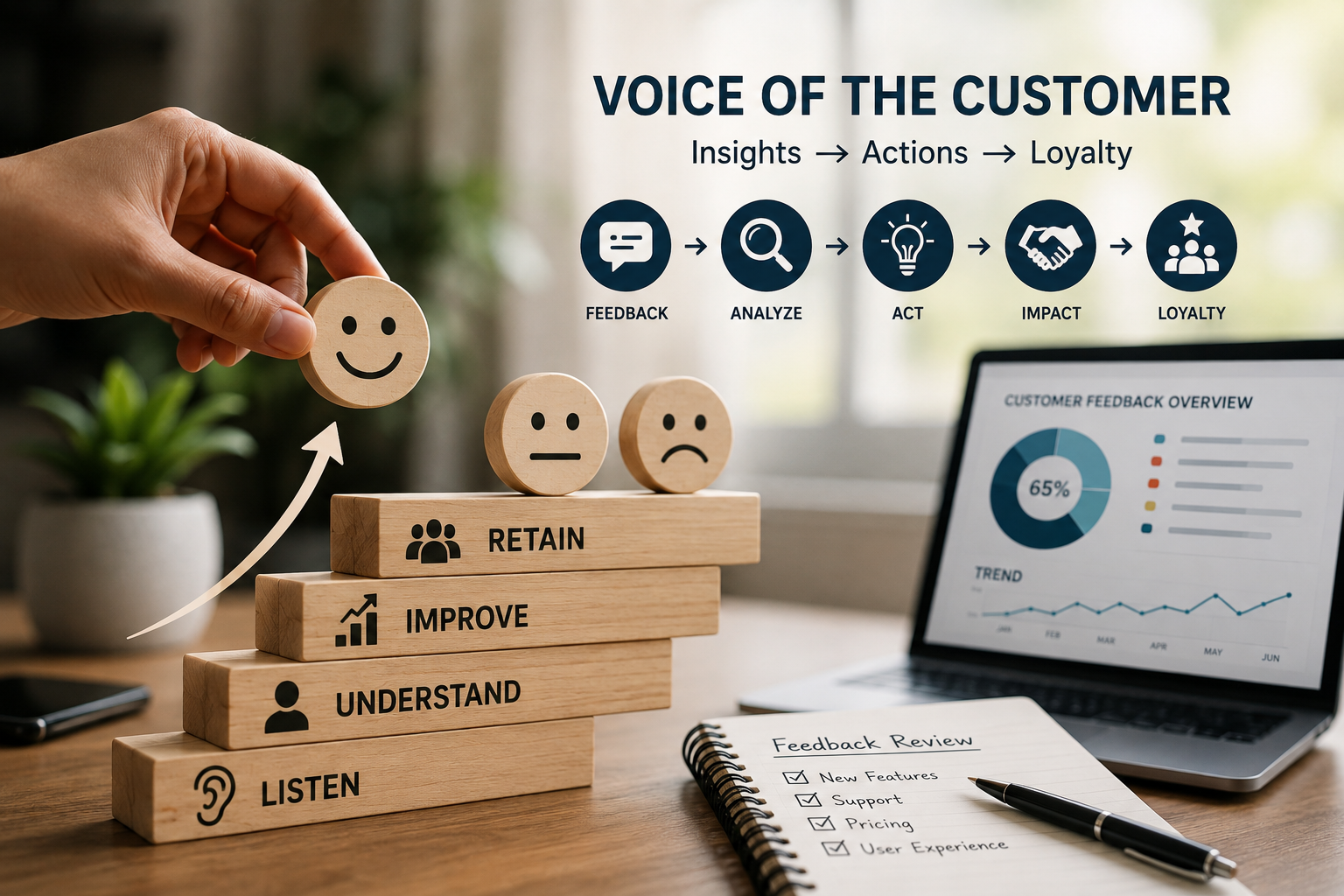
Closing the Voice-of-Customer loop demands more than just opinion collection; firms require a defined workflow to gather feedback, spot key patterns, rank necessary steps, share updates, and verify if modifications truly shift user conduct.
How to Turn Voice-of-Customer Insights Into Retention Drivers
Source AI
- Collect Feedback Across Multiple Touchpoints
Customers communicate in many different ways.
Collect data from questionnaires, evaluations, help desk logs, face-to-face talks, client discussions, online networks, and usage patterns when suitable. Examining multiple avenues offers a wider grasp of user needs rather than depending on just one type of response.
Multiple feedback sources create a clearer customer picture.
- Identify Recurring Customer Themes
Individual comments may reveal larger patterns.
Collect group responses regarding shared subjects, including product ease of use, service standards, costs, assistance, contact methods, initial setup, or desired capabilities. Spotting repeating patterns assists crews in concentrating on problems impacting bigger populations instead of responding individually to each separate remark.
Recurring themes reveal important retention opportunities.
- Connect Feedback With Customer Behavior
When merged with behavioral metrics, customer sentiments gain greater utility.
Look at how feedback stacks up against metrics such as engagement levels, how often purchases occur, renewal rates, how much the product is used, support interactions, and similar data points. Doing so allows companies to figure out if specific worries link up with dropping engagement or a higher chance that customers will leave.
Combining feedback and behavior strengthens customer insights.
- Prioritize Actions Based on Customer Impact
Not all feedback received requires immediate attention.
Order client problems based on elements including how often they happen, their seriousness, effect on business operations, and count of clients involved. Focusing on top-tier worries aids groups in steering assets towards fixes able to generate real shifts inside the client journey.
Focused action improves retention potential.
- Turn Insights Into Product and Service Improvements
Feedback should lead to visible improvements.
Apply customer knowledge to sharpen offerings, streamline workflows, enhance service interactions, revise messaging, or build capabilities for solving real user problems. If responses shape changes directly, firms may craft encounters aligning closer with what clients anticipate.
Actionable feedback creates stronger customer value.
- Close the Loop With Customers
Clients ought to understand when their input results in movement.
Send relevant updates via email, software releases, support calls, or other appropriate channels. Strong consumer engagement depends on this moment of acknowledgment, demonstrating to clients that their issues were reviewed, bolsters reliability, and proves the firm prizes their feedback above all else.
Closing the loop strengthens customer relationships.
- Measure the Impact of Changes
Retention improvements should be measurable.
Once you make changes based on client input, track specific metrics, including satisfaction, engagement, renewal percentages, repurchases, support load, and attrition. Evaluating results prior to versus subsequent to a fix allows groups to determine if their reaction generated the anticipated outcome.
Measurement validates retention strategies.
- Make Voice-of-Customer an Ongoing Process
Customer expectations continue to change.
Check feedback on a regular basis instead of regarding Voice-of-Customer research as a single event. Setting up a continuous workflow permits companies to find developing issues, spot fresh possibilities, and modify client interactions as demands shift over time.
Continuous listening supports long-term retention.
Final Thoughts
Voice-of-Customer programs gain worth only when firms look past simple data collection and transform those insights into real enhancements. By pulling opinions from various contact points, spotting repeating patterns, linking remarks to user actions, ranking problems by their effect, and tracking results, groups can grasp what drives both satisfaction levels and how long people stay.
Closing the feedback loop further gives clients a clear reason to trust the firms they choose. When individuals see their issues acknowledged and improvements follow, the relationship becomes more responsive and meaningful.
Entities that embed client feedback into daily workflows develop more robust retention plans eventually. Every piece of user commentary, feedback, or dialogue is a chance to study, improve, and design interactions that motivate clients to stay connected to the company.

View 0 comments