

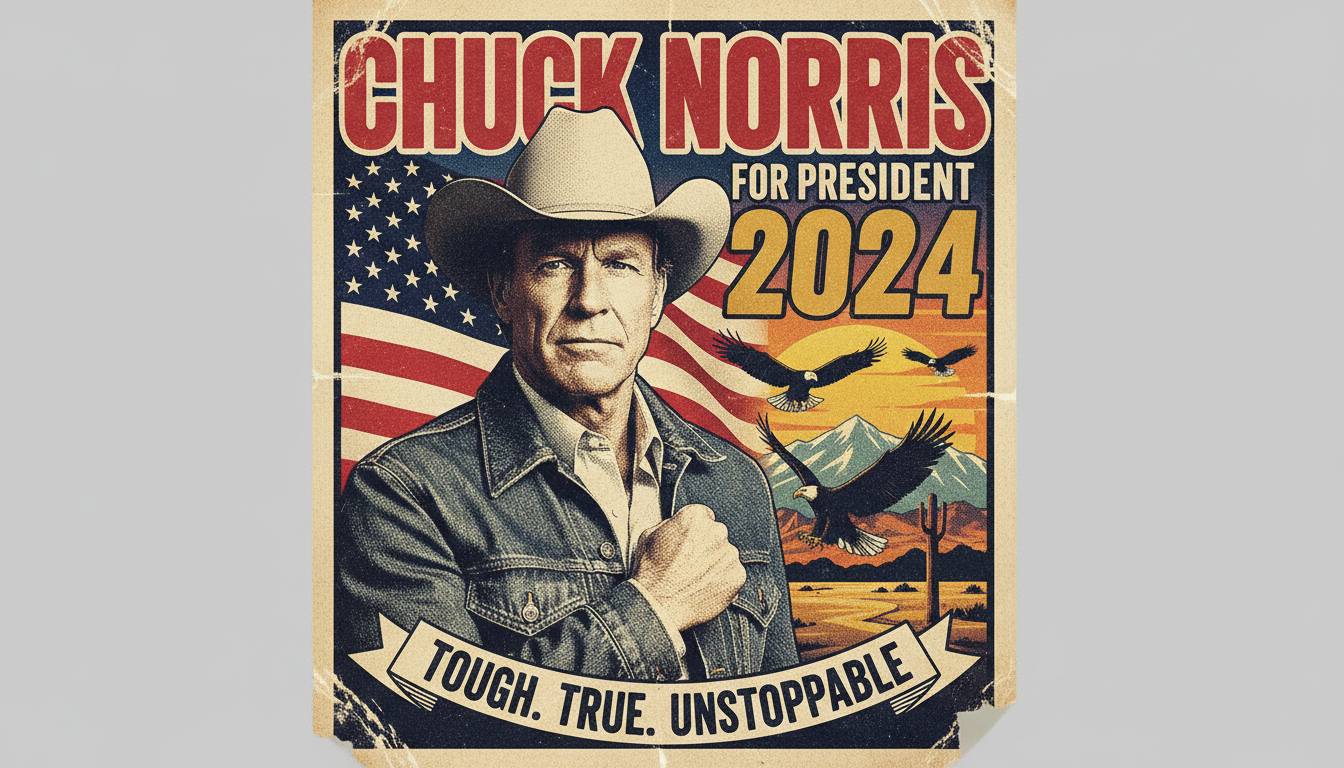
Chuck Norris once framed his screen persona in terms that sounded ambitious, even a little audacious: he saw himself working in the tradition of John Wayne. On the surface, that comparison can seem strange. Wayne was the towering face of the American Western, while Norris built his fame through karate, Cannon Films action vehicles, and later television. But the more closely you look at what Norris actually played, and what audiences expected from him, the less far-fetched the comparison becomes. He was not copying Wayne’s style beat for beat. He was adapting Wayne’s moral template for a different era.
The quote makes more sense than it first appears
Norris did not hide the influence. In a 1993 Los Angeles Times profile, he said he modeled himself after older film heroes such as John Wayne and Gary Cooper, describing the ideal as “a guy who doesn’t look for trouble but can handle it.” That line gets to the heart of the comparison. Norris was never arguing that his movies looked like The Searchers or Rio Bravo. He was pointing to a character type: the restrained, self-reliant American hero who uses force reluctantly, then decisively.
That same idea appears elsewhere in Norris’s public comments. The Week, reflecting on his career, highlighted Norris’s own explanation of his appeal: audiences wanted to believe in him, “just as I believed in John Wayne when I was a boy.” That is not a casual name-drop. It suggests that Wayne was not merely a favorite actor to Norris. He was a model for what a movie star could represent to viewers: steadiness, toughness, and a code.
Empire also captured Norris discussing the old-screen ideal more broadly, invoking figures like Roy Rogers, Gene Autry, and Wayne as men who embodied a “code of the West.” That phrase matters. Norris’s best-known roles are not Westerns in the strict genre sense, yet many of them operate according to Western logic. The setting changes. The code does not.
Norris translated the Western hero into the modern action movie
This is where the comparison becomes persuasive. John Wayne’s classic persona was built around moral clarity, physical courage, and a refusal to grandstand emotionally. Norris’s strongest screen roles work in much the same register. He often played men who were quiet, direct, and ethically legible. They were not antiheroes in the cynical 1970s mold, and they were not wisecracking demolition experts either. They were professionals. Lone operators. Men with a line they would not let others cross.
That is especially visible in films like Lone Wolf McQuade, Code of Silence, and even Walker, Texas Ranger. Lone Wolf McQuade is practically a modern frontier story in contemporary clothes: a lawman on the edge of institutions, isolated, capable, and defined by personal resolve. Collider has even argued that the film helped lay groundwork for Walker, Texas Ranger, which is not hard to see. Both projects lean into the image of Norris as a modern cowboy, less interested in psychological complexity than in restoring order.
That is the real overlap with Wayne. Neither star depended on verbal fireworks. Neither built his appeal around vulnerability in the modern prestige-drama sense. Their characters were often strongest when they said less, stood firm, and acted with certainty. Different genres, same dramatic function.
Why the comparison was not exact
Still, Norris was not John Wayne with roundhouse kicks. The differences matter, and they explain why the comparison has always sounded slightly off to some critics. Wayne’s authority came from voice, size, gait, and mythic command of space. Norris’s came from discipline, athletic credibility, and the promise of controlled violence. Wayne looked like he had been carved out of Monument Valley. Norris looked like a martial artist who had stepped into American genre filmmaking and bent it around his strengths.
There is also the matter of performance style. Wayne’s best work often carried a weathered, sometimes melancholy presence beneath the swagger. Norris, especially in his 1980s run, was more functional as an actor. Even sympathetic observers admitted that. The Lone Wolf McQuade record preserved on Wikipedia notes that one reviewer wrote Norris had not yet achieved his “often-repeated wish of becoming the next John Wayne,” even while acknowledging his effectiveness as an action hero. That criticism was not entirely unfair. Norris did not possess Wayne’s range of screen myth. What he did have was consistency.
And consistency counts for a lot in popular cinema. Audiences knew what a Chuck Norris movie promised. Much as Wayne’s fans once did, Norris’s fans showed up for a dependable moral universe. The hero would be tested. Institutions might fail. Corruption would spread. Then Norris would restore balance, usually with fists, boots, or a firearm, but always with the same underlying ethic. That predictability was not a weakness. It was the brand.
His films shared Wayne’s moral architecture
If you strip away the helicopters, machine guns, and martial arts choreography, many Norris vehicles are built on an old-fashioned foundation. Good Guys Wear Black already announces the worldview in its title. The hero is not morally ambiguous. He is decent, patient, and dangerous only when pushed. That is pure old-school star construction.
Even when Norris moved into harder-edged 1980s action, the core remained intact. He was not playing chaos agents. He was playing guardians. In that sense, his movies often resembled Wayne’s less in plot than in purpose. They offered reassurance. They told audiences that courage and decency could still prevail through individual action. That is why the Wayne comparison fits better at the level of myth than at the level of genre.
It also helps explain Norris’s long television success. Walker, Texas Ranger worked because it distilled his persona into weekly form: a courteous but formidable lawman, rooted in tradition, physically capable, and morally unconfused. That is not far from what Wayne represented for generations of moviegoers, just translated into 1990s network television.
Why the comparison still holds up
Norris was not wrong because he understood something essential about stardom. Great popular screen personas are not only about setting or costume. They are about what the audience believes the actor stands for. Wayne stood for a certain American ideal, however contested that ideal later became. Norris, in his own lane, did too. He offered a cleaned-up, late-20th-century version of the same fantasy: the honorable man who does not seek conflict but never backs away from it.
So no, Chuck Norris did not make John Wayne movies in the literal sense. He made martial-arts action films, military revenge stories, and modern law-and-order adventures. But he often occupied the same moral space Wayne did. That is why the comparison was not completely wrong. In fact, judged by persona rather than genre, it was sharper than it sounded.
Frequently Asked Questions
Did Chuck Norris actually compare himself to John Wayne?
Yes. Norris repeatedly spoke about modeling his screen image after older American film heroes, including John Wayne and Gary Cooper. In a 1993 Los Angeles Times profile, he described that ideal as a man who does not look for trouble but can handle it.
Was Chuck Norris trying to become the next John Wayne?
In a broad star-persona sense, yes. He was not trying to make traditional Westerns on Wayne’s scale, but he did aim for a similar kind of heroic identity: morally clear, physically capable, and reassuring to audiences.
What Chuck Norris movie feels most like a John Wayne role?
Lone Wolf McQuade is probably the closest match. It presents Norris as a frontier-style lawman operating on the edge of institutions, which makes it feel like a modern Western even though it is framed as an action film.
What is the biggest difference between Chuck Norris and John Wayne as stars?
Wayne’s power came from mythic screen presence and classical Western iconography. Norris’s came from martial arts credibility and a more stripped-down action style. Wayne projected frontier authority; Norris projected disciplined force.
Why did audiences accept the comparison at all?
Because both men played heroes with a recognizable code. Their characters usually avoided unnecessary conflict, acted with certainty, and restored order when institutions failed. That shared moral structure made the comparison understandable, even across very different genres.

View 0 comments