

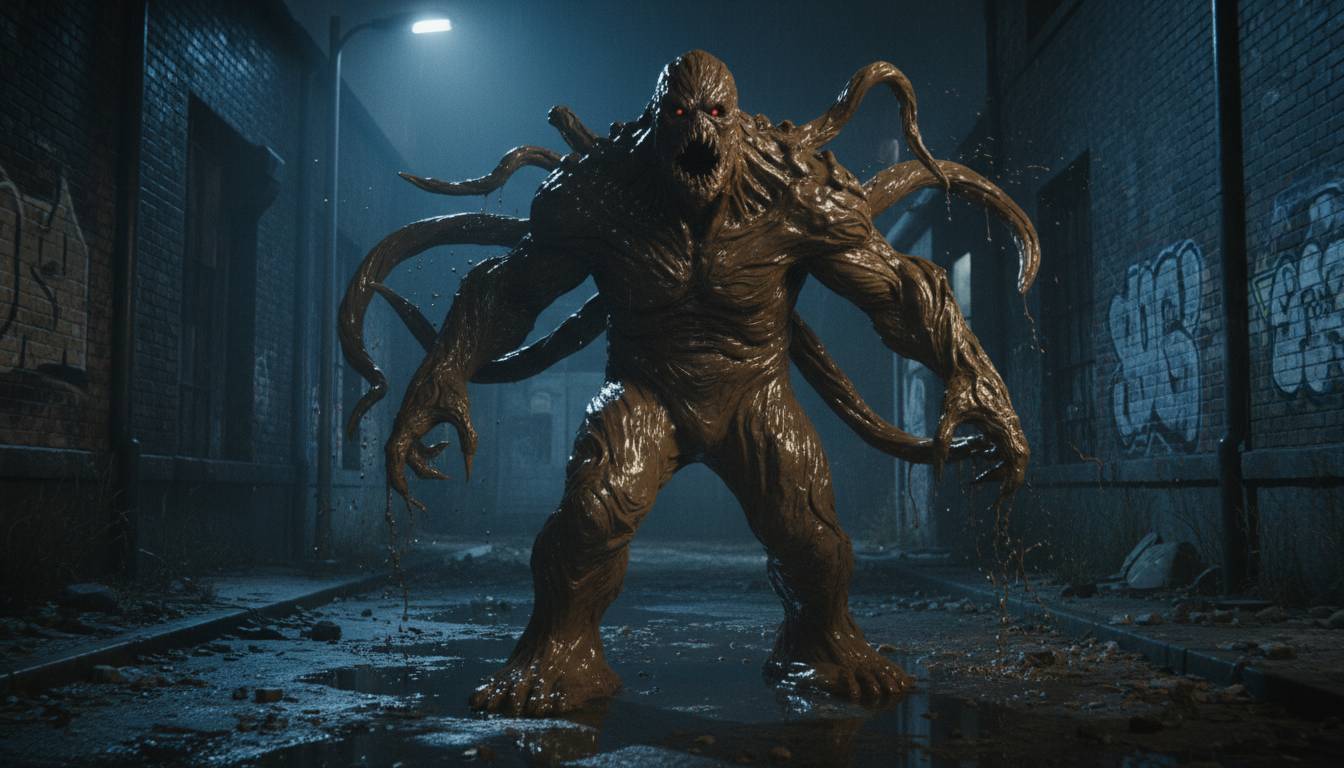
Most fans assume Clayface first reached live-action television decades after Batman’s campy 1960s boom. That is not quite right. The character’s earliest live-action footprint can be traced back to ABC’s Batman, where a one-off villain called False-Face appeared in March 1966 and later became retroactively tied to Basil Karlo’s Clayface in DC’s Batman ’66 continuity. That makes the story stranger, and more interesting, than a simple trivia answer. It is a case of television invention, comic-book reinterpretation, and Batman history folding back on itself.
The forgotten 1966 episode that started the conversation
The key text here is “True or False-Face,” episode 17 of Batman season 1, which first aired on ABC on March 9, 1966, according to episode records on Wikipedia and IMDb. Its second half, “Holy Rat Race,” aired on March 10, 1966. In those episodes, Batman and Robin face False-Face, a master of disguise played by Malachi Throne, with the actor initially credited on screen as a question mark to preserve the gimmick. That detail alone tells you what the show was selling: not a monster made of mud, but a shape-shifting criminal illusion built around masks, impersonation, and theatrical deception.
False-Face was not originally Clayface in the strict comic-book sense. He was presented as his own villain for the TV series, one whose entire hook was disguise. Still, the overlap with Basil Karlo’s earliest comic identity is obvious. When Clayface debuted in Detective Comics #40 in June 1940, he was not yet the later mud-bodied supervillain many viewers know from animation and modern comics. He began as a horror-themed actor turned killer, built around impersonation, makeup, and performance. In that narrower historical sense, False-Face feels much closer to Golden Age Clayface than many people realize.
That is why the 1966 Batman episodes matter. They did not adapt Clayface by name, but they did put a live-action master-of-disguise Batman villain on television at a time when the franchise was still defining how comic-book rogues could work outside the page. For viewers looking at Batman history rather than strict label accuracy, False-Face is the missing link.
Why False-Face is often treated as Clayface’s live-action ancestor
The strongest evidence comes from later DC material. Batman Wiki’s entry on the Dozierverse version of False-Face notes that the character later returned in the Batman ’66 comic series and was identified as Basil Karlo, then transformed into Clayface. Batman Wiki’s page for Batman ’66 Issue #23 goes further, describing False-Face as emerging from a swamp and attacking Batman after becoming “Clayface” with shapeshifting powers. In other words, DC itself eventually closed the loop.
That retroactive move matters because it changes how the 1966 episodes are read. Instead of being a dead-end TV original, False-Face becomes an early live-action expression of the Clayface concept, one that predates later screen versions by decades. It is not the same as saying ABC’s Batman formally introduced comic-book Clayface in 1966. It did not. The episodes call him False-Face, not Clayface. But once DC’s later continuity work identifies that version with Basil Karlo, the historical line becomes hard to ignore.
This is also why the phrase “first live-action appearance” needs care. If someone means the first time a character explicitly named Clayface appeared in live action, that answer points elsewhere. If they mean the earliest live-action appearance of the character concept that DC later folded into Clayface canon, then False-Face from Batman in March 1966 has a strong claim.
What later live-action versions changed
Later adaptations pushed Clayface closer to the version modern audiences know. IMDb trivia for The Batman episode “Artifacts” notes that Clayface appeared in live action on Birds of Prey in 2002, a short-lived series that used the character in a very different era of DC television. Gotham, meanwhile, introduced many Batman villains in proto-form, though not as the classic Basil Karlo Clayface centerpiece that fans often expect. On the animated side, Clayface became far more famous through Batman: The Animated Series and later shows, where the tragic, mutable body-horror version took center stage.
That shift in public memory is part of why the 1966 connection gets overlooked. When people hear “Clayface,” they picture a towering mud creature or a shapeshifter with melting features, not a tuxedoed criminal swapping identities in a brightly lit pop-art Gotham. Yet the character’s publication history supports the comparison. Clayface was not born as a sludge monster. He evolved into one over time through multiple incarnations, including Matt Hagen and later versions that emphasized transformation over theatrical disguise.
So the 1966 Batman series did something unusual: it accidentally preserved an older Clayface-like idea before the broader culture settled on the monster version as definitive. That makes False-Face feel less like a curiosity and more like a historical snapshot of a Batman villain archetype in transition.
Why the episode faded from mainstream Batman memory
Part of the answer is simple. False-Face appeared only once in the original TV run, across a two-part story, while villains like the Joker, Penguin, Catwoman, and Riddler became recurring icons. Cesar Romero, Burgess Meredith, Julie Newmar, and Frank Gorshin dominated the show’s legacy. Malachi Throne’s False-Face did not get that kind of repetition, and Batman nostalgia tends to orbit recurring stars.
There is also a branding problem. “False-Face” sounds adjacent to Batman lore rather than central to it. Fans searching for Clayface history do not always think to look under another name. Even IMDb trivia points out that False-Face is often assumed to have been created specifically for the TV series. That assumption keeps the character siloed as television ephemera instead of being discussed as part of Clayface’s broader adaptation history.
Then there is the issue of canon. Batman continuity is famously elastic. A retroactive comic-book identification does not erase the fact that the 1966 episodes were produced as False-Face stories. Some fans accept the Batman ’66 comic bridge as enough to count this as Clayface’s first live-action appearance. Others treat it as an interesting footnote, not a definitive first. Both positions are understandable. What is not really debatable is that the 1966 series is central to the conversation.
What Batman history tells us about Clayface’s screen legacy
The bigger takeaway is that Batman adaptations rarely move in a straight line. Characters are renamed, recombined, softened for television, darkened for film, then reabsorbed into comics later. False-Face is a perfect example of that process. He began as a TV villain in March 1966, built around disguise and mystery. Decades later, DC-linked reference material and Batman ’66 comics tied him to Basil Karlo and Clayface. That does not just answer a trivia question. It shows how Batman mythology expands by revision as much as by invention.
So, was Clayface’s first live-action appearance in a forgotten Batman TV series? In the most literal naming sense, no, because ABC’s Batman used False-Face. In the broader historical and retroactive continuity sense, very possibly yes. And that is what makes the story worth revisiting. The first live-action shadow of Clayface did not arrive as a CGI creature or prestige-TV villain. It arrived in 1966, under studio lights, wearing another face.
Frequently Asked Questions
Was False-Face officially Clayface in the 1966 Batman series?
No. In the original ABC episodes “True or False-Face” and “Holy Rat Race,” the villain is called False-Face, not Clayface. The connection comes later through Batman ’66 comic continuity and reference material that identify that version with Basil Karlo.
When did False-Face first appear on TV?
False-Face first appeared in “True or False-Face,” which aired on March 9, 1966, as season 1 episode 17 of Batman. The story concluded in “Holy Rat Race” on March 10, 1966.
Who played False-Face in Batman?
Malachi Throne played False-Face. Contemporary episode listings on IMDb and Wikipedia identify him as the guest villain, even though the original on-screen credit used a question mark as part of the disguise gimmick.
Why do some fans say this was Clayface’s first live-action appearance?
They say it because False-Face was later folded into Batman ’66 comic continuity as Basil Karlo, who then becomes Clayface. That retroactive link makes the 1966 TV appearance part of Clayface’s screen history for many readers.
What was Clayface like in the earliest comics?
The original Clayface, Basil Karlo, debuted in Detective Comics #40 in June 1940 as a horror-themed criminal tied to acting, disguise, and murder. He was not yet the mud-bodied monster that later versions popularized.
Did Clayface appear in live action after that?
Yes. Later live-action television used Clayface-related material in other forms, including Birds of Prey in 2002. But the 1966 False-Face episodes remain important because they may represent the earliest live-action version of the core character concept.

View 0 comments