

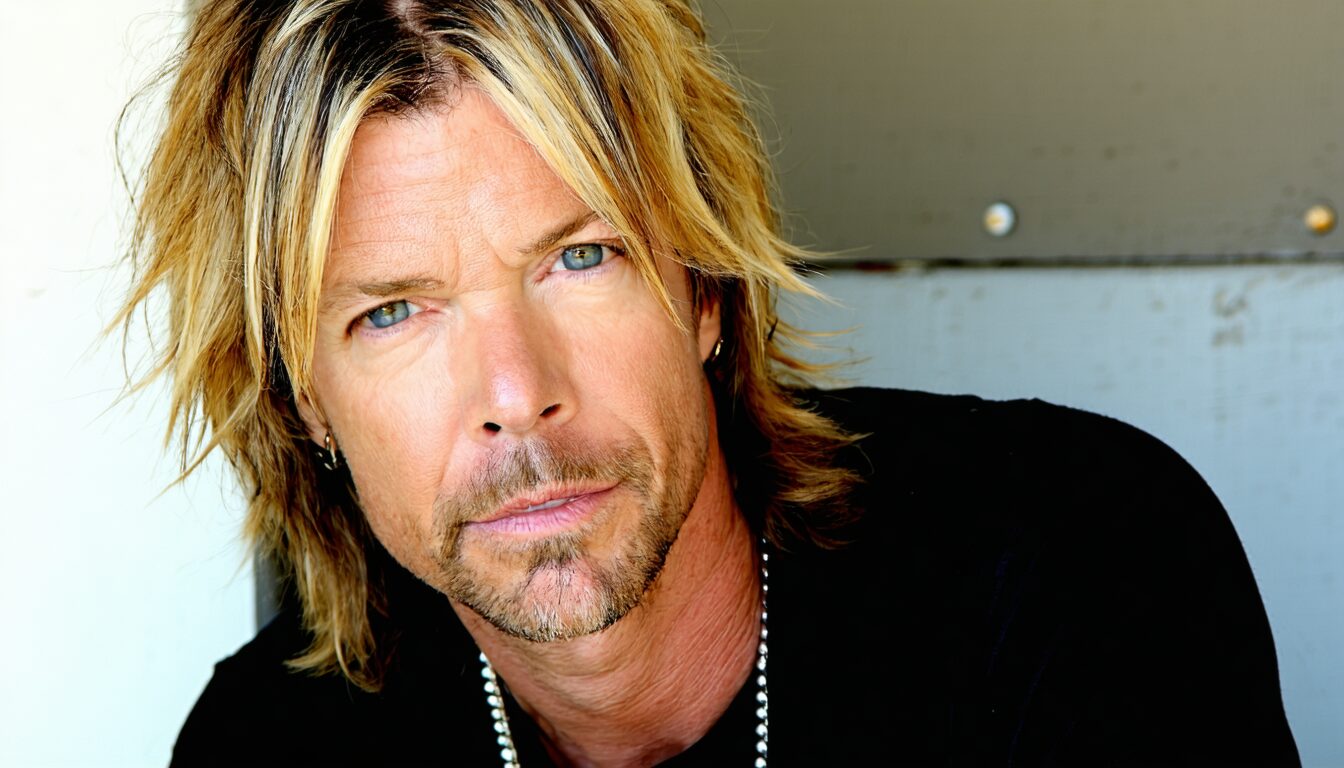
Duff McKagan—Michael Andrew McKagan—is a name entwined with the heart-thumping rise of Guns N’ Roses. Born in Seattle on February 5, 1964, McKagan’s path has been far more than another bassist in a legendary band. His life reads like a mosaic of punk roots, hard rock anthems, personal reinvention, and a commitment to honesty—both on stage and off. This narrative, with its little imperfections and unexpected turns, mirrors the unpredictability of life, especially behind the bass lines.
A Rocky Start: Seattle Punk to Stardom
Growing up as the youngest of eight children, he learned bass from his brother Bruce and soaked in the raw energy of Prince’s 1999 and Black Flag’s Damaged—albums that were pivotal in shaping his early style . By age 15, he was navigating Seattle’s underground with bands like The Vains and The Fartz, embracing punk as more than music—it was a mindset .
By the early ‘80s, he migrated to Los Angeles, juggled odd jobs and auditions, and found kindred spirits in Slash and Steven Adler—thus, the spark that would ignite Guns N’ Roses was lit . In March 1985, destiny clicked when he officially joined the band, and by 1987’s Appetite for Destruction, he had cemented his place in rock history .
Guns N’ Roses: Triumphs and Tensions
The late ’80s and early ’90s were heady. Albums like Appetite for Destruction, G N’ R Lies, and the Use Your Illusion pair shattered sound barriers and sales records—Appetite alone sold millions globally . Yet behind the massive riffs lay internal chaos. The Use Your Illusion tour stretched nearly two and a half years, and by mid-1990s, creative frictions and personal responsibilities forced McKagan to reassess his place within the band .
In 1993, he unveiled Believe in Me, his debut solo album—an effort that may have only landed modest chart numbers, but revealed his songwriting ambitions outside Guns N’ Roses .
Reinvention: Solo Ventures & Supergroups
Leaving Guns N’ Roses in 1997, and newly a father, he sought stability elsewhere . Back in Seattle, he resurrected 10 Minute Warning and launched Loaded, led his own hard rock outfit, and later joined Velvet Revolver with Slash and Matt Sorum. Velvet Revolver’s debut, Contraband, shot to No. 1 and even scored a Grammy—proof that he wasn’t just coasting on past fame, but fueling new creative fires .
Beyond performing, Duff dove into writing, contributing finance columns for Playboy as “Duffonomics,” sports pieces for ESPN, and reflections for Seattle Weekly—each piece a snapshot of his intellectual curiosity and reinvention .
Sobriety, Struggle, and New Soundscapes
Duff’s rock ‘n’ roll excesses nearly killed him; in 1994 he suffered a life-threatening alcohol-induced pancreatitis, a wake-up call that sparked his journey to sobriety .
“I was so fucked up when I made my first solo record… but I couldn’t sing. I had so much cocaine in my throat…”
— on Believe in Me’s raw honesty
Decades later, his vulnerability runs deeper and richer. The 2019 album Tenderness channeled global travels with GNR into reflective rock and Americana, earning praise as one of the best of the year . The 2023 follow-up, Lighthouse, captured a man rooted in hope and survival, shaped by pandemic grief, mental health struggles, and a steady love at home .
Off the Road: Family, Finance & Literature
Duff’s home life anchors him. Married to Susan since 1999, he’s father to two daughters, Grace and Mae, the latter launching a punk-inspired fashion line—proof that creativity flows throughout his family .
After sobriety, he turned to accounting and financial literacy—studying business, consulting musicians through Meridian Rock, and demystifying industry finances through his writing . His passion for literature blossomed as well; interviews from the early 2010s reveal a man rooted in Hemingway and candid discourse .
A Resilient Return to Guns N’ Roses
In 2016, he returned to Guns N’ Roses for the Not In This Lifetime tour—a massive financial and cultural success that pulled him back into the fold and sparked a Rock and Roll Hall of Fame induction in 2012 .
Today, his presence adds a sense of survival and legacy more than swagger—older, reflective, and judged not just by riffs, but what he’s spoken about and how he’s rebuilt. As he said, he’s “absolutely” a survivor—now carrying the weight and responsibility he hopes to pass on, especially to the kids in front of GNR shows that span generations .
Conclusion
Duff McKagan’s story isn’t a straight line—it’s jagged, messy, heartfelt. From Seattle punk to global stages, solo introspection, financial literacy, and mental health advocacy, he’s navigated survival with candor. His recent work—Tenderness, Lighthouse—and his continuing role in Guns N’ Roses show a musician who embraces his complexity, rather than shies from it. For anyone studying artistic longevity or creative rebirth, his journey offers clear steps—and plenty of grit behind them.
FAQs
Who is Duff McKagan?
Michael Andrew “Duff” McKagan is the bassist for Guns N’ Roses, initially joining in 1985. He’s also a solo artist, author, columnist, and financial advisor to musicians .
What solo albums has he released?
Duff has released Believe in Me (1993), Tenderness (2019), and Lighthouse (2023). A second album, Beautiful Disease, remains unreleased due to label issues .
What happened when he left Guns N’ Roses?
He left in 1997 amid creative stagnation and to focus on family life. Afterward he reunited 10 Minute Warning, formed Loaded, and launched Velvet Revolver .
How did he recover from addiction?
After near-death alcohol-induced pancreatitis, Duff embraced sobriety, pursued education in finance, and redirected his energy into health, writing, and mentoring .
Is he active with Guns N’ Roses today?
Yes—he rejoined during the 2016 Not In This Lifetime tour and continues to perform with the band while pursuing solo creative projects .
What else has he done beyond music?
He’s authored two memoirs, penned columns for ESPN and Playboy, advised musicians financially, and become a voice for mental health awareness .

View 0 comments