

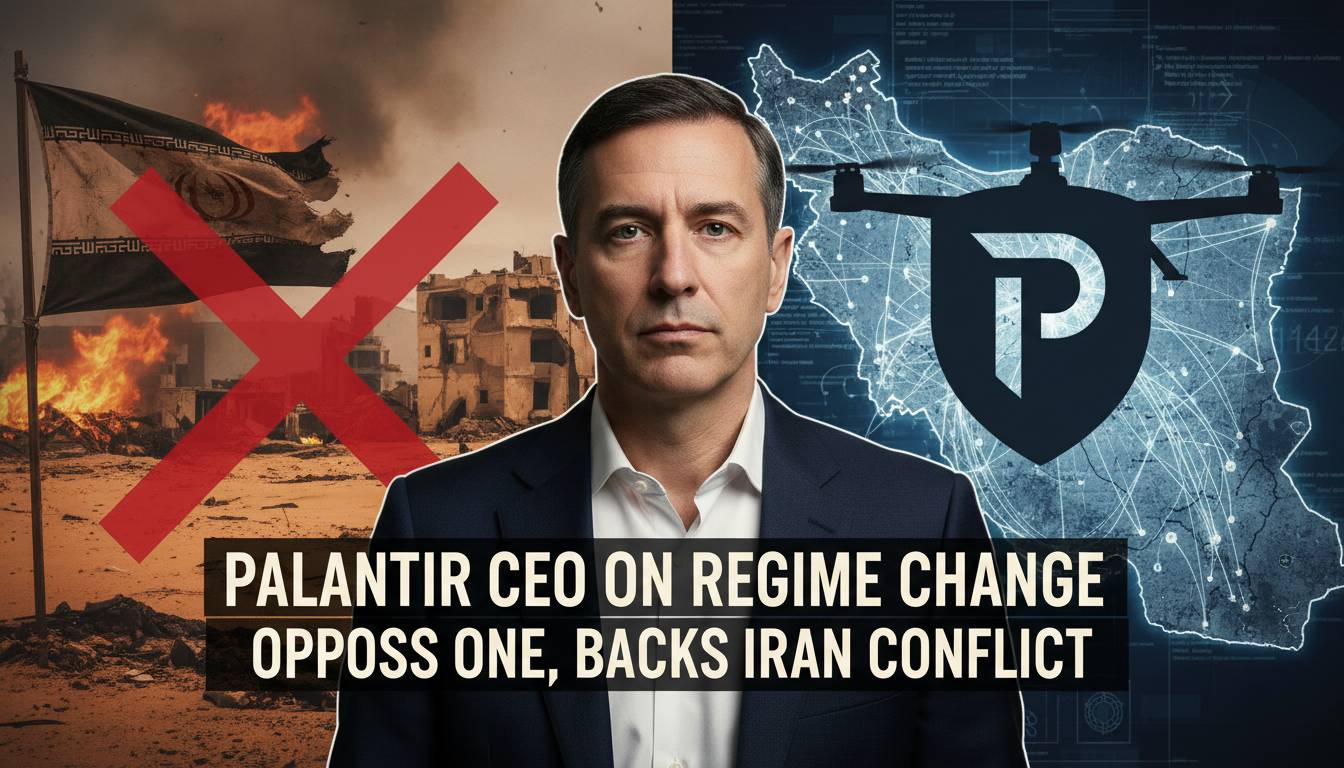
Palantir CEO Alex Karp has again placed himself at the center of a debate over war, technology, and U.S. foreign policy. In recent public remarks and interviews, Karp has argued that he does not support “regime change wars” in the abstract, while also taking a sharply hawkish line on Iran and defending the use of Western military power against U.S. adversaries. His position has drawn scrutiny because Palantir is not only a major software company, but also one of the most prominent defense technology firms serving the U.S. government and allied militaries.
The controversy matters beyond one executive’s rhetoric. Palantir’s business has expanded rapidly through government contracts, and Karp has increasingly framed the company’s mission in civilizational terms, arguing that Western democracies must build stronger military and intelligence capabilities. That message resonates with some investors and national security officials, but it also raises questions about how defense contractors shape public debate on war, deterrence, and intervention.
Why Alex Karp’s Comments Are Drawing Attention
Karp has long presented Palantir as a company built to support the United States and its allies. In a New York Times profile cited by other outlets, he said the United States would “very likely” face a three-front conflict involving China, Russia, and Iran, and argued that frightening adversaries is an appropriate strategic goal. Axios later reported that Palantir hired former Congressman Mike Gallagher, noting Karp’s warning about a possible future war involving those three countries.
He has also been explicit that Palantir is willing to work on military and intelligence missions that many Silicon Valley firms avoid. In a 2022 CNBC interview about Ukraine, Karp said the war was forcing countries to rethink defense priorities and argued that software would play a central role in modern conflict. In a separate profile, he said critics of Palantir’s worldview effectively favored appeasing Iran, Russia, and China.
Those statements have become more politically sensitive as tensions involving Iran have remained a major issue in U.S. national security debates. The phrase “Palantir CEO Insists He Doesn’t Support Regime Change Wars (But Supports Iran War)” captures the contradiction critics see: opposition to open-ended nation-building campaigns on one hand, and support for military confrontation with Iran on the other. That distinction is not unique to Karp, but his role as the head of a defense-focused software company gives it unusual weight.
Palantir CEO Insists He Doesn’t Support Regime Change Wars (But Supports Iran War)
The core issue is how Karp defines the difference between a “regime change war” and a justified conflict. Publicly available reporting shows that he has consistently argued for a muscular Western response to adversaries and has spoken in favor of military strength, deterrence, and battlefield technology. At the same time, he has not framed every conflict as a democracy-building project. Instead, his rhetoric tends to focus on defeating threats and preserving Western power.
That framing helps explain why critics say his position amounts to backing war with Iran while rejecting the label of regime change. If a conflict is justified as deterrence, defense, or strategic necessity, supporters can argue it is not the same as the Iraq-style interventions that came to define the phrase “regime change war.” But opponents counter that a major war with Iran would almost inevitably carry regime-change implications, whether or not leaders used that language at the outset. This is an inference based on the scale and likely consequences of such a conflict, rather than a direct quote from Karp.
Karp’s broader public posture reinforces that interpretation. He has defended Israel forcefully, saying in a March 2024 CNBC interview that some employees had left Palantir because of his outspoken pro-Israel views and that he expected more departures. He said that if a position never costs a leader anything, it is not really a position.
Palantir’s Expanding Government Footprint
The debate over Karp’s comments is amplified by Palantir’s growing role in government technology. According to Palantir’s 2025 annual report, revenue increased by $1.6 billion, or 56%, from 2024, while revenue from government customers increased by $832.7 million, or 53%. In its Q4 2025 earnings release filed with the SEC, the company said U.S. government revenue rose 66% year over year to $570 million for the quarter.
Associated Press reported in August 2025 that Palantir recorded its first $1 billion sales quarter and raised full-year guidance to roughly $4.14 billion to $4.15 billion. The same report said the quarter was fueled in part by a 53% jump in government sales. These figures underscore why Karp’s geopolitical statements are watched closely: Palantir is not a commentator on the sidelines, but a company deeply embedded in the national security and defense procurement system.
Recent contract news has added to that attention. Reporting in February 2026 said the Department of Homeland Security entered into a five-year agreement worth up to $1 billion to expand AI tools and data analytics across multiple agencies. While contract details and implementation can evolve, the headline figure reflects the scale of Palantir’s current government business.
Key numbers shaping the debate
- Palantir’s 2025 revenue rose 56% year over year.
- Government customer revenue increased 53% in 2025.
- U.S. government revenue reached $570 million in Q4 2025, up 66% year over year.
- AP reported Palantir’s first $1 billion sales quarter in August 2025.
- A reported DHS agreement in February 2026 carried a ceiling value of up to $1 billion over five years.
Supporters See Strategic Clarity, Critics See Dangerous Ambiguity
Supporters of Karp’s position argue that he is articulating a doctrine of deterrence, not adventurism. They point to his repeated insistence that Palantir’s work helps democratic governments respond faster, target more accurately, and potentially prevent larger wars. Axios reported in November 2025 that Karp said “the most important thing Palantir does is prevent war,” even as he urged the United States to accept more risk in the AI race with China.
From that perspective, a hard line on Iran is consistent with a belief that adversaries must be deterred before conflict becomes unavoidable. According to Karp’s public comments cited by multiple outlets, he sees the geopolitical contest with Iran, Russia, and China as part of a broader struggle over Western security and technological leadership.
Critics, however, argue that this language blurs the line between deterrence and escalation. A defense executive who publicly endorses confrontational policies toward a U.S. adversary may be seen as normalizing war while benefiting from the expansion of military and intelligence spending. That criticism is sharpened by Palantir’s role in supplying software to defense, intelligence, and homeland security agencies.
According to CNBC, Karp has accepted that his political and geopolitical positions can alienate employees. That willingness to absorb internal backlash may strengthen his image among supporters, but it also reinforces the perception that Palantir’s leadership sees ideological conflict as part of its corporate identity.
What This Means for Investors, Policymakers, and the Tech Sector
For investors, the issue is partly reputational and partly strategic. Palantir’s growth has been driven by both commercial AI demand and a surge in government business. Karp’s outspoken worldview may help differentiate the company in Washington, where alignment with national security priorities can be commercially valuable. But it can also expose the company to political controversy, employee activism, and public criticism.
For policymakers, the bigger question is whether defense technology leaders are becoming more influential voices in foreign policy debates. Palantir is part of a broader shift in which software, AI, and data integration are central to military planning and battlefield operations. As that shift accelerates, executives like Karp are likely to play a larger role in shaping how threats are described and how responses are justified.
For the wider tech sector, Karp’s stance marks a clear break from the older Silicon Valley instinct to distance companies from military work. He has repeatedly argued that technology firms should support democratic states and their armed forces, even when that position is unpopular inside the industry. That message has helped make Palantir a symbol of a more openly nationalist and defense-oriented model of tech leadership.
Conclusion
The debate around “Palantir CEO Insists He Doesn’t Support Regime Change Wars (But Supports Iran War)” reflects a larger tension in U.S. politics and business: how to distinguish deterrence from intervention, and strategy from escalation. Alex Karp has built Palantir around the idea that software and AI should strengthen the West against its adversaries. His comments on Iran fit that worldview, even if they appear inconsistent with a stated rejection of regime change wars.
What makes the issue especially significant is Palantir’s scale and influence. This is not simply a CEO offering abstract geopolitical opinions. It is the head of a fast-growing defense technology company whose government business is expanding rapidly and whose products are increasingly tied to national security operations. As U.S. debates over Iran, military power, and AI continue, Karp’s words are likely to remain under close scrutiny.
Frequently Asked Questions
Who is the Palantir CEO discussed in this article?
The executive is Alex Karp, co-founder and chief executive officer of Palantir Technologies. He has led the company since its early years and is one of its most visible public voices.
What is the controversy over his comments?
The controversy centers on the apparent tension between rejecting “regime change wars” as a concept while supporting a hard-line or potentially military approach toward Iran. Critics argue those positions may be difficult to separate in practice.
Why do Karp’s views matter so much?
They matter because Palantir is a major supplier of software to U.S. government, defense, and intelligence customers. The company’s government revenue has grown quickly, making Karp’s geopolitical statements more consequential than those of a typical tech CEO.
Is Palantir mainly a government contractor?
Palantir serves both government and commercial customers, but government business remains a major part of its operations. Its 2025 annual report said government customer revenue increased 53% year over year.
Has Karp taken other controversial foreign policy positions?
Yes. He has publicly defended military work, strongly backed Israel, and argued that the United States and its allies must confront adversaries such as Iran, Russia, and China from a position of strength.
Does Karp say Palantir’s technology promotes war?
Karp has argued the opposite, saying Palantir’s work helps prevent war by improving deterrence and decision-making. Critics dispute that framing, but it is central to his public defense of the company’s mission.

View 0 comments