

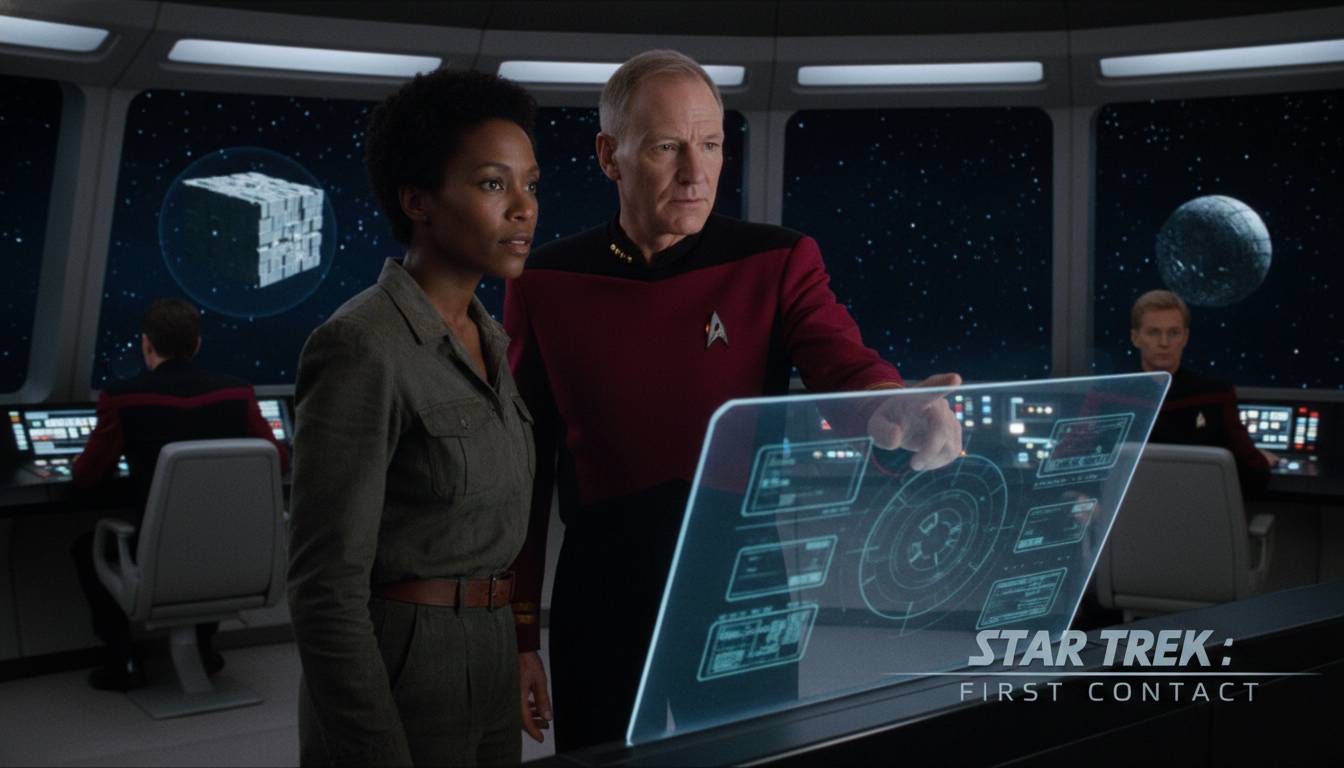
James Cromwell did not take Star Trek: First Contact just because it was a major studio science-fiction film. He took it because the material touched a subject that had already captured his attention off screen: extraterrestrial life. That detail gives his performance as Zefram Cochrane a different weight. It was not only another acting job. It was a role tied to ideas he had explored in real life, and that connection helps explain why Cochrane feels so unusually grounded in the 1996 film.
Why James Cromwell’s casting matters more than fans usually realize
Star Trek: First Contact opened in 1996 and centered on one of the most important events in franchise history: humanity’s first warp flight and first meeting with the Vulcans. IMDb’s film listing identifies Cromwell as the actor who played Zefram Cochrane, the scientist whose Phoenix flight triggers that historic encounter. That much is familiar to most fans. What is more interesting is why Cromwell wanted in.
Cromwell had already appeared in the Star Trek universe before First Contact. ScreenRant’s coverage of his Trek history notes that he had played other unrelated characters in The Next Generation and Deep Space Nine before landing Cochrane. So this was not a case of a newcomer simply joining a famous franchise for exposure. He already knew the world. He already understood the tone. When he stepped into First Contact, he was doing so with prior Trek experience and with a personal curiosity about extraterrestrial questions that made the story more appealing than a standard genre assignment.
That distinction matters because Cochrane is not written as a polished hero. He is messy, skeptical, funny, reluctant, and a little overwhelmed by his own place in history. A performer who had spent time thinking about whether intelligent life exists beyond Earth was well positioned to play a man standing on the edge of humanity’s first verified alien encounter. It gives the role an extra layer. Cromwell was not just pretending to confront the unknown. He was portraying a threshold he had apparently thought about in real life.
The real-life extraterrestrial angle behind the role
The key hook is simple: Cromwell was interested in extraterrestrial studies outside the movie, and that interest helped draw him to First Contact. That makes him a particularly fitting choice for Cochrane, because the film is not only about time travel or the Borg. At its core, it is about the moment human civilization realizes it is not alone.
That idea sits at the center of the movie’s final movement. According to IMDb’s FAQ summary for the film, the plot follows the Enterprise crew as they protect Cochrane’s warp test because that flight leads directly to Earth’s first contact with alien life. ScreenRant also emphasizes the historical importance of that event in Trek canon, noting that Cochrane’s successful warp flight on April 5, 2063 leads to the Vulcan meeting that changes human history. In other words, the movie’s emotional payoff is not merely the launch. It is the extraterrestrial encounter that follows.
For an actor already fascinated by alien-life studies, that is a strong reason to sign on. It is one thing to appear in a science-fiction action movie. It is another to play the human being whose actions open the door to interstellar civilization. Cromwell’s personal interest aligns almost perfectly with the film’s central philosophical question: what happens when humanity crosses from speculation into proof?
That alignment is probably why his performance never feels like broad genre parody, even though Cochrane gets some of the film’s funniest scenes. He plays the character as a man who is not fully prepared for the myth built around him. That tension works because First Contact treats alien contact as awe-inspiring, disruptive, and deeply human all at once.
How First Contact uses Cochrane differently from earlier Star Trek lore
Zefram Cochrane was not invented for the 1996 film. IMDb’s FAQ page notes that the character had been introduced much earlier in Star Trek: The Original Series episode “Metamorphosis” in 1967. But First Contact recontextualized him for a new era. Instead of an already legendary figure seen from a distance, the movie presents him at the fragile moment before history hardens into myth.
That is where Cromwell’s casting becomes especially effective. He does not play Cochrane as a saintly visionary. He plays him as a brilliant but imperfect man who stumbles into immortality. ScreenRant’s retrospective on hidden details in the movie points out that the producers specifically turned to the acclaimed actor for this pivotal role. Looking back, that choice seems obvious. Cochrane needed warmth, intelligence, and unpredictability. Cromwell brought all three.
The extraterrestrial-studies angle strengthens that reading. An actor with genuine curiosity about alien life would likely understand that first contact is not just a plot device. It is a civilizational rupture. In First Contact, the Vulcan arrival is quiet, almost intimate. There is no giant battle. No speechifying. Just a landing, an approach, and a handshake. ScreenRant’s discussion of Solkar, the Vulcan who appears at the end of the film, underlines how important that moment is to the wider Star Trek timeline. It is the hinge on which the future turns.
Cromwell had to sell the human side of that hinge. He had to make viewers believe that this flawed, half-drunk, uncertain inventor could still be the man who changes everything. He does.
Why this behind-the-scenes detail changes the way the performance plays
Knowing that Cromwell was drawn to the project because of his real-life interest in extraterrestrial studies does not rewrite the movie, but it does sharpen it. It explains why his Cochrane feels so invested in the unknown without becoming melodramatic. The performance has curiosity in it. Not just fear. Not just comic disbelief. Curiosity.
That is important because First Contact works best when it balances spectacle with wonder. The Borg storyline gives the film urgency and danger, but Cochrane gives it perspective. He represents the ordinary human being standing at the edge of an extraordinary future. If the actor playing him had approached the role as just another eccentric scientist, the ending might not land as powerfully. Because Cromwell had a real-world fascination with extraterrestrial questions, the role seems to have met him halfway.
It also fits the broader appeal of Star Trek. The franchise has always been about more than ships and battles. It is about contact, discovery, and the moral consequences of learning that the universe is larger than human assumptions. An actor who already cared about extraterrestrial possibilities was stepping into one of the purest expressions of that theme.
What makes this one of First Contact’s best casting stories
Hollywood is full of casting anecdotes, but this one stands out because it is not just trivia. It connects directly to the movie’s meaning. Cromwell joined a film about humanity meeting alien life because he had his own real-life interest in extraterrestrial studies. That is not a random coincidence. It is a rare case in which an actor’s off-screen curiosity mirrors the exact idea at the heart of the character.
First Contact remains one of the most admired Star Trek films because it understands scale. It can move from Borg horror to character comedy to cosmic hope without losing focus. Cromwell is a major reason that balance holds. His Cochrane is funny, nervous, selfish, inspired, and finally unforgettable. Once fans know why the role appealed to him, the performance makes even more sense.
Frequently Asked Questions
Which Star Trek: First Contact actor joined because of alien studies?
James Cromwell is the actor tied to that behind-the-scenes detail. He played Zefram Cochrane in Star Trek: First Contact, and his real-life interest in extraterrestrial studies is what made the project especially appealing.
Who does James Cromwell play in Star Trek: First Contact?
Cromwell plays Zefram Cochrane, the scientist who completes humanity’s first warp flight. In Star Trek lore, that achievement leads directly to first contact with the Vulcans and helps launch the future seen across the franchise.
Was James Cromwell new to Star Trek when he made First Contact?
No. He had already appeared in Star Trek before First Contact. ScreenRant notes that he previously played other characters in The Next Generation and Deep Space Nine before taking on the much larger role of Cochrane.
Why is Zefram Cochrane so important in Star Trek history?
Cochrane is central because his warp flight creates the conditions for Earth’s first contact with alien life. That moment becomes one of the foundational events in the Star Trek timeline and eventually leads toward the Federation era.
Did Zefram Cochrane exist in Star Trek before the 1996 movie?
Yes. The character appeared earlier in Star Trek: The Original Series. First Contact did not invent him, but it reintroduced him in a much more immediate and human way by showing the historical event that made him famous.
Why does this casting fact matter to fans?
It matters because it adds context to Cromwell’s performance. Knowing he had a real interest in extraterrestrial questions makes his portrayal of the man at the center of humanity’s first alien encounter feel even more fitting and memorable.


View 0 comments