

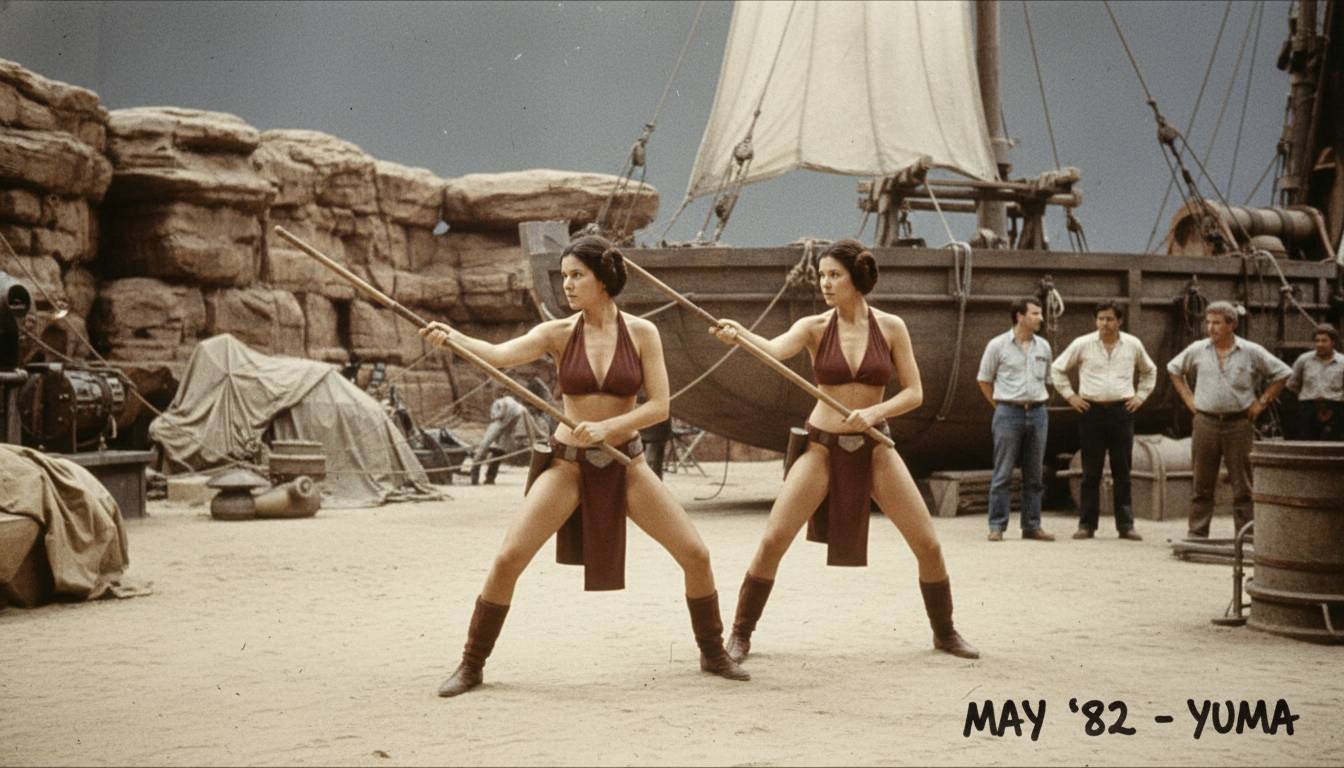
Return of the Jedi remains one of the most closely studied films in the Star Wars saga, yet Lucasfilm’s archive still turns up production images that feel fresh decades later. Behind-the-scenes galleries and archival features published by StarWars.com show candid moments from the 1982–1983 production, from creature work and effects planning to on-set staging, offering a clearer view of how the film’s practical craftsmanship came together.
📊
Lucasfilm continues to surface archival production material from Episode VI.
StarWars.com’s official “Return of the Jedi: Behind the Scenes” gallery presents behind-the-scenes photos from Episode VI, while related archive features and oral-history excerpts add production context from Lucasfilm’s own records.
1983’s finale still yields new production context
Star Wars: Episode VI – Return of the Jedi was released in 1983 as the concluding chapter of the original trilogy. What keeps the film historically valuable is not only its place in franchise history, but the scale of its production methods. Official Lucasfilm archive material shows a movie built through practical creature effects, miniatures, matte paintings, optical compositing, and extensive set work rather than digital pipelines.
That is why unseen or lesser-known filming photos matter. They do more than satisfy nostalgia. They document process. In official behind-the-scenes material, viewers can trace how performers, puppeteers, model makers, and visual-effects teams translated concept art and storyboards into finished scenes. For a film that includes Jabba’s Palace, the speeder bike chase, the forest moon of Endor, and the second Death Star battle, production stills reveal how many departments had to work in sequence for the final cut to function.
Verified Archive Points on Return of the Jedi
| Item | Verified detail | Source type |
|---|---|---|
| Official gallery | “Return of the Jedi: Behind the Scenes” is hosted by StarWars.com | Lucasfilm official site |
| Archive access | J.W. Rinzler was described by StarWars.com as having unprecedented access to Lucasfilm archives | Lucasfilm official feature |
| Effects scale | StarWars.com reported more than 500 special-effects scenes and 3,000 elements for the film | Lucasfilm official archive feature |
| Jabba context | StarWars.com published an oral-history excerpt focused on Jabba’s Palace production | Lucasfilm official feature |
Source: StarWars.com archival pages and features, accessed March 19, 2026.
Why archive photos from Jabba’s Palace carry unusual weight
Among the most revealing production images tied to Return of the Jedi are those connected to Jabba’s Palace. Lucasfilm’s official excerpt from Star Wars: The Skywalker Saga – The Official Collector’s Edition underscores how labor-intensive those scenes were, with puppeteers, performers, makeup teams, and creature technicians all contributing to the final environment. That makes still photography from the set especially useful: a single frame can show multiple practical techniques operating at once.
Jabba himself is central to that story. The palace scenes were not built around a digital centerpiece added later. They were staged around physical performance and mechanical effects. When archive photos capture the set between takes, they often expose scale, lighting rigs, operator positions, and the density of creature design in ways the finished film does not. For film historians, that is the value of these images: they preserve evidence of method, not just memory.
Production and Archive Timeline
1983: Return of the Jedi reaches theaters as Episode VI of the original trilogy.
July 23, 2012: StarWars.com introduces J.W. Rinzler and says he had unusual access to Lucasfilm archives while working on The Making of Return of the Jedi.
May 6, 2021: StarWars.com publishes an official excerpt focused on the behind-the-scenes story of Jabba’s Palace.
2026: Official StarWars.com archive pages continue to host behind-the-scenes image galleries from Episode VI.
3,000 effects elements explain why these images matter
One of the strongest data points in Lucasfilm’s own archive coverage is the scale of the film’s visual-effects workload. In a StarWars.com feature on a vintage Return of the Jedi poster magazine, the site says the movie involved 3,000 elements shot for more than 500 special-effects scenes, described there as the largest such effort in history at the time. That figure gives behind-the-scenes photography a second function: it helps map the industrial complexity behind the movie’s spectacle.
Photos from model shops, effects stages, and planning sessions are not filler. They are records of a production system that relied on physical assets at every stage. The second Death Star battle, for example, depended on miniature photography, optical compositing, and tightly coordinated shot design. StarWars.com’s behind-the-scenes hub also includes material on the film’s “moving storyboard,” with visual-effects veteran Ken Ralston discussing the previsualization approach used for the climactic attack. In that context, still photos become evidence of workflow.
💡
The archive images are most valuable when they show process, not just cast candids.
Official Lucasfilm material links Episode VI to large-scale miniature work, creature effects, and previsual planning, making production stills a practical record of how the film was built.
How J.W. Rinzler helped frame the search for lost material
Any discussion of unseen Return of the Jedi production photos also runs through the work of J.W. Rinzler. StarWars.com said in 2012 that Rinzler had “unprecedented” access to Lucasfilm archives while preparing The Making of Return of the Jedi. That matters because archive discoveries rarely appear in isolation. They are usually the result of cataloging, editorial selection, and historical verification.
StarWars.com’s later remembrance of Rinzler reinforces that role, describing his work uncovering “Lost Interviews” and documenting his broader contribution to Lucasfilm publishing. In practical terms, that archival culture is part of why fans still see unfamiliar production images emerge years after a film’s release. The photos are compelling on their own, but their credibility comes from provenance: official archive custody, editorial context, and identifiable production history.
What the unseen photos add to the film’s legacy in 2026
In 2026, the appeal of unseen Return of the Jedi filming photos is not simply that they are rare. It is that they sharpen understanding of a major studio production made at the high point of analog effects filmmaking. Official Lucasfilm galleries and archive features show a movie assembled through departments that had to solve physical problems in real space: creature movement, miniature scale, matte integration, and complex optical layering.
For readers, the best images are the ones that reveal those solutions. A candid frame from Jabba’s Palace can show the density of practical creature work. A model-shop image can clarify how the space battle was engineered. A set photo from Endor can expose blocking and camera placement. Taken together, these archive photos do not revise the film’s history so much as deepen it. They make visible the labor that the finished movie was designed to hide.
Frequently Asked Questions
Are these Return of the Jedi photos officially sourced?
Yes. The most reliable source is StarWars.com, Lucasfilm’s official site, which hosts a dedicated “Return of the Jedi: Behind the Scenes” gallery and related archival features. That official provenance matters because it ties the images to Lucasfilm’s own archive and editorial review, accessed March 19, 2026.
Why do behind-the-scenes photos from this film matter so much?
They document practical filmmaking methods used at scale. StarWars.com’s archive material says the film involved more than 500 special-effects scenes and 3,000 elements, which means production stills can reveal how miniatures, puppets, sets, and optical effects were coordinated on a pre-digital blockbuster.
What part of the film is most illuminated by archive photos?
Jabba’s Palace stands out because official Lucasfilm material describes it through oral-history accounts involving performers and puppeteers. Photos from those scenes often show multiple practical effects techniques in one frame, making them especially useful for understanding how the sequence was staged and operated.
Who was J.W. Rinzler, and why is he relevant here?
J.W. Rinzler was a Lucasfilm author and historian. StarWars.com said in 2012 that he had unusual access to the company’s archives while working on The Making of Return of the Jedi. His archival work helped preserve and contextualize production materials, including lesser-known photos and interviews.
Do these photos change what fans know about the movie?
Usually they add detail rather than overturn established history. The strongest value is production insight: they show how scenes were physically built, lit, and performed. For a film known for creature effects and miniature work, that added context can materially improve historical understanding of the production.
Disclaimer: This article is for informational purposes only. Information may have changed since publication. Always verify information independently and consult qualified professionals for specific advice.

View 0 comments