

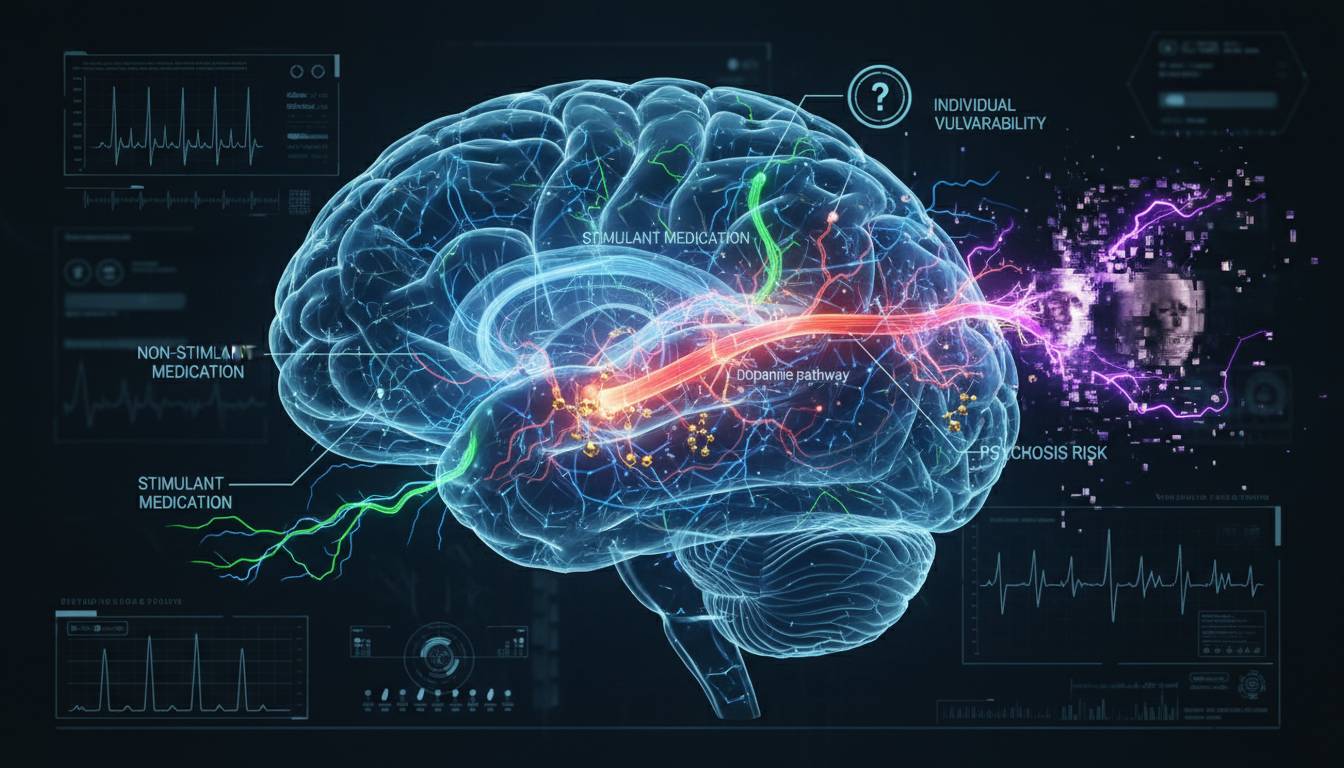
A growing body of research is narrowing an important question for patients, parents, and clinicians: do common ADHD medicines themselves raise psychosis risk, or is the signal concentrated in specific drugs and doses? Evidence published through 2025 points to a more nuanced answer. Several large studies and a 2025 review suggest methylphenidate, the stimulant sold in products such as Ritalin and Concerta, does not show the same psychosis signal seen with amphetamine-based stimulants, while the absolute risk of severe psychotic events after starting any ADHD medication remains low.
💡
Key finding:
Across multiple recent studies, methylphenidate is not consistently linked to a higher risk of psychosis, while amphetamine formulations show a stronger association in several datasets. Sources: PubMed, American Journal of Psychiatry, and a 2025 review indexed online, accessed March 25, 2026.
2025 Review Data Shifted the Debate
The strongest reason this story is back in focus is a 2025 systematic review and meta-analysis that assessed whether stimulant treatment in ADHD is associated with later psychosis or bipolar disorder. The review, indexed online with a March 9, 2025 publication date, reported that amphetamines carried a higher psychosis risk than methylphenidate, with odds about 1.6 times greater in the summary cited by the source page. That matters because older public discussion often treated “stimulants” as one category, even though newer evidence increasingly separates methylphenidate from amphetamine products.
That distinction is consistent with earlier observational work. A population-based cohort study on methylphenidate in adolescents and young adults found no clear increase in psychotic events after treatment initiation in the overall analysis. A 2024 clinical review also stated that current evidence does not support a causal link between ADHD medication and psychosis, at least for methylphenidate. Those are not identical study designs, but they point in the same direction.
What the Recent Evidence Shows
| Study | Population | Main finding |
|---|---|---|
| 2025 systematic review/meta-analysis | Studies searched through Oct. 1, 2024 | Amphetamines showed higher psychosis risk than methylphenidate |
| 2024 AJP case-control study | Hospitalized psychiatric patients | Amphetamine use linked to higher odds of psychosis/mania vs methylphenidate |
| Population cohort on methylphenidate | Adolescents and young adults | No clear increase in psychotic events after methylphenidate initiation |
| 2025 adult cohort | 16,125 adults starting ADHD medication | First-onset psychosis/mania hospitalization within 1 year was 0.38% |
Source: PubMed, PMC, and indexed review pages | Accessed March 25, 2026
0.38% in Adults Puts the Severe-Event Risk in Context
One of the most useful recent numbers comes from a nationwide adult cohort study published in the past year. Among 16,125 adults who started methylphenidate, amphetamine derivatives, or atomoxetine, 61 people were hospitalized for first-onset psychosis or mania within a year, equal to 0.38%. In plain terms, severe events requiring hospitalization were uncommon across the full treated population.
Yet the same study found the risk was almost twofold among people prescribed lisdexamfetamine or dexamphetamine compared with methylphenidate. That relative difference is important. It suggests the headline question is not whether every ADHD drug carries the same psychiatric risk, but which medicines appear to contribute more to it and in whom.
A separate 2024 case-control study in the American Journal of Psychiatry sharpened that point further. After adjustment for dose and other factors, prescription amphetamine use was associated with higher odds of psychosis or mania than methylphenidate, with an adjusted odds ratio of 2.85 among people with past-month stimulant use. The same source summary reported no association between methylphenidate and psychotic or manic episodes in that analysis.
How the Evidence Evolved
2007: The FDA added warnings to prescription stimulant labels about psychotic or manic symptoms, according to Psychiatric News coverage summarizing the regulatory backdrop.
2019 and earlier data: Population-based methylphenidate research found no strong signal of increased psychosis after treatment initiation in adolescents and young adults.
September 12, 2024: An American Journal of Psychiatry study reported higher odds of psychosis or mania with prescription amphetamines versus methylphenidate.
March 9, 2025: A systematic review and meta-analysis reinforced the drug-class split, citing higher psychosis risk with amphetamines than methylphenidate.
Why Amphetamine and Methylphenidate Are No Longer Treated as One Risk Category
The mechanism question is still being studied, but the clinical pattern is becoming clearer. Methylphenidate and amphetamine-based stimulants both treat ADHD, yet they act differently enough that pooled safety conclusions can blur meaningful differences. The WHO pharmacovigilance analysis indexed on PubMed found amphetamine use was associated with higher reporting of psychotic symptoms than methylphenidate use in adolescents and adults, especially in patients with ADHD.
That does not prove causation on its own, because spontaneous safety-report databases are vulnerable to reporting bias. Still, when pharmacovigilance findings line up with case-control and cohort data, the pattern becomes harder to dismiss. The 2025 review, the 2024 hospital-based study, the adult cohort, and the earlier methylphenidate cohort all point toward the same practical distinction: the psychosis signal appears stronger for amphetamines than for methylphenidate.
ℹ️
Context matters:
People with ADHD already have a higher baseline risk of psychotic disorders than people without ADHD, independent of medication exposure, according to a 2024 clinical review. That makes careful study design essential when interpreting drug safety signals.
What Clinicians and Families Should Take From the 2024-2025 Data
The first takeaway is that absolute risk appears low, especially for severe outcomes such as hospitalization. The second is that relative risk may still differ meaningfully by drug class and dose. In the 2024 American Journal of Psychiatry study, higher amphetamine doses were associated with greater odds of psychosis or mania, while methylphenidate did not show the same association in the reported findings.
The third is that nonstimulants are not automatically risk-free. A 2024 study of 5,171 youth receiving ADHD medications found an elevated risk of newly diagnosed psychotic symptoms with atomoxetine exposure, particularly when combined with stimulant classes. That finding does not overturn the broader methylphenidate story, but it does show why medication choice should be individualized rather than reduced to “stimulant versus nonstimulant.”
Separately, a large nationwide cohort reported that ADHD medications were associated with decreased risk of psychiatric hospitalization, suicidal behavior, and some nonpsychiatric hospitalizations during medicated periods compared with nonuse periods. That broader benefit-risk context matters because untreated ADHD also carries measurable harms.
Frequently Asked Questions
Does methylphenidate cause psychosis?
Recent evidence does not show a consistent causal link. A population-based cohort study in adolescents and young adults found no clear increase in psychotic events after methylphenidate initiation, and a 2024 clinical review stated that current evidence does not support a causal link for methylphenidate. Sources accessed March 25, 2026.
Which ADHD medicines show the stronger psychosis signal?
Amphetamine-based stimulants show the stronger signal in several recent studies. A 2025 review reported higher psychosis risk with amphetamines than methylphenidate, and a 2024 case-control study found higher adjusted odds of psychosis or mania with prescription amphetamines versus methylphenidate.
How common are severe psychotic events after starting ADHD medication?
In one nationwide adult cohort, 61 of 16,125 new users were hospitalized for first-onset psychosis or mania within one year, or 0.38%. That suggests severe events are uncommon, though risk is not identical across drug classes.
Are nonstimulant ADHD drugs free of psychosis risk?
No. A 2024 youth cohort found an increased risk of newly diagnosed psychotic symptoms with atomoxetine exposure, especially when combined with methylphenidate, amphetamine, or both. That means nonstimulant treatment still requires monitoring.
Why has this issue been hard to study?
ADHD itself is associated with a higher baseline risk of psychotic disorders, according to a 2024 review. That makes it difficult to separate the effect of the condition from the effect of the medication without large, carefully controlled studies.
Conclusion
The newer evidence does not erase concern about psychosis and ADHD treatment, but it does refine it. The best-supported reading of the 2024-2025 literature is that methylphenidate may not carry the same psychosis risk profile as amphetamine-based stimulants, and severe events remain uncommon overall. For clinicians and families, that is a meaningful shift: the question is no longer whether all common ADHD medicines raise psychosis risk equally, but which drugs, doses, and patient profiles warrant the closest monitoring.
Disclaimer: This article is for informational purposes only. Information may have changed since publication. Always verify information independently and consult qualified professionals for specific medical advice.

View 0 comments