

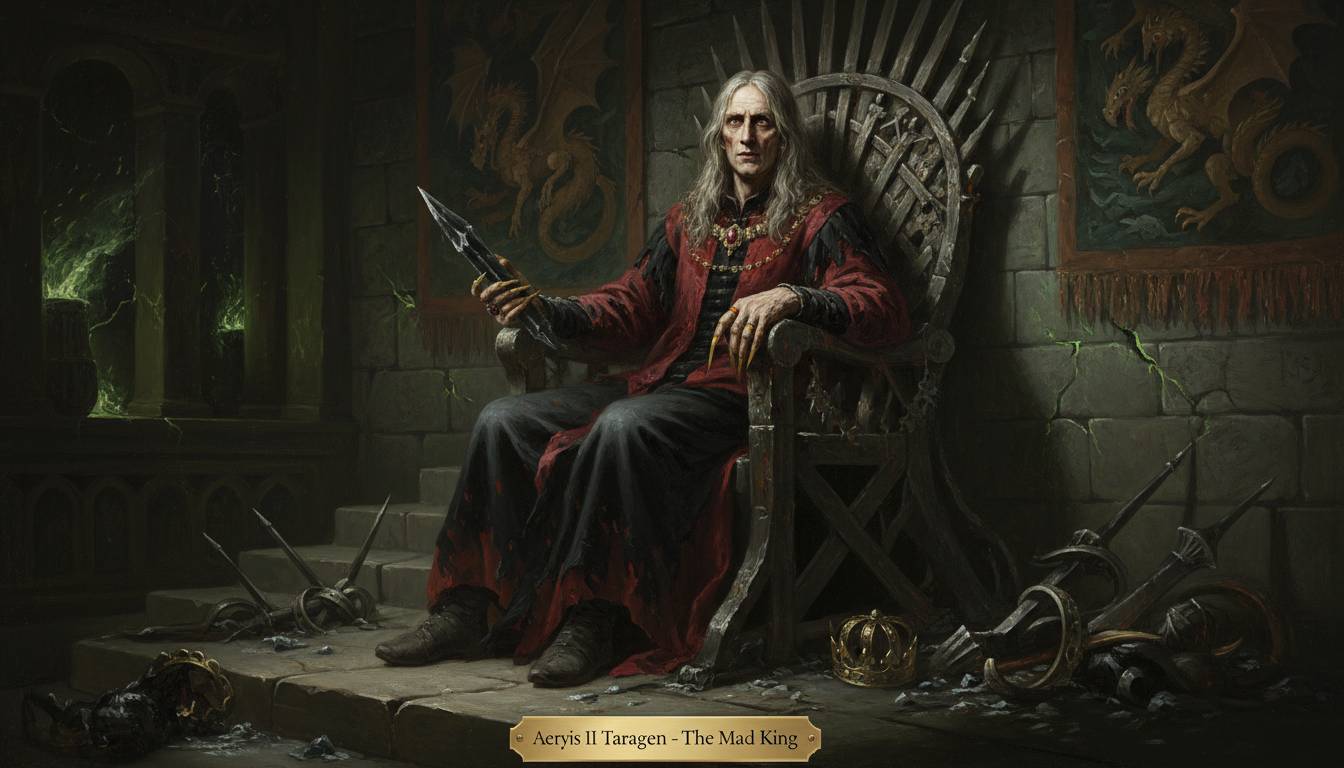
Among the Targaryen kings who sat the Iron Throne, three names dominate any serious debate over the dynasty’s worst ruler: Maegor I, Aegon IV, and Aerys II. The evidence from George R.R. Martin’s published canon points most strongly to Aegon IV Targaryen, called “the Unworthy,” because his damage outlived him. Maegor ruled through terror and Aerys II ended the dynasty in fire, but Aegon IV combined corruption, dynastic sabotage, and deliberate misrule in ways that poisoned Westeros for generations.
💡
Best-supported answer: Aegon IV Targaryen.
In canon reference material, Aegon IV is explicitly described as one of Westeros’s worst kings and is singled out for “willful misrule” in a way that distinguishes him from merely weak or mad rulers.
Aegon IV’s 12-year reign left damage that lasted far beyond 184 AC
Aegon IV Targaryen ruled from 172 AC to 184 AC, a span of 12 years that became a byword for indulgence, favoritism, and political decay. In the canon reference tradition surrounding The World of Ice & Fire and A Knight of the Seven Kingdoms, he is remembered not simply as immoral, but as actively destructive in office. That distinction matters. Westeros had weak kings before him and cruel kings before him, yet Aegon IV is repeatedly framed as a ruler whose choices were knowingly corrosive.
His reign was marked by court excess, mistresses elevated for pleasure rather than policy, and a pattern of humiliating or undermining capable figures around him. He alienated his lawful heir, Daeron, and fostered factionalism inside the royal family. Most consequentially, on his deathbed he legitimized his bastards, including Daemon Blackfyre. That single act did not create every later conflict by itself, but it gave legal and symbolic fuel to the Blackfyre cause, which helped drive repeated rebellions that destabilized the realm for decades.
Main Candidates for Worst Targaryen King
| King | Reign | Main Failure | Long-Term Effect |
|---|---|---|---|
| Maegor I | 43-48 AC | Terror, executions, usurpation | Short, brutal crisis |
| Aegon IV | 172-184 AC | Willful misrule, dynastic sabotage | Blackfyre conflicts and court decay |
| Aerys II | 262-283 AC | Paranoia, cruelty, mass political rupture | Robert’s Rebellion and dynasty’s fall |
Source: Published canon reference works and companion material from George R.R. Martin’s world-building.
The case against Aegon IV is therefore cumulative. He was not merely hated. He governed badly, weakened succession, and left a political time bomb. In a hereditary monarchy, that may be the most damaging failure of all.
Why Maegor I’s 6 years of terror still make him the fiercest rival
Maegor I Targaryen, remembered as Maegor the Cruel, ruled for roughly six years, from 42/43 AC to 48 AC depending on the counting of his seizure and consolidation of power. If the question is which Targaryen king was the most openly violent, Maegor is the strongest candidate. He usurped the throne from the line of his brother Aenys, fought a brutal struggle against the Faith Militant, ordered executions on a wide scale, and became synonymous with rule by fear.
His reign included the killing of rivals, the destruction of opponents, and the use of Balerion to impose obedience. The completion of the Red Keep is tied to his reign, but even that legacy is darkened by the story that he had builders killed to preserve its secrets. Whether one weighs every tale equally or not, the historical memory inside the books is clear: Maegor embodied naked tyranny.
Three Reigns at the Center of the Debate
43-48 AC: Maegor I rules through force after a disputed succession and leaves a reputation for exceptional cruelty.
172-184 AC: Aegon IV governs in excess, weakens the crown’s moral authority, and legitimizes bastards before his death.
262-283 AC: Aerys II begins with promise, then descends into paranoia, ending with Robert’s Rebellion and the sack of King’s Landing.
Yet Maegor’s reign also has one limiting factor in this debate: it was comparatively short, and the realm recovered under Jaehaerys I. His brutality was immense, but its institutional aftershocks were eventually contained. That makes him a powerful contender for “cruelest,” though not necessarily for “worst” in total state damage.
283 AC ended the dynasty: does that make Aerys II the worst?
Aerys II Targaryen, the Mad King, ruled from 262 AC to 283 AC and is the last Targaryen king to sit the Iron Throne before Robert Baratheon’s victory. His reign presents the strongest argument from outcome. Under Aerys, the dynasty collapsed. He alienated major houses, embraced paranoia after the Defiance of Duskendale, relied on fear, and committed atrocities that made reconciliation impossible.
The executions of Rickard and Brandon Stark became a turning point. His demand for the heads of Robert Baratheon and Eddard Stark pushed Jon Arryn into open defiance. By the end of the war, Aerys was prepared to burn King’s Landing with wildfire rather than lose it. Jaime Lannister’s killing of the king prevented that final act, but the intent itself defines Aerys’s place in Targaryen history.
⚠️
Aerys II has the strongest “final outcome” case.
His reign ended in rebellion, the near-destruction of his house, and a planned wildfire massacre in King’s Landing, making him the clearest candidate if the standard is catastrophic collapse.
Still, Aerys differs from Aegon IV in one important way. Early in his reign, he showed signs of promise, and some of the realm’s stability came from strong administration around him, especially in the years when Tywin Lannister served as Hand. His later madness was catastrophic, but the arc of his reign is partly one of deterioration. Aegon IV, by contrast, is remembered as practicing misrule more deliberately and consistently.
Aegon IV vs. Aerys II: which failure did more lasting harm?
This is the core comparison. Aerys II destroyed the dynasty in one generation. Aegon IV damaged the political order across several. If the standard is immediate catastrophe, Aerys has the edge. If the standard is sustained, preventable, and inherited damage, Aegon IV stands out.
Aegon IV’s legitimization of his bastards did more than insult his lawful heir. It blurred succession, empowered rival claimants, and helped create the Blackfyre line, whose rebellions troubled Westeros long after Aegon’s death. Those conflicts shaped the politics of the crown, the loyalties of noble houses, and the military burdens of later kings. In that sense, Aegon IV did not merely fail to govern well; he sabotaged the future governance of the realm.
How the Three Main Candidates Compare
| Measure | Maegor I | Aegon IV | Aerys II |
|---|---|---|---|
| Cruelty | Extreme | Lower, but vindictive | Extreme in later reign |
| Administrative quality | Poor | Poor by design | Collapsed over time |
| Succession damage | High | Severe | High |
| Dynastic outcome | Contained | Long-term instability | Dynasty overthrown |
| Best case for “worst” | Most brutal | Most willfully destructive | Most catastrophic ending |
Source: Comparative reading of canon histories in the Targaryen sections of Martin’s published world books.
That is why many readers and in-world historians place Aegon IV at the bottom. He was sane enough to know better, powerful enough to do better, and selfish enough to choose otherwise. Maegor terrorized the realm. Aerys burned it down. Aegon IV corrupted it from within.
The strongest factual verdict from canon points to Aegon IV
The most defensible answer is Aegon IV Targaryen. Maegor the Cruel may be the bloodiest ruler, and Aerys II may be the king whose reign ended in the most spectacular collapse, but Aegon IV best fits the broader definition of the worst ruler. He combined vice, negligence, factionalism, and dynastic sabotage in a reign that weakened the monarchy long after his death.
That conclusion also aligns with how the source material distinguishes types of failure. Aenys was weak. Maegor was cruel. Aerys became mad. Aegon IV is remembered for willful misrule. In a monarchy, deliberate misrule may be the harshest judgment of all, because it means the damage was not only tragic but chosen.
Frequently Asked Questions
Frequently Asked Questions
Was Maegor the Cruel worse than Aegon IV?
Maegor was almost certainly more openly violent. He ruled through executions, usurpation, and fear during a short reign in the 40s AC. Aegon IV’s case is stronger when the standard is long-term political harm, because his 172-184 AC reign helped set up later Blackfyre conflicts and weakened the legitimacy of the crown.
Why do many readers call Aegon IV “the Unworthy” the worst king?
The nickname reflects more than personal vice. Aegon IV is associated with deliberate misgovernment, court corruption, humiliation of allies and family, and the legitimization of bastards on his deathbed. That final act gave lasting force to succession disputes that troubled Westeros for generations.
Does Aerys II have the strongest claim because he lost the throne?
He has the strongest claim if the measure is final catastrophe. Aerys II’s reign ended in Robert’s Rebellion in 283 AC, the sack of King’s Landing, and the fall of the Targaryen dynasty. His planned use of wildfire against his own capital makes his record uniquely catastrophic.
Were there any other bad Targaryen kings in the running?
Yes. Aenys I is often judged weak, and Aegon II is tied to the devastation of the Dance of the Dragons. Still, the most common serious debate centers on Maegor I, Aegon IV, and Aerys II because each represents a different form of disastrous rule: terror, corruption, and collapse.
What is the most factual answer rather than the most popular one?
The most factual answer is that there is no official single ranking issued inside the novels, but the published canon strongly supports Aegon IV as the best candidate. He is repeatedly treated as one of the worst kings in Westerosi history, especially because his misrule was both deliberate and enduring in its consequences.
Conclusion
If the question is who was the cruelest Targaryen king, Maegor I has a formidable case. If the question is who brought the house to ruin, Aerys II stands at the center of that disaster. But if the question is who was the worst ruler of Westeros overall, judged by the mix of bad governance, selfish intent, and generational damage, Aegon IV Targaryen remains the strongest answer. His reign did not just fail in the moment. It made future failure far more likely.
Disclaimer: This article is for informational purposes only. It discusses a fictional history drawn from George R.R. Martin’s published works and companion materials. Interpretations can vary where the canon presents competing in-world perspectives.

View 0 comments