

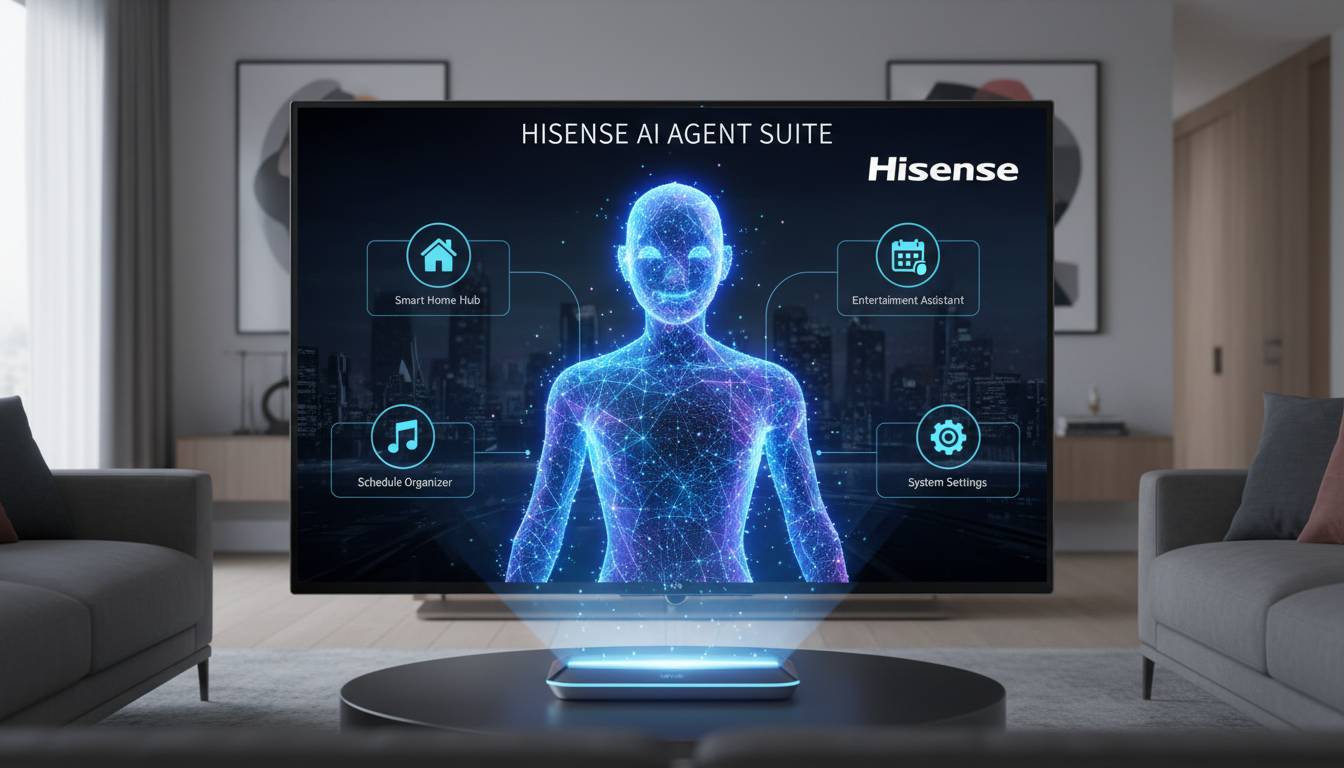
Hisense is expanding its ConnectLife platform from basic device control into an AI-led smart home system built around cooking, laundry, energy coordination and cross-device automation. The shift became clearer across IFA 2025 and CES 2026, where the company detailed its ConnectLife AI Agent, AI Cooking Agent and AI Laundry Agent, while also extending support for Google Home APIs and Matter-compatible products. For U.S. consumers, the story is less about a single gadget and more about how Hisense is trying to make appliances feel coordinated, personalized and more useful in daily routines.
At IFA 2025 on September 4, 2025, Hisense said its debuting ConnectLife AI Agent would power specialized functions including AI Cooking Agent and AI Laundry Agent, positioning the platform as the intelligence layer across home appliances rather than a simple remote-control app, according to the company’s U.S. announcement and a parallel PR Newswire release. On January 7, 2026, Hisense used CES 2026 to show how that software layer connects with new appliances and a broader “full-scenario smart home ecosystem,” again emphasizing AI-powered coordination across the home.
💡
The core product is not one appliance but the ConnectLife AI layer.
Hisense said at IFA 2025 and CES 2026 that ConnectLife AI Agent powers task-specific agents for cooking and laundry, while the broader platform also links third-party devices through Google Home APIs and Matter support. Source: Hisense and PR Newswire, published September 4, 2025, and January 7, 2026.
September 2025 to January 2026: How the AI Push Took Shape
Hisense’s public roadmap shows a steady build rather than a one-day launch. On May 23, 2025, the company announced integration of Google’s Home APIs into the ConnectLife app, saying users would be able to onboard and control third-party smart home products, including Matter and “Works with Google Home” certified devices, by the fall of 2025. That matters because interoperability has been one of the biggest barriers in smart homes: appliances often work well inside one brand’s ecosystem but poorly across others.
Hisense AI Smart Home Timeline
January 7, 2025: Hisense presented AI-enabled smart home appliances at CES 2025, including ConnectLife-enabled refrigeration and kitchen features such as AI food recognition and meal planning.
May 23, 2025: Hisense announced Google Home API integration for ConnectLife, with support for third-party Matter and Google Home devices planned for fall 2025.
September 4, 2025: At IFA 2025, Hisense introduced the ConnectLife AI Agent, including AI Cooking Agent and AI Laundry Agent.
January 7, 2026: At CES 2026, Hisense showcased a full-scenario smart home ecosystem built around AI-powered appliances and coordinated living.
By IFA 2025, Hisense had moved from feature-level AI to agent-based branding. The company said the ConnectLife AI platform would help households optimize energy use, streamline chores and make life “more connected, efficient, and creative.” By CES 2026, that software strategy was tied to visible hardware, including a slide-in induction range with a high-resolution touch display for the ConnectLife AI Cooking Agent, plus a smart dishwasher and refrigerator designed to work inside the same ecosystem.
What Is Driving the “Emotional Value” Claim?
The phrase “emotional value” in smart appliances usually refers to personalization, reduced friction and a sense that devices understand household habits. Hisense’s public materials do not frame this as emotional AI in the human-sentiment sense. Instead, the company describes practical functions: personalized meal planning, recipe guidance, optimized washing cycles, food inventory management, expiration reminders and remote control through ConnectLife.
That distinction matters. The emotional angle appears to come from convenience and coordination. A cooking agent that suggests recipes from available ingredients, a dishwasher that adapts to load conditions, and a refrigerator that tracks food status can reduce repetitive decisions in the home. Tom’s Guide, reporting from CES 2026 on January 6, 2026, described the induction range’s built-in AI assistant as offering recipes, meal planning and step-by-step guidance through its touch display.
ConnectLife AI Functions Cited by Hisense
| Function | Use Case | Source Date |
|---|---|---|
| AI Cooking Agent | Recipe guidance, meal planning, cooking support | Sep. 4, 2025 / Jan. 2026 |
| AI Laundry Agent | Optimized washing cycles | Sep. 4, 2025 |
| AI Food Recognition | Ingredient identification and planning | Jan. 7, 2025 |
| AI Meal Planner | Personalized meal suggestions and shopping lists | Jan. 7, 2025 |
| Third-party device integration | Control of Matter and Google Home devices | May 23, 2025 |
Source: Hisense global and U.S. announcements, PR Newswire | Published January 7, 2025, May 23, 2025, and September 4, 2025.
In that sense, “emotional value” is best understood as a consumer positioning term built on utility. Hisense is arguing that appliances become more meaningful when they save time, coordinate tasks and adapt to routines. The verifiable facts support the utility side strongly; the emotional outcome remains a marketing interpretation rather than a measurable published metric.
5 Connected Functions Show How Hisense Is Expanding Beyond Single Devices
First, Hisense is building around a platform model. ConnectLife is no longer limited to controlling Hisense-branded hardware. The Google Home API integration announced in May 2025 explicitly extends the app to third-party products, including Matter devices.
Second, the company is using specialized agents instead of one generic assistant. Public materials name at least two: AI Cooking Agent and AI Laundry Agent. That suggests a modular approach where each household task gets its own software logic and interface.
Third, Hisense is embedding AI directly into appliance interfaces. The CES 2026 induction range includes a high-resolution touch display that puts the cooking agent on the appliance itself, not only in a phone app.
Fourth, the company is linking appliance data across tasks. Hisense said its smart dishwasher can communicate with other products to detect which recipes have been cooked and adjust behavior accordingly, according to CES 2026 coverage.
Fifth, the strategy is broadening from kitchen and laundry into whole-home orchestration. CES 2026 materials describe a “full-scenario smart home ecosystem,” while IFA 2025 messaging framed AI as part of “smarter everyday living.”
ℹ️
Interoperability is a key competitive point.
Hisense’s May 23, 2025 announcement on Google Home APIs and Matter support indicates the company is trying to reduce ecosystem lock-in, a common friction point in U.S. smart homes.
Hisense vs Traditional Smart Appliances: Why the Agent Model Matters
Traditional smart appliances often center on remote start, status alerts and maintenance notifications. Hisense’s newer messaging adds recommendation and coordination layers on top of those basics. At CES 2025, the company highlighted AI food recognition, dish design, meal planning and personalized shopping lists. At IFA 2025 and CES 2026, it shifted toward “agent” terminology, which implies software that can guide decisions rather than just execute commands.
Traditional Smart Features vs Hisense Agent-Led Features
| Category | Traditional Smart Appliance | Hisense Agent-Led Direction |
|---|---|---|
| Control | Remote on/off, monitoring | Cross-device orchestration through ConnectLife |
| Cooking | Preset modes | Recipe guidance, meal planning, ingredient-based suggestions |
| Laundry | Cycle notifications | AI Laundry Agent for optimized washing cycles |
| Ecosystem | Brand-specific app | Google Home API and Matter device integration |
| User value | Convenience | Convenience plus personalization and routine support |
Source: Hisense announcements and CES 2026 product materials | Published January 7, 2025, May 23, 2025, September 4, 2025, and January 2026.
For U.S. buyers, the practical test will be execution. Public announcements establish the feature direction, but real-world value depends on app reliability, device compatibility and whether the AI recommendations improve household tasks without adding friction. The verified record so far shows Hisense has expanded both the software stack and the hardware endpoints that use it.
Frequently Asked Questions
Frequently Asked Questions
What is the Hisense AI Agent Suite?
Hisense uses the term to describe the ConnectLife AI platform and its task-specific agents, including AI Cooking Agent and AI Laundry Agent. The company publicly detailed those functions at IFA 2025 on September 4, 2025, and expanded the concept at CES 2026 on January 7, 2026.
Does Hisense support devices outside its own brand?
Yes. On May 23, 2025, Hisense announced that ConnectLife would integrate Google’s Home APIs and support third-party smart home products, including Matter and “Works with Google Home” certified devices. That indicates a broader interoperability strategy rather than a closed ecosystem.
Which appliances are tied to the AI agents?
Public materials connect the AI platform to cooking, laundry, refrigeration and dishwashing. CES 2026 materials highlighted an induction range with the AI Cooking Agent, while earlier and parallel announcements referenced AI Laundry Agent, smart refrigerators and connected dishwashers.
What does “emotional value” mean in this context?
Hisense’s published materials support a practical interpretation: appliances that personalize tasks, reduce repetitive decisions and coordinate routines. The company documents features such as meal planning, recipe guidance, food tracking and optimized washing cycles, but it has not published a standalone metric quantifying “emotional value.”
When did Hisense begin this broader AI smart home push?
The public timeline spans at least from CES 2025 on January 7, 2025, when Hisense highlighted AI-enabled home features, through the Google Home API announcement on May 23, 2025, to the formal debut of ConnectLife AI Agent at IFA 2025 and the broader CES 2026 ecosystem showcase.
Conclusion
Hisense’s AI Agent Suite is best understood as a platform strategy that turns appliances into coordinated participants in a larger smart home system. The company’s verified announcements show a clear progression: AI-assisted kitchen and home features at CES 2025, third-party ecosystem expansion in May 2025, formal agent branding at IFA 2025, and a broader full-scenario smart home presentation at CES 2026. The “emotional value” language is marketing shorthand, but the underlying facts point to something concrete: Hisense is trying to make smart appliances more personal by making them more connected, more context-aware and more useful in everyday life.
Disclaimer: This article is for informational purposes only. Information may have changed since publication. Always verify information independently and consult qualified professionals for specific advice.

View 0 comments