

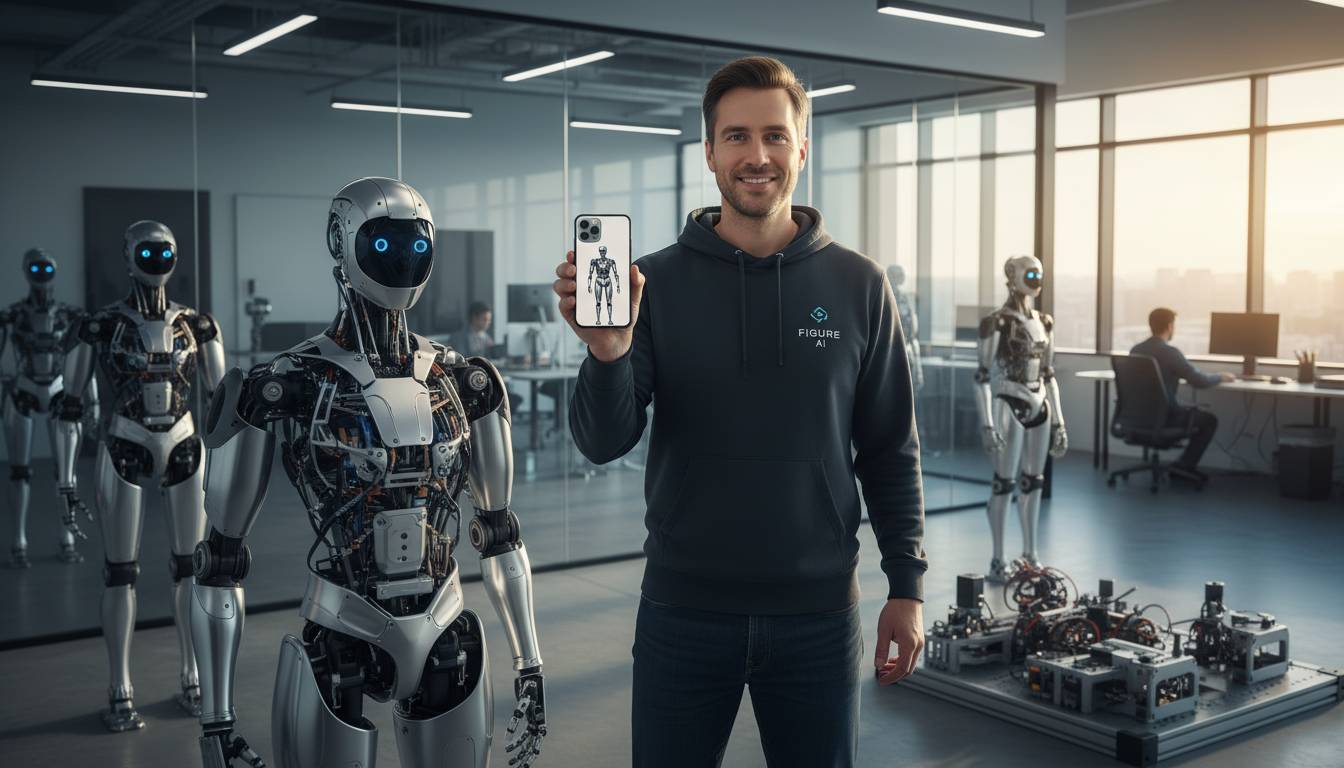
Brett Adcock, the founder and chief executive of Figure AI, is building a separate artificial intelligence hardware startup called Hark and has recruited former Apple designer Abidur Chowdhury as head of design, according to Bloomberg’s January 6, 2026 report. The move matters because Adcock already leads one of the best-funded robotics companies in Silicon Valley, while Chowdhury is identified as a designer behind Apple’s ultra-thin iPhone Air, giving the still-secret Hark project unusual credibility at a time when AI hardware remains an unsettled category.
That combination places Hark in a crowded but still undefined race to build a new kind of AI device. Public information remains limited: no product name, launch date, price, or technical specifications have been disclosed in the reporting reviewed for this article. What is verifiable is the team formation, the timing, and the strategic backdrop. Bloomberg reported on January 6, 2026 at 7:00 p.m. UTC that Chowdhury would join Hark as head of design and that Hark is founded by Adcock, who also runs Figure AI. Separate coverage citing Bloomberg says Adcock invested $100 million into Hark in December 2025, suggesting the company is being capitalized well before any public product reveal.
Verified Facts on Hark and Its Founding Team
| Item | Verified detail | Source and time |
|---|---|---|
| Founder | Brett Adcock | Bloomberg, January 6, 2026, 7:00 p.m. UTC |
| Design hire | Abidur Chowdhury joins as head of design | Bloomberg, January 6, 2026 |
| Chowdhury background | Former Apple designer tied to iPhone Air work | Bloomberg, January 6, 2026 |
| Capital committed | $100 million invested into Hark in December 2025 | Bloomberg-cited coverage, January 7, 2026 |
| Adcock’s other role | CEO of Figure AI | Bloomberg, January 6, 2026 |
Source: Bloomberg, as cited by Mobile World Live and other follow-on reports | January 6-7, 2026
January 2026 Hiring Move Signals a Hardware-First AI Push
The strongest signal in this story is not a product teaser but the choice of talent. Chowdhury is described in Bloomberg’s report as the Apple veteran behind the iPhone Air design who is now taking the top design role at Hark. Apple hardware designers rarely move into stealth startups unless the product ambition is substantial, and the hire gives Hark immediate relevance in a sector where industrial design has become a differentiator after several first-generation AI devices struggled to find product-market fit.
By comparison, Adcock’s public track record is rooted in robotics rather than consumer electronics. Figure AI raised $675 million at a $2.6 billion valuation in February 2024 and announced a collaboration agreement with OpenAI at the same time, according to the company’s funding release. That financing round included Microsoft, Nvidia, Jeff Bezos through Bezos Expeditions, Intel Capital, ARK Invest, Parkway Venture Capital, and the OpenAI Startup Fund. For readers tracking founder credibility, that matters: Adcock is not entering AI hardware as a first-time operator but as an executive who has already attracted major strategic capital and built a company with commercial manufacturing pilots.
💡
Hark’s clearest verified edge is team quality, not disclosed product detail.
As of March 24, 2026, public reporting confirms the founder, the lead design hire, and the reported $100 million self-funded backing, but not the device category, launch schedule, or technical stack.
Why Figure AI’s 30,000-BMW Context Matters for Hark
Hark is separate from Figure AI, but Adcock’s robotics record provides context for how investors and rivals may read the new venture. Figure said in a November 2025 update that its Figure 02 robot contributed to the production of 30,000 cars during an 11-month deployment at BMW Group Plant Spartanburg. BMW separately said in March 2026 that Figure 02 supported production of more than 30,000 BMW X3 vehicles, working ten-hour shifts from Monday to Friday during the U.S. deployment. Those figures do not prove Hark’s product strategy, but they show Adcock has already moved one advanced hardware-and-AI system from lab demonstrations into a real industrial setting.
That operating history stands out because AI hardware has become a difficult category. Humane’s AI Pin shipped in 2024 and drew weak reviews, while OpenAI’s hardware effort with Jony Ive has faced delays and legal complications around branding. AP reported in 2025 that OpenAI had to temporarily stop marketing the venture after a federal judge’s ruling in a trademark dispute. MacRumors reported on February 10, 2026 that OpenAI’s Ive-designed device had been delayed to 2027. In that environment, Hark’s secrecy may be strategic rather than unusual.
Timeline of the Hark Story
February 29, 2024: Figure announces a $675 million Series B at a $2.6 billion valuation and a collaboration agreement with OpenAI.
December 2025: Bloomberg-cited coverage says Brett Adcock invested $100 million into Hark.
January 6, 2026: Bloomberg reports that former Apple designer Abidur Chowdhury joins Hark as head of design.
March 24, 2026: No public product launch date, category confirmation, or specifications have been disclosed for Hark.
What Product Category Is Hark Building?
No authoritative public source reviewed for this article specifies whether Hark is building a wearable, a phone-adjacent device, a home assistant, glasses, a robotics interface, or another form factor. That absence is central to the story. The market has seen multiple attempts to define “AI hardware” beyond smartphones, but the category remains fluid. OpenAI’s own hardware effort has been described in outside reporting as neither a phone nor a wearable, while still potentially screen-light or screenless. Hark has disclosed even less.
Still, the available facts support a narrower inference. Hiring a senior Apple industrial designer as head of design, combined with a reported $100 million initial investment, points to a physical product effort rather than a software-only lab. That is an inference based on the role and funding structure, not a confirmed specification. Until Hark or Adcock publishes product details, any stronger claim would go beyond the verified record.
Hark vs. Other High-Profile AI Hardware Efforts
| Company/project | What is verified | Status as of March 24, 2026 |
|---|---|---|
| Hark | Founded by Brett Adcock; Abidur Chowdhury hired as head of design; $100 million reportedly invested in December 2025 | Product undisclosed |
| OpenAI + Jony Ive/io | OpenAI acquired io in a deal valued around $6.5 billion; first device reportedly delayed | Launch reportedly pushed to 2027 |
| Humane AI Pin | Commercial AI hardware product shipped in 2024 | Serves as a cautionary market precedent |
Source: Bloomberg, AP, MacRumors, company announcements | accessed March 24, 2026
$100 Million Backing Raises the Stakes for a Stealth Launch
The reported $100 million commitment is large for a startup that has not publicly shown a product. In practical terms, that level of funding can support industrial design, prototyping, custom hardware engineering, recruiting, and early supply-chain work. It also suggests Adcock is trying to move quickly. For context, Figure itself emerged from stealth with substantial early funding and later scaled to one of the largest private financings in humanoid robotics.
There is also a broader competitive pattern. AI companies are now trying to control more of the stack, from models to chips to interfaces. If Hark is building a new device category, it enters a market where the central question is no longer whether AI can answer prompts, but what hardware should mediate that experience. That is why the Chowdhury hire matters more than a typical executive move: it links a proven hardware designer to a founder already associated with ambitious AI systems.
Frequently Asked Questions
Who is behind Hark?
Hark is founded by Brett Adcock, according to Bloomberg’s January 6, 2026 report. Adcock is also the founder and CEO of Figure AI, the humanoid robotics company that raised $675 million at a $2.6 billion valuation in February 2024.
Who is the former Apple designer joining the project?
Bloomberg identified Abidur Chowdhury as the Apple veteran joining Hark as head of design on January 6, 2026. The report tied him to the iPhone Air design effort, making him one of the most notable recent Apple departures into AI hardware.
Has Hark revealed its AI product yet?
No. As of March 24, 2026, public reporting reviewed for this article does not disclose a product name, category, launch date, price, or technical specifications. The story is about the team and funding, not a confirmed device announcement.
How much money has Hark raised?
Follow-on coverage citing Bloomberg says Adcock invested $100 million into Hark in December 2025. No larger outside financing round or valuation has been publicly confirmed in the sources reviewed here as of March 24, 2026.
Why is Figure AI relevant to this story?
Figure AI shows Adcock’s hardware execution record. The company announced a $675 million funding round in February 2024 and later said its Figure 02 robot contributed to the production of 30,000 cars at BMW’s Spartanburg plant, giving Adcock credibility as a builder of complex AI-driven hardware systems.
Disclaimer: This article is for informational purposes only. Information may have changed since publication. Always verify information independently and consult qualified professionals for specific advice.

View 0 comments