

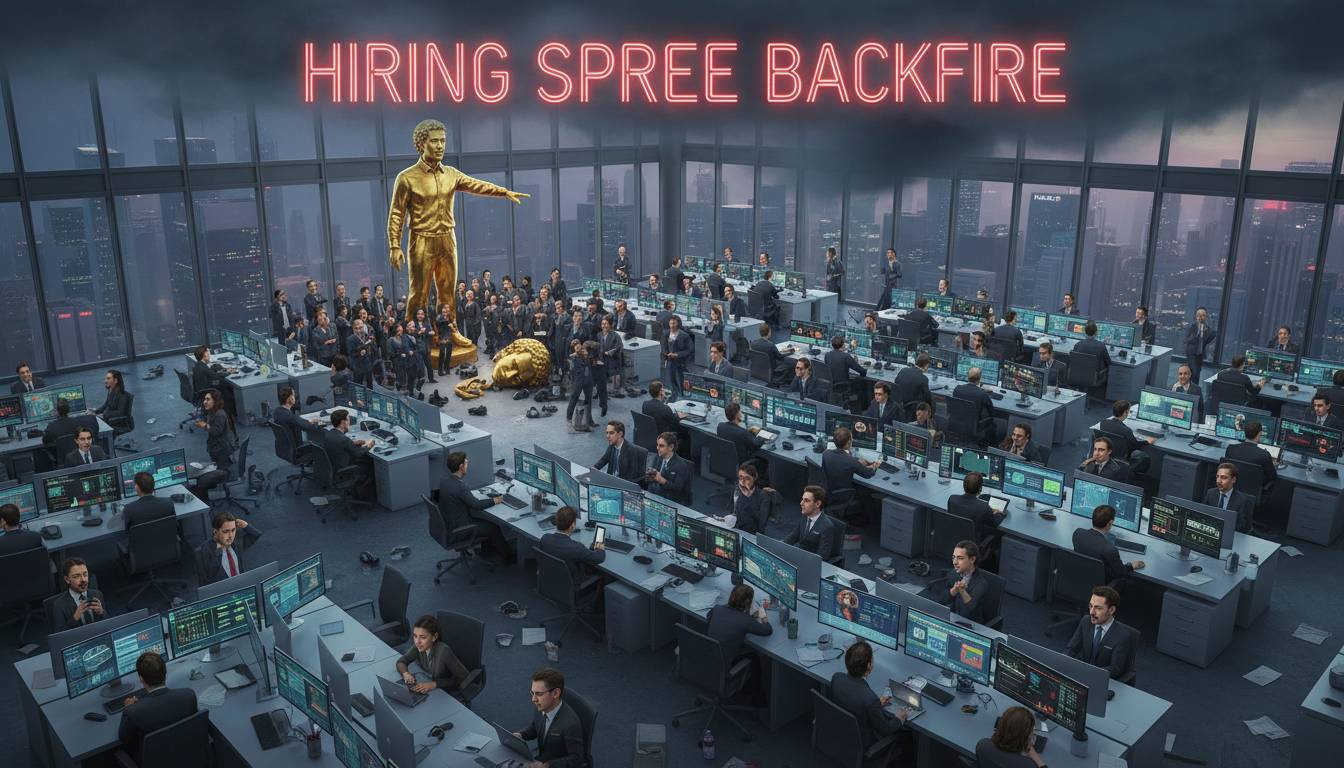
Mark Zuckerberg’s push to build a world-leading artificial intelligence operation has become one of the most expensive talent grabs in Silicon Valley. Meta has spent aggressively on elite researchers, infrastructure, and strategic deals as it tries to close the gap with OpenAI, Google, and Anthropic. But the early signs suggest that Mark Zuckerberg’s Billion-Dollar Hiring Spree Doesn’t Seem to Be Going So Great. The company’s hiring surge has already been followed by internal restructuring, a pause in AI hiring, and growing investor scrutiny over whether the spending can deliver results.
A costly race to dominate AI
Meta’s recent AI strategy centers on speed. Zuckerberg has pursued top researchers with unusually large compensation packages and backed that recruiting effort with major capital commitments. In June 2025, Meta announced a $14.3 billion investment for a 49% stake in Scale AI, a deal tied closely to its broader effort to strengthen its AI capabilities and leadership bench. At the same time, Meta intensified recruiting for what became known as Meta Superintelligence Labs.
The scale of the spending is striking even by big-tech standards. Meta said in July 2025 that its capital expenditures for 2025 would reach $66 billion to $72 billion, up sharply from prior levels, as it expanded data centers and AI infrastructure. The company also signaled that investment would rise further in 2026, underscoring how central AI has become to Zuckerberg’s long-term strategy.
That spending comes on top of already elevated operating costs. Meta said with its January 2025 earnings that total expenses for 2025 were expected to be between $114 billion and $119 billion, with much of the increase tied to infrastructure and AI-related investment. By early 2026, Meta reported full-year 2025 capital expenditures of $72.22 billion.
Why Mark Zuckerberg’s Billion-Dollar Hiring Spree Doesn’t Seem to Be Going So Great
The core problem is not that Meta failed to hire talent. It is that the company’s expensive recruitment drive has quickly run into signs of strain. In August 2025, Meta confirmed that it had paused hiring for its new AI division after a burst of recruiting and a reorganization that split the unit into four teams. The company described the move as organizational planning, but the timing raised questions about whether the hiring blitz had outpaced the company’s ability to integrate new leaders and researchers effectively.
The hiring pause matters because it followed weeks of headlines about extraordinary pay packages. OpenAI CEO Sam Altman said Meta had tried to poach OpenAI staff with signing bonuses as high as $100 million and even larger annual compensation offers. Later reporting suggested that the most eye-catching figures may have applied only to a limited number of senior roles rather than standard offers across the board. Even so, the episode reinforced the view that Meta was paying a premium in a highly competitive market without any guarantee of breakthrough results.
There is also a performance backdrop to this story. TechCrunch reported in June 2025 that the hiring spree followed disappointment around Meta’s Llama 4 launch, which did not perform as well as Zuckerberg had hoped. While Meta continues to promote its AI ambitions, the company’s recruiting urgency appears linked to pressure to improve model quality and regain momentum in the generative AI race.
Investors are watching the bill
Wall Street has so far given Meta some room because its advertising business remains strong. Meta’s fourth-quarter 2024 results beat expectations, and the company reiterated plans to spend $60 billion to $65 billion on capital expenditures in 2025 to support its AI strategy. Strong ad revenue has helped offset concerns that AI spending could weigh on margins in the near term.
Still, investors are increasingly focused on whether Meta can convert spending into durable returns. According to former OpenAI board member Helen Toner, lavish recruiting budgets do not guarantee success in AI, where execution, research culture, and product integration matter as much as compensation. That view reflects a broader concern in the market: buying talent is easier than building a coherent organization that can consistently ship leading models and products.
Meta’s own history adds to the skepticism. The company spent years pouring money into Reality Labs, which CNBC noted had accumulated losses of more than $60 billion since late 2020 as of April 2025. That does not mean Meta’s AI push will follow the same path, but it does show why some investors are cautious when Zuckerberg commits to another multiyear spending cycle built around an ambitious future platform.
The contradiction inside Meta’s strategy
One of the more striking aspects of this story is the contrast between Meta’s recent hiring spree and its earlier efficiency message. In February 2024, Zuckerberg said Meta would “keep things lean” even as it invested heavily in AI. Yet by 2025, the company was engaged in one of the most aggressive talent wars in the industry. In January 2025, Meta also announced 5% cuts targeting lower-performing employees, showing that the company was simultaneously trimming parts of the workforce while paying heavily for select AI talent.
That contradiction may be strategic rather than accidental. Meta appears to be concentrating resources on a smaller number of high-impact AI roles while reducing spending elsewhere. But this approach carries risks. It can create internal tension, raise expectations for rapid breakthroughs, and make it harder to justify the spending if product gains arrive slowly. This is especially true in AI, where the path from research hiring to commercial payoff is often long and uncertain.
What it means for employees, rivals, and users
For employees, Meta’s hiring spree has reshaped the labor market for elite AI researchers. Compensation expectations have risen, and competition among major labs has intensified. That may benefit a small group of top engineers and scientists, but it also increases pressure on companies to show that these hires can produce measurable advances.
For rivals, Meta’s spending has forced a response. OpenAI, Google, Anthropic, and others now operate in a market where retaining talent may require richer pay, stronger missions, or both. Yet Meta’s hiring pause also offers a warning: aggressive recruitment alone does not solve the deeper challenge of building a stable, high-performing AI organization.
For users and advertisers, the stakes are practical. If Meta’s AI investments improve ad targeting, content recommendations, business messaging, and consumer-facing assistants, the spending may eventually look justified. If not, the company risks repeating a familiar pattern in which huge bets generate headlines long before they generate returns. That is the central reason Mark Zuckerberg’s Billion-Dollar Hiring Spree Doesn’t Seem to Be Going So Great right now.
What comes next
Meta is not retreating from AI. The company has made clear that infrastructure investment will continue, and its 2026 plans point to even heavier spending. The more important question is whether Meta can turn a costly recruiting campaign into a disciplined operating model that produces leading models, useful products, and financial payoff.
In the near term, the hiring pause and restructuring suggest Meta is still trying to impose order on a fast-moving strategy. That does not mean the effort will fail. It does mean the market is moving from excitement about the scale of Zuckerberg’s ambition to a harder question: what, exactly, has all that money bought so far?
Conclusion
Mark Zuckerberg’s Billion-Dollar Hiring Spree Doesn’t Seem to Be Going So Great because the spending has become easier to measure than the results. Meta has committed tens of billions of dollars to AI infrastructure, pursued top researchers with unusually rich offers, and reorganized its AI division after a rapid expansion. For now, the company still has the advertising profits to fund that gamble. But unless Meta can translate its hiring blitz into clear product and research wins, the spree may come to be seen less as a masterstroke and more as another costly attempt to buy time in a race that no company can win with money alone.
Frequently Asked Questions
Why is Meta spending so much on AI talent?
Meta is trying to catch up and compete more aggressively with OpenAI, Google, and Anthropic in advanced AI models, products, and infrastructure.
Did Meta really offer $100 million signing bonuses?
Sam Altman said Meta made offers that included bonuses as high as $100 million, but later reporting indicated those figures likely applied only to a small number of senior roles and were not standard packages.
Has Meta stopped hiring for AI?
Meta confirmed a pause in hiring for its AI division in August 2025, saying it was part of organizational planning after a major recruiting push and restructuring.
How much is Meta spending on AI infrastructure?
Meta said in 2025 that capital expenditures would reach $66 billion to $72 billion for the year, and it later reported full-year 2025 capex of $72.22 billion.
Why are investors concerned?
Investors want proof that Meta’s heavy spending will produce durable returns rather than simply raising costs. Meta’s history of large losses in Reality Labs adds to that caution.

View 0 comments