

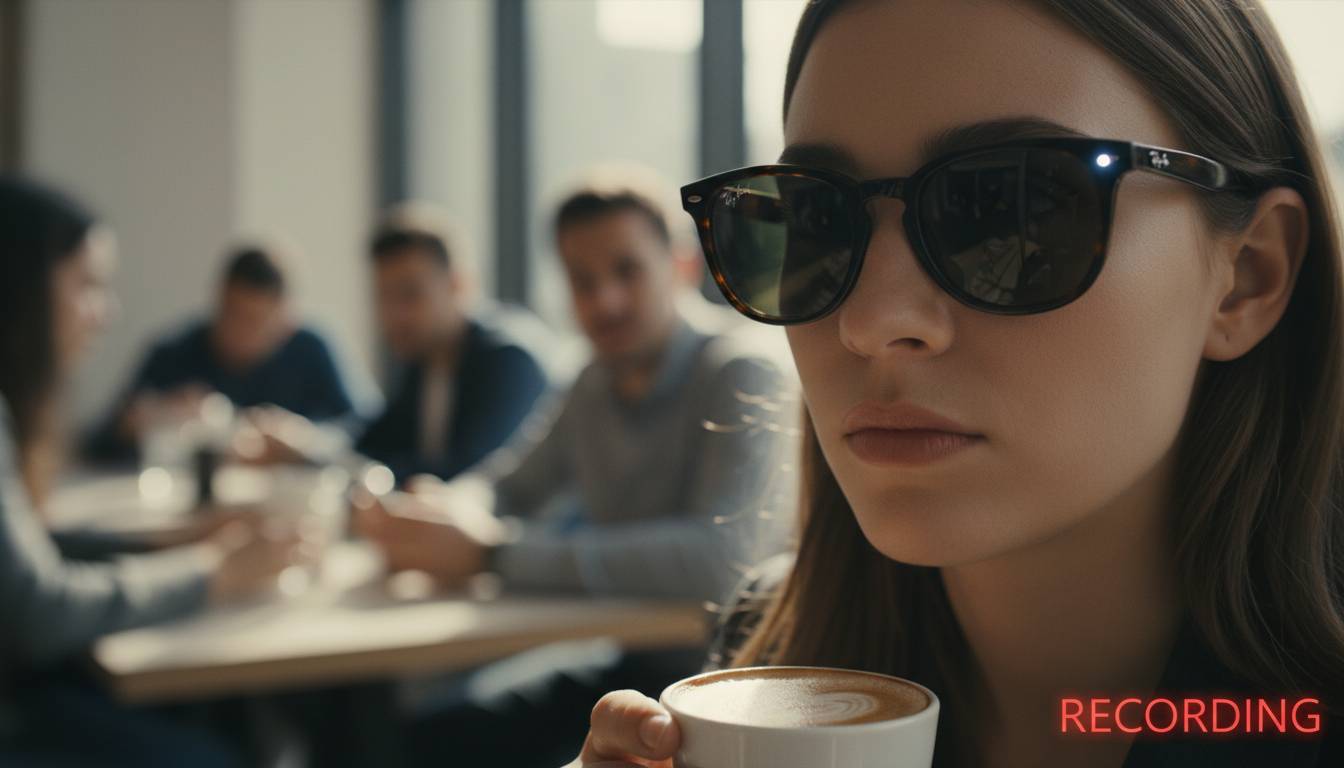
Meta’s smart glasses are marketed as lightweight AI wearables, but the product’s challenges extend well beyond surveillance concerns. From battery limits and uneven real-world camera framing to regulatory friction in Europe and persistent questions about public recording, the category still faces practical barriers that matter as much as privacy. This article examines the hardware constraints, compliance issues, and adoption hurdles shaping Meta’s glasses in the US market.
Meta and EssilorLuxottica have pushed smart glasses further into the consumer mainstream with Ray-Ban Meta models, adding a 12-megapixel camera, open-ear speakers, voice controls, livestreaming, and Meta AI features. Meta said on April 23, 2025, that it was expanding Meta AI on Ray-Ban Meta glasses across more European countries after working through the region’s “complex regulatory system,” a reminder that compliance remains a live issue alongside product design and usability. Meta introduced the original Ray-Ban Meta generation in September 2023, while later product updates focused heavily on battery life, video capture, and AI functions rather than privacy alone.
⚠️
Battery life remains a core product constraint.
Meta said Ray-Ban Meta (Gen 2) reaches up to eight hours of typical use, versus roughly half that on the prior generation, according to its September 2025 product announcement. That improvement itself signals how central power management has been to the category.
Meta Smart Glasses: Key Product Limits and Claims
| Issue | Verified detail | Named source |
|---|---|---|
| Battery life | Up to 8 hours typical use on Ray-Ban Meta Gen 2; earlier display model lists up to 6 hours mixed use | Meta Newsroom; Ray-Ban US |
| Storage | 32 GB flash storage, 100+ videos or 500+ photos on display model | Ray-Ban US |
| Camera | 12 MP ultra-wide camera on display model | Ray-Ban US |
| Regulatory rollout | Meta AI expansion in EU followed compliance work tied to Europe’s regulatory framework | Meta Newsroom |
Source: Meta Newsroom and Ray-Ban US product pages | accessed March 25, 2026
8-Hour Battery Claims Show a Hardware Problem, Not a Footnote
Battery life is one of the clearest signs that Meta’s smart glasses still operate under tight hardware trade-offs. In Meta’s September 2025 announcement for Ray-Ban Meta Gen 2, the company said the glasses could last up to eight hours with typical use and that the charging case could provide an additional 48 hours. By comparison, Meta Ray-Ban Display materials published by Ray-Ban in 2025 listed up to six hours of mixed-use battery life and up to 24 hours with a fully charged case. Those figures are meaningful because smart glasses compete with devices people expect to wear for long stretches, not just short sessions.
That matters in daily use. A wearable camera, microphones, speakers, wireless connectivity, and on-device AI interactions all draw power. If users need to ration recording, voice queries, or calls to preserve battery, the product’s convenience drops. The issue is not unique to Meta, but it is especially important for glasses because they are supposed to disappear into routine behavior. A phone can be recharged midday without much friction. Eyewear cannot.
There is also historical context. Meta’s own messaging around later generations emphasizes “up to 2X the battery life,” which implies the earlier baseline was a meaningful weakness. In consumer electronics, companies usually spotlight battery gains when prior endurance has constrained adoption or reviews. That pattern appears here.
Why Camera Utility Still Falls Short of Hands-Free Promise
Privacy concerns dominate headlines because the glasses can record from face level, but camera usability is another obstacle. WIRED’s November 2023 review of Ray-Ban Meta smart glasses praised audio and image quality improvements while also reporting framing problems, including a tendency for subjects to appear shifted and for the ultra-wide perspective to feel distorted. Those are not trivial complaints. A wearable camera succeeds only if users can trust what it captures without repeated retakes.
Meta’s hardware specs show why expectations are high. Ray-Ban’s US product page lists a 12 MP ultra-wide camera, 3024 x 4032 image resolution, and 1440 x 1920 video at 30 fps for the display model. Meta’s September 2025 update then raised the bar further by promising 3K Ultra HD video capture on Gen 2. Better resolution helps, but it does not automatically solve composition, perspective, or social acceptability.
In practice, smart-glasses cameras create a mismatch between what the wearer thinks they are seeing and what the lens records. That gap can reduce the product’s usefulness for spontaneous capture, especially compared with a smartphone screen that gives immediate framing feedback. For a device sold on frictionless recording, that is a structural challenge.
Product and Policy Timeline
September 2023: Meta launches Ray-Ban Meta smart glasses, expanding beyond the earlier Ray-Ban Stories line.
September 2024: The FTC publishes a staff report criticizing large platforms, including Meta, for broad surveillance practices and weak privacy controls.
April 23, 2025: Meta says it is expanding Meta AI on Ray-Ban Meta glasses in more EU countries after compliance work tied to Europe’s regulatory system.
September 2025: Meta announces Ray-Ban Meta Gen 2 with up to 8 hours of battery life and 3K video capture.
April 2025 in Europe: Regulation Slows Features as Much as Privacy Fears
Meta’s own statements show that regulation is shaping the product roadmap. In its April 23, 2025 update, the company said it had been “diligently working” to ensure Ray-Ban Meta glasses complied with Europe’s regulatory system before expanding Meta AI features in additional EU markets. It also noted that some visual AI features had been available in the US, Canada, and Australia before broader European rollout.
That is significant because it shows the main friction is not simply whether consumers feel uneasy about being recorded. It is also whether regulators accept how AI-enabled glasses process voice, images, and contextual information. Feature availability by geography can fragment the user experience and weaken the product’s global consistency.
Separately, the Federal Trade Commission’s September 2024 staff report found that major social media and video streaming companies, including Meta, had engaged in extensive data collection with lax privacy controls. The report did not target Meta’s glasses specifically, but it adds context to why any Meta hardware that captures audio, images, or behavioral data receives heavier scrutiny than a neutral gadget maker might face.
ℹ️
Meta’s brand history amplifies hardware risk.
When a company already faces regulatory and privacy scrutiny, every new sensor-based device inherits that trust deficit. For smart glasses, that affects adoption, retail acceptance, and feature rollout.
Meta vs Smartphones: The Social Trade-Off Is Still Unresolved
Meta’s glasses solve one problem well: they let users capture media and hear audio without holding a phone. Open-ear speakers and a five-microphone array have drawn positive reviews, and that audio performance is one of the product’s strongest points. Yet the same design creates a social trade-off. People nearby may not know when recording starts, even with an LED indicator, and wearers may hesitate to use the device in offices, restaurants, schools, or transit.
That tension affects adoption more than a spec sheet does. Smartphones are already accepted as cameras, even if they raise privacy concerns of their own. Smart glasses move recording into a more ambient form. The result is not just a privacy debate but a norms problem: where is it acceptable to wear them, and when does passive capture become socially costly?
Smart Glasses vs Phone Camera Trade-Offs
| Category | Smart glasses | Smartphone |
|---|---|---|
| Hands-free use | Strong | Weak |
| Framing control | Limited | Strong |
| Battery flexibility | Constrained wearable battery | Larger battery, easier top-up |
| Social acceptance | Still contested | Established |
| Regulatory sensitivity | High due to always-available sensors | Lower by comparison |
Source: Meta and Ray-Ban product materials; product reviews; accessed March 25, 2026
What 32 GB and 12 MP Reveal About the Next Adoption Barrier
Storage, optics, and AI integration show that Meta is trying to turn glasses into a lightweight computing platform. Ray-Ban’s US page lists 32 GB of storage, capacity for more than 100 videos of 30 seconds each, and support for iOS 15.2+ and Android 10+. Those are credible consumer specs. But they also underline the next barrier: smart glasses still depend on a companion app, phone ecosystem compatibility, and frequent charging. That makes them an accessory, not a replacement device.
For now, the biggest problems are cumulative. Privacy concerns remain real. But battery endurance, camera framing, regulatory delays, trust issues tied to Meta’s broader data history, and unresolved social norms all weigh on adoption at the same time. That combination is why Meta’s smart glasses face more than privacy risks.
Frequently Asked Questions
Are privacy concerns the main problem with Meta’s smart glasses?
No. Privacy is central, but verified reporting and product materials show other issues, including battery limits, camera framing challenges, regulatory delays in Europe, and dependence on companion apps and charging cases. Those factors affect daily usability as much as surveillance concerns do. Data accessed March 25, 2026.
How long does the battery last on Meta smart glasses?
Meta said in September 2025 that Ray-Ban Meta Gen 2 lasts up to eight hours with typical use, while Ray-Ban’s display-model page lists up to six hours of mixed use and up to 24 hours total with the case. Real-world endurance varies by recording, calls, and AI use. Data accessed March 25, 2026.
Why has Europe been slower to get some Meta AI glasses features?
Meta said on April 23, 2025 that it had worked to ensure compliance with Europe’s regulatory system before expanding Meta AI on Ray-Ban Meta glasses in more EU countries. That indicates legal and compliance requirements, not just product readiness, shape feature rollouts.
Do Meta’s smart glasses replace a smartphone camera?
Not fully. The glasses offer hands-free capture and convenience, but reviews have documented framing and perspective limitations. Smartphones still provide better preview control, easier retakes, and broader social acceptance in public settings. That makes glasses a complement rather than a full substitute.
What is Meta’s strongest advantage in smart glasses today?
Audio and convenience appear to be the strongest advantages. Reviews have praised speaker and microphone performance, while Meta and Ray-Ban emphasize voice control, calls, and quick media capture. Those strengths help explain the product’s appeal even as broader adoption barriers remain unresolved.
Disclaimer: This article is for informational purposes only. Information may have changed since publication. Always verify information independently and consult qualified professionals for specific advice.

View 0 comments