

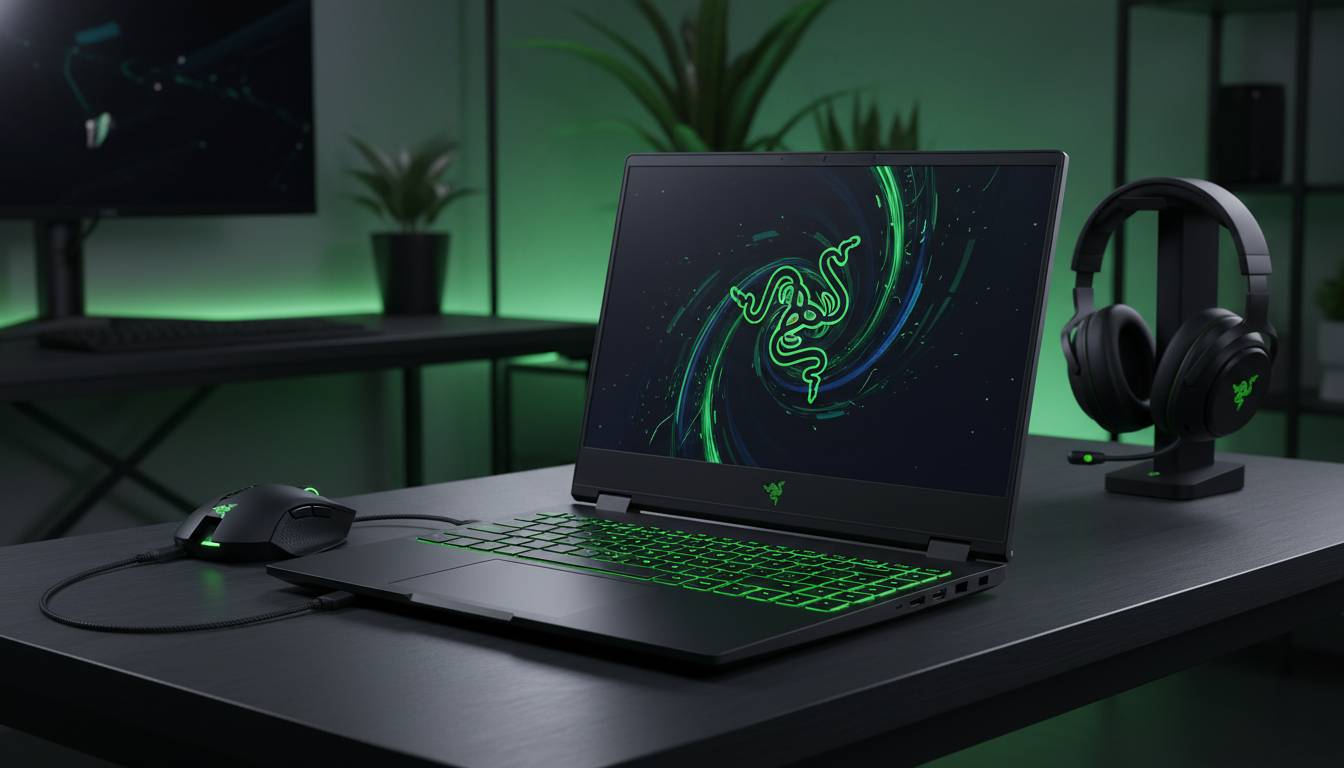
Razer’s 2025 Blade 16 appears to fix one of the line’s longest-running weaknesses: battery life. Announced by Razer on January 6, 2025, the redesigned 16-inch gaming laptop pairs AMD’s Ryzen AI 9 HX 370 with Nvidia’s RTX 50-series laptop GPUs in a thinner 0.59-inch chassis, and early reviews from Tom’s Hardware, Laptop Mag, and Notebookcheck show runtimes above seven hours in light-use tests—well ahead of prior Blade 16 models and many large gaming rivals.
💡
The key change is not just a bigger battery.
Notebookcheck reports the 2025 Blade 16 uses a 90Wh battery, which is slightly smaller than before, yet still delivers nearly eight hours in its Wi‑Fi test. That points to platform efficiency gains from AMD’s Ryzen AI chip, display tuning, graphics switching, and Nvidia’s battery-saving features rather than raw battery capacity alone.
7:22 to Nearly 8 Hours Marks a Clear Shift
The headline number is simple: this Blade 16 lasts much longer away from the wall than older Razer 16-inch gaming laptops. Laptop Mag measured the 2025 Blade 16 at 7 hours 22 minutes on its web-surfing battery test at 150 nits, versus 4 hours 41 minutes for the 2024 Blade 16. In the same comparison chart, Alienware’s x16 R2 reached 6:32 and Gigabyte’s Aorus Master 16 posted 5:02.
Early Battery Results for Razer Blade 16
| Model / Test Source | Battery Result | Context |
|---|---|---|
| Razer Blade 16 (2025) – Laptop Mag web test | 7:22 | 150 nits web-surfing test |
| Razer Blade 16 (2024) – Laptop Mag web test | 4:41 | Prior-generation comparison |
| Razer Blade 16 (2023) – Laptop Mag web test | 5:29 | Older generation reference |
| Razer Blade 16 (2025) – Tom’s Hardware | 7:21 | Web/video/light OpenGL test at 150 nits |
| Razer Blade 16 (2025) – Notebookcheck Wi‑Fi test | 7:57 | Nearly 8 hours |
Source: Laptop Mag, Tom’s Hardware, Notebookcheck | accessed March 25, 2026
Tom’s Hardware independently landed at 7 hours 21 minutes in a mixed light-use battery benchmark, effectively confirming Laptop Mag’s result within one minute. Notebookcheck went slightly higher at 7 hours 57 minutes in its Wi‑Fi web-surfing test, and said the system still managed 5.5 hours at full brightness. When three outlets using different methodologies all cluster around the seven-to-eight-hour range, the pattern is hard to dismiss as a fluke.
The historical context matters. Laptop Mag’s archive shows the 2024 Blade 16 at 4:41 and the 2023 Blade 16 at 5:29. That means the 2025 redesign improves on the 2024 model by 2 hours 41 minutes, or roughly 57%, and beats the 2023 machine by 1 hour 53 minutes, about 34%, based on the same publication’s testing.
Why a 0.59-Inch Redesign Changed the Battery Story
Razer’s official pitch for the 2025 Blade 16 centered on portability. The company said the new model is its thinnest gaming laptop ever at 0.59 inches at its thinnest point, and it moves the Blade 16 line to AMD Ryzen AI 300-series processors for the first time, topping out at the Ryzen AI 9 HX 370. The laptop also scales up to Nvidia’s GeForce RTX 5090 Laptop GPU with up to 155W maximum graphics power.
That combination matters because previous Blade 16 systems leaned harder into maximum performance, often with battery life as a secondary concern. The 2025 model still targets premium gaming, but the platform mix is different: a more efficient AMD processor, OLED panel management, graphics switching, and Nvidia’s newer battery-saving stack all appear to contribute. Tom’s Hardware specifically pointed to software and hardware optimization, including Nvidia Advanced Optimus, as part of the improvement.
Blade 16 Battery Timeline
2023: Laptop Mag measured the Blade 16 at 5:29 in web surfing, establishing a middling baseline for a premium gaming notebook.
Early 2024: Laptop Mag recorded 4:41 for the Blade 16 , showing battery life moved backward even as performance stayed high.
January 6, 2025: Razer announced the redesigned Blade 16 with AMD Ryzen AI processors and a 0.59-inch profile.
March 28, 2025: Tom’s Hardware published a review measuring 7:21 of battery life, one of the strongest results yet for a large Blade gaming system.
What 2:28 of Gaming Runtime Says About Real Use
Light-use battery life is only part of the story for a gaming laptop. Laptop Mag measured the Blade 16 at 2 hours 28 minutes in the PCMark 10 Gaming Battery test, compared with 1:37 for the 2024 Blade 16 and 1:19 for Alienware’s x16 R2. Gigabyte’s Aorus Master 16 did better at 2:54 in that specific test, so Razer has not taken the crown in every unplugged gaming scenario.
Still, 2:28 is a meaningful improvement for the Blade line. Laptop Mag also said it got “almost 2.5 hours” of gaming battery life, while Tom’s Hardware reported that after an hour of playing Alan Wake with settings reduced and DLSS Frame Generation enabled, the system still had about 35% battery remaining. Those are not desktop-replacement numbers, but they are far more usable than the short unplugged sessions many high-end gaming laptops have delivered in the past.
Gaming Battery Context
| System | PCMark 10 Gaming Battery | Source |
|---|---|---|
| Razer Blade 16 (2025) | 2:28 | Laptop Mag |
| Razer Blade 16 (2024) | 1:37 | Laptop Mag |
| Alienware x16 R2 | 1:19 | Laptop Mag |
| Gigabyte Aorus Master 16 | 2:54 | Laptop Mag |
Source: Laptop Mag comparison chart | accessed March 25, 2026
Notebookcheck adds another useful detail: gaming on battery is possible, but it said runtime lasts only “slightly longer than an hour” in its own testing, while Battery Boost can extend endurance by capping performance to around 30 fps depending on the scene. Different test methods explain the spread, but the takeaway is consistent: unplugged gaming is improved, though still limited compared with general productivity use.
90Wh vs Older Blade 16 Models: Efficiency Beats Capacity
One of the more interesting findings is that the 2025 Blade 16 does not win on battery size alone. Notebookcheck says the battery is now 90Wh and “slightly lower than before,” yet runtime is better than the previous generation. That suggests Razer’s gains come from efficiency per watt, not simply packing in a larger cell.
There is also a tradeoff. The thinner chassis and lower weight—Laptop Mag lists 4.6 pounds—help mobility, but some reviewers note that performance is not always as dominant as the GPU badge might imply. Laptop Mag said the machine is impressive overall but not as overwhelming in graphics performance as expected from an RTX 5090 laptop, while Notebookcheck’s benchmarks show it often lands close to, rather than far ahead of, the prior RTX 4090 Blade 16 in several games. That makes the battery improvement more notable: Razer appears to have shifted the Blade 16 toward a better balance of portability, endurance, and high-end gaming rather than chasing only peak numbers.
ℹ️
The battery story is finally credible because multiple outlets agree.
Tom’s Hardware measured 7:21, Laptop Mag measured 7:22, and Notebookcheck reported 7:57 in Wi‑Fi browsing. For a premium 16-inch gaming laptop with up to RTX 5090 graphics, that level of cross-publication consistency is the strongest evidence that Razer has materially improved endurance.
Frequently Asked Questions
Is the 2025 Razer Blade 16 battery life actually good?
By gaming-laptop standards, yes. Tom’s Hardware measured 7:21, Laptop Mag measured 7:22, and Notebookcheck reported 7:57 in Wi‑Fi use. That is materially better than the Blade 16 models tested in 2023 and 2024, which were closer to the 4.5-to-5.5-hour range in comparable light-use tests.
How much better is it than the 2024 Razer Blade 16?
Laptop Mag’s data shows the 2025 Blade 16 at 7:22 versus 4:41 for the 2024 model on its web-surfing test. That is an improvement of 2 hours 41 minutes, a large jump for the same product family in one generation.
Can you really game on battery with the Blade 16?
Yes, but with limits. Laptop Mag measured 2:28 in PCMark 10 Gaming Battery and described almost 2.5 hours of gaming battery life. Notebookcheck was more conservative, saying gaming on battery lasted only slightly longer than an hour, though Nvidia Battery Boost can extend runtime by reducing performance.
What hardware changes may be helping battery life?
Razer moved the Blade 16 to AMD Ryzen AI processors for the first time, with configurations up to the Ryzen AI 9 HX 370, and reviewers cite graphics-switching and Nvidia battery-saving features as contributors. Notebookcheck also notes the machine improves battery life despite using a 90Wh battery that is slightly smaller than before.
Is this the best battery life in a gaming laptop?
Not universally. In Laptop Mag’s comparison, the Blade 16 beat several rivals in light-use battery life, but the Gigabyte Aorus Master 16 posted a longer 2:54 result in the PCMark 10 Gaming Battery test versus the Blade’s 2:28. The Blade’s improvement is significant, but category leadership still depends on the exact workload and test method.
Disclaimer: This article is for informational purposes only. Information may have changed since publication. Always verify information independently and consult qualified professionals for specific advice.

View 0 comments