

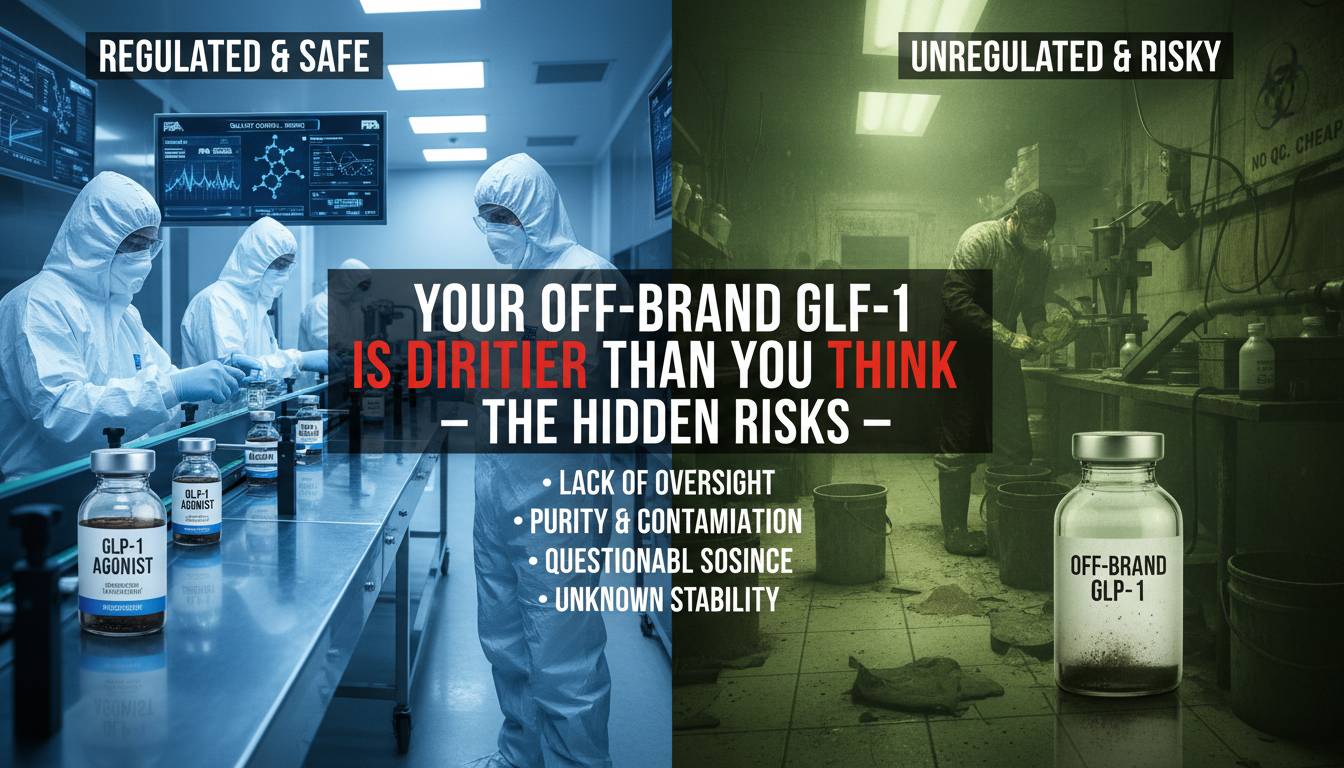
The boom in GLP-1 weight-loss drugs has created a parallel market of off-brand, compounded, and sometimes counterfeit products that promise lower prices and easier access. But as U.S. regulators tighten scrutiny, the safety concerns are becoming harder to ignore. The Food and Drug Administration has warned about fraudulent compounded GLP-1 products, dosing errors, counterfeit Ozempic in the U.S. supply chain, and the use of unapproved ingredients in some semaglutide products.
Why the off-brand GLP-1 market exploded
Demand for GLP-1 medicines such as Wegovy, Ozempic, Zepbound, and Mounjaro surged as clinical results and consumer interest pushed these drugs into the mainstream. During periods of shortage, compounding pharmacies and telehealth platforms stepped in to offer alternatives, often marketed as more affordable versions of semaglutide or tirzepatide. FDA policy during shortage periods gave some compounders temporary enforcement discretion, but that did not make compounded products FDA-approved.
That distinction matters. FDA-approved GLP-1 drugs are manufactured under tightly controlled standards for identity, potency, sterility, labeling, and distribution. Compounded drugs, by contrast, are not reviewed by the FDA for safety, effectiveness, or quality before they reach patients. The agency says compounded drugs can be appropriate in limited circumstances, such as when a patient needs a formulation that is not commercially available, but they are not intended to function as mass-market substitutes for approved medicines.
The regulatory environment has shifted quickly. In February 2026, the FDA said it intended to take decisive steps to restrict GLP-1 active pharmaceutical ingredients used in non-FDA-approved compounded drugs that were being mass-marketed as alternatives to approved products. In March 2026, the agency also announced warning letters to 30 telehealth companies over false or misleading claims about compounded GLP-1 products.
Your Off-Brand GLP-1 Is Dirtier Than You Think
The phrase “dirtier” is not just rhetorical. For injectable drugs, contamination and sterility are central safety issues. The FDA has warned that drugs sold outside regulatory safeguards may be contaminated, counterfeit, contain varying amounts of active ingredient, or even contain different ingredients altogether. In a February 2025 warning letter involving online peptide sales, the agency said injectable semaglutide and tirzepatide products raised heightened public health concerns because they bypassed normal drug protections.
Counterfeit products add another layer of risk. In April 2025, the FDA said several hundred units of counterfeit Ozempic had entered the U.S. drug supply chain after Novo Nordisk notified the agency. By December 2025, the FDA reported that seized counterfeit Ozempic units included counterfeit needles whose sterility could not be confirmed, creating an increased infection risk for patients.
The FDA has also warned about fraudulent compounded semaglutide and tirzepatide products carrying false label information. In some cases, the pharmacies named on the labels did not exist. In others, the label used the name of a licensed pharmacy that, based on FDA information, did not actually make the product. The agency said it had received at least one adverse event report tied to a product labeled as compounded tirzepatide from a pharmacy that did not compound it, with symptoms including redness, swelling, pain, and a lump at the injection site.
Sterility, sourcing, and ingredient concerns
The biggest hidden risk in off-brand GLP-1 products is often invisible to the buyer. Patients may see a vial, a syringe, and a familiar drug name, but they cannot independently verify whether the product was made in sterile conditions, whether the active ingredient matches the label, or whether the concentration is correct. That is especially important for injectable medicines, where contamination can lead to infection or inflammatory reactions.
FDA warnings also point to ingredient problems. The agency has said some compounders may use salt forms such as semaglutide sodium or semaglutide acetate, which are different active ingredients from the semaglutide base used in approved drugs. FDA says it is not aware of a legal basis for using those salt forms in compounding that would satisfy federal requirements. The agency has further noted that some compounded semaglutide products include added ingredients such as vitamin B-12, vitamin B-6, L-carnitine, or NAD, even though the safety and effectiveness of those combinations have not been established.
According to the FDA, patients should carefully inspect labels for spelling mistakes, incorrect addresses, and other warning signs, and should make sure the medicine comes from a licensed pharmacy and a licensed prescriber. That advice reflects a broader concern: the off-brand GLP-1 market is no longer just about compounding. It now includes a mix of legitimate pharmacy compounding, aggressive telehealth marketing, gray-market imports, and outright fraud.
Dosing errors are sending patients to the hospital
Even when a compounded GLP-1 product contains the intended drug, the dose may still be wrong. In its safety alert on compounded injectable semaglutide, the FDA said it had received reports of adverse events, some requiring hospitalization, that may be related to overdoses caused by dosing errors. The agency linked those errors to confusion over measuring doses from vials and to providers prescribing amounts beyond what appears in the FDA-approved labeling.
This is one of the clearest differences between approved branded products and many off-brand alternatives. Wegovy, for example, is supplied in single-dose prefilled pens that deliver preset doses. Some compounded products are dispensed in multi-dose vials that require patients to draw up the medication themselves with a syringe. That creates more room for misunderstanding, especially for first-time users who are unfamiliar with units, milliliters, and concentration differences.
The practical risks include:
- Taking too much medication because syringe markings are misunderstood.
- Using a concentration different from what the patient expects.
- Following instructions that do not match FDA-approved titration schedules.
- Receiving a product with labeling that is incomplete or misleading.
For patients, the result can be severe nausea, vomiting, dehydration, and emergency care. For clinicians, it creates a difficult environment in which side effects may reflect not only the drug itself, but also the quality and dosing accuracy of the product dispensed.
Industry, regulators, and telehealth are colliding
The off-brand GLP-1 market sits at the center of a larger fight over access, affordability, and regulation. Drugmakers have argued that unlawful compounding and deceptive marketing put patients at risk. Eli Lilly has said it found compounded products advertised as tirzepatide with safety, sterility, and efficacy problems, and it has pursued litigation over products marketed as if they were equivalent to approved medicines.
Novo Nordisk has also emphasized that, after FDA shortage-related grace periods expired in 2025, compounded semaglutide became illegal under U.S. compounding laws except in rare circumstances. That company statement reflects the industry position that the shortage-era workaround should not continue as a routine commercial channel.
Regulators are now moving in the same direction. The FDA’s recent actions suggest a more aggressive posture toward mass-marketed, non-FDA-approved GLP-1 alternatives and toward telehealth advertising that blurs the line between compounded and approved drugs. Still, some providers and patient advocates argue that demand, price, and insurance barriers helped create the market in the first place. That tension is likely to remain as long as branded GLP-1 therapy stays expensive for many Americans.
What patients should do now
For U.S. consumers, the immediate takeaway is simple: source matters. Patients considering GLP-1 therapy should verify that the product is prescribed by a licensed clinician, dispensed by a state-licensed pharmacy, and clearly identified. They should be cautious if a seller offers unusually cheap vials, uses vague language such as “research peptide,” or avoids naming the dispensing pharmacy. FDA guidance also supports checking packaging closely for errors and avoiding products obtained outside authorized channels.
Patients should also ask direct questions before starting treatment:
- Is this an FDA-approved product or a compounded product?
- What exact ingredient form does it contain?
- Is the dose delivered in a prefilled pen or drawn from a vial?
- Which pharmacy dispensed it, and is that pharmacy licensed?
- What should I do if I suspect a side effect or a counterfeit product?
Conclusion
The warning behind “Your Off-Brand GLP-1 Is Dirtier Than You Think” is increasingly backed by regulatory evidence. FDA alerts now cover fraudulent compounded products, counterfeit Ozempic, unapproved ingredient forms, and dosing errors serious enough to send some patients to the hospital. None of that means every compounded GLP-1 product is unsafe in every circumstance, but it does mean consumers should stop treating off-brand injectables as interchangeable with FDA-approved medicines. In the current U.S. market, lower cost and easier access can come with risks that are far less visible than the label on the box.
Frequently Asked Questions
What is an off-brand GLP-1?
In this context, it usually refers to a compounded, non-FDA-approved, or counterfeit product marketed as an alternative to branded GLP-1 drugs such as Wegovy, Ozempic, Zepbound, or Mounjaro.
Are compounded GLP-1 drugs FDA-approved?
No. The FDA says compounded drugs are not FDA-approved, which means the agency does not review them for safety, effectiveness, or quality before they are sold.
Why are regulators worried about these products?
The FDA has cited fraudulent labeling, counterfeit products, uncertain sterility, dosing errors, use of unapproved salt forms, and adverse events including some hospitalizations.
How can patients reduce the risk of getting a bad product?
Use a licensed prescriber and a state-licensed pharmacy, inspect packaging carefully, avoid products sold through unauthorized channels, and ask whether the medicine is FDA-approved or compounded.
What should someone do if they suspect a counterfeit or harmful GLP-1 product?
The FDA advises patients and providers to report adverse events and medication errors through MedWatch and to contact the agency if they suspect counterfeit or fraudulent products.

View 0 comments