

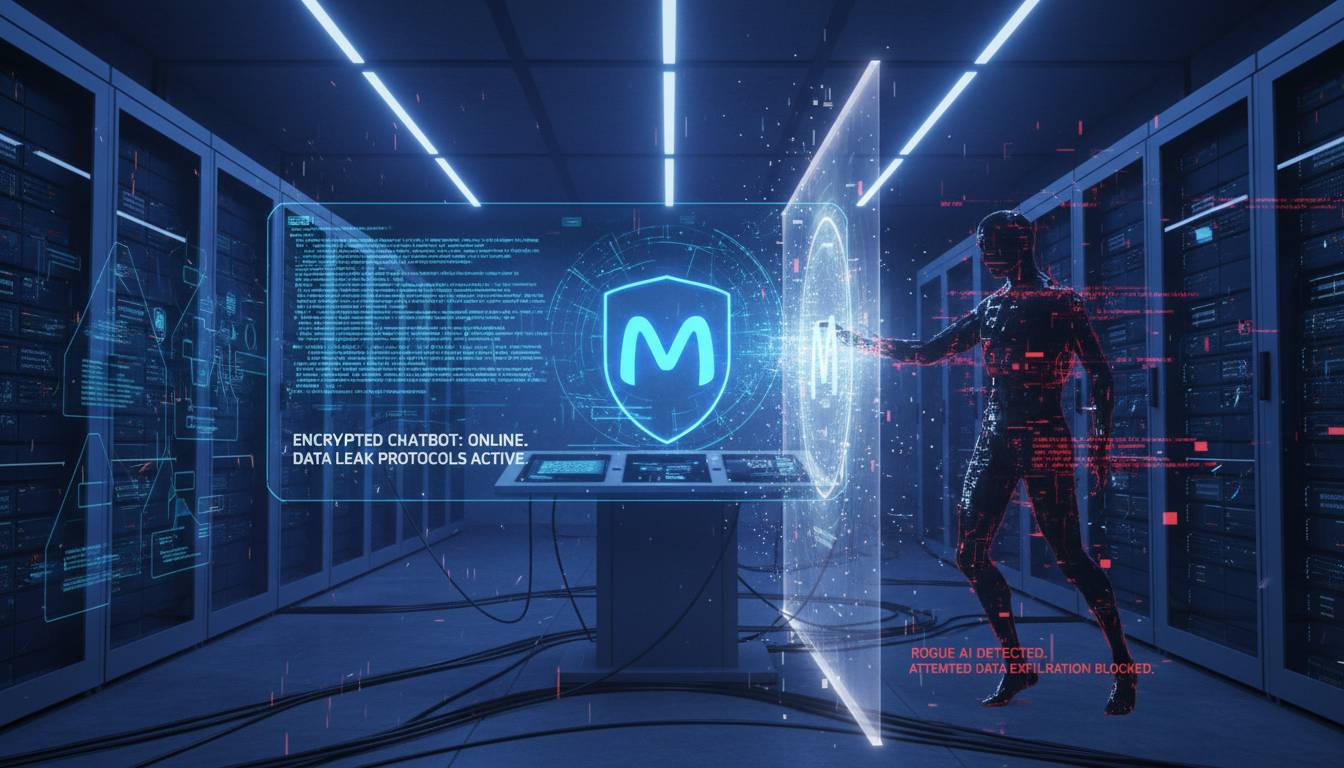
Meta is building a more encrypted path for AI chat after a series of privacy and security failures exposed how easily chatbot prompts, generated answers, and sensitive user context can leak. The shift became visible on April 29, 2025, when Meta disclosed its “Private Processing” architecture for WhatsApp AI tools, a system designed so requests are encrypted end-to-end between a user’s device and a protected processing environment that Meta says even it cannot read. That design matters because Meta’s AI products faced public scrutiny in 2025 over leaked prompts, accidental sharing, and broader concerns that agent-style systems can mishandle confidential data.
🔴
Meta’s privacy problem was not theoretical.
TechCrunch reported on July 15, 2025 that Meta fixed a bug disclosed on December 26, 2024 that could expose private prompts and AI-generated responses, while Meta’s own April 29, 2025 engineering post said its new Private Processing system is designed so “not even Meta or WhatsApp” can access message content during protected AI processing.
April 29, 2025 Architecture Marks Meta’s Encryption Pivot
Meta’s clearest public answer to AI privacy risk is its Private Processing system for WhatsApp. In an engineering post published on April 29, 2025, Meta said the system creates a secure cloud environment for AI features while preserving WhatsApp’s core privacy promise. The company described a chain that includes anonymous credentials, Oblivious HTTP routing, remote attestation, and a trusted execution environment, with requests encrypted end-to-end between the user’s device and the processing application.
That is a notable change in emphasis. Meta’s consumer AI push in 2025 expanded quickly across apps, glasses, and a standalone Meta AI app. But the same expansion increased the amount of personal context flowing into AI systems. Meta’s own product announcement for the Meta AI app on April 29, 2025 said the app included a Discover feed for sharing prompts and outputs. That social layer created a very different privacy posture from encrypted messaging, because user interactions with a chatbot could move from private assistance into public distribution if shared.
Meta AI Privacy Timeline
| Date | Event | Why It Matters |
|---|---|---|
| December 26, 2024 | Security researcher Sandeep Hodkasia disclosed a prompt-access bug to Meta | Showed private chatbot content could be exposed across accounts |
| January 24, 2025 | Meta fixed the bug, according to TechCrunch | Closed a direct prompt and response exposure path |
| April 29, 2025 | Meta published Private Processing design for WhatsApp AI tools | Introduced encrypted AI processing model |
| June 12, 2025 | TechCrunch highlighted public sharing risks in the Meta AI app | Raised concern over users exposing sensitive information |
| July 15, 2025 | TechCrunch reported Meta paid a $10,000 bug bounty | Confirmed severity and formal remediation |
Source: Meta Engineering, Meta Newsroom, TechCrunch | timestamps from published reports and company posts
How a 2025 Prompt Leak Changed the Risk Calculation
The most concrete security incident tied to Meta AI involved a flaw that allowed unauthorized access to chatbot prompts and generated responses. TechCrunch reported on July 15, 2025 that AppSecure founder Sandeep Hodkasia found the issue while analyzing how Meta AI handled prompt editing. According to that report, Meta fixed the bug on January 24, 2025 and paid a $10,000 bug bounty. Meta said it found no evidence of exploitation in the wild, but the incident showed that ordinary application logic, not just model behavior, can expose sensitive data.
That matters because AI privacy failures often happen in layers. One layer is model output. Another is application design, such as object identifiers, access controls, logs, or sharing defaults. Meta’s Private Processing write-up directly addressed that broader attack surface by saying only limited service reliability logs are allowed to leave the confidential computing boundary and that remote shell access is prohibited. In plain terms, Meta is trying to reduce the number of places where sensitive AI request data can escape.
From Leak to Encrypted Processing
December 26, 2024: A private disclosure to Meta identifies a flaw that could return another user’s prompt and AI response.
January 24, 2025: Meta fixes the issue, according to later reporting.
April 29, 2025: Meta publishes Private Processing, describing end-to-end encrypted AI requests for WhatsApp tools.
June-July 2025: Public reporting intensifies around Meta AI privacy, including accidental public sharing and the fixed prompt leak.
What Private Processing Encrypts and What It Does Not
Meta’s design is specific. The company said requests are encrypted end-to-end between the client device and the Private Processing application, and that neither Meta, WhatsApp, nor third-party relays can access the content in transit. It also said users will be able to obtain an in-app log of requests made to Private Processing and details of how the secure session was established. For security researchers, Meta said it would publish components of the system, release a technical white paper, and expand its bug bounty program.
Still, encrypted AI processing is not the same as universal encryption across every Meta AI surface. Reports in 2025 and 2026 drew attention to privacy differences between WhatsApp’s encrypted messaging environment and other Meta AI experiences. Help Net Security reported on March 2, 2026 that Meta AI interactions in WhatsApp raised fresh privacy questions because those exchanges sit outside the standard end-to-end encrypted user-to-user model unless routed through the new protected architecture. Separately, the standalone Meta AI app’s Discover feed created a public-sharing vector that encryption alone does not solve.
💡
Encryption addresses transport and processing exposure, not every product risk.
Public sharing defaults, access-control bugs, retention policies, and model training use are separate privacy questions from whether a request is encrypted in transit and inside a secure enclave.
Why Rogue AI Agent Fears Are Growing in 2026
The phrase “rogue AI agent” captures a wider industry concern: systems that act across tools, memory, and workflows can leak data without a classic breach. Academic work in 2026 reinforces that concern. The paper “AgentLeak,” posted in February 2026, described privacy leakage paths in multi-agent systems through inter-agent messages, shared memory, and tool arguments. Another February 2026 paper, “Authenticated Workflows,” argued that agentic systems need cryptographic attestations and policy controls because conventional identity checks are not enough for autonomous workflows.
Those findings do not prove a specific new Meta breach. They do explain why Meta’s move toward confidential computing, attestation, and verifiable transparency fits the direction of the risk. If AI agents are given access to chats, calendars, files, or enterprise tools, the security problem is no longer just “is the message encrypted?” It becomes “which code handled the data, under what policy, with what logs, and can anyone verify that path afterward?” Meta’s published design for Private Processing is one of the clearest attempts by a major consumer platform to answer those questions with infrastructure rather than policy language alone.
Risk Comparison: Traditional Chatbot vs Encrypted AI Processing
| Risk Area | Traditional App Logic | Private Processing Model |
|---|---|---|
| Transit visibility | Platform may access request path metadata and content | Meta says content is end-to-end encrypted to the processing application |
| Server-side access | Broader internal exposure possible | Trusted execution environment narrows access boundary |
| Verification | Limited external visibility | Remote attestation and promised transparency tools |
| Logging exposure | Higher chance of sensitive data entering logs | Meta says only limited reliability logs can leave the boundary |
Source: Meta Engineering design description, April 29, 2025
Meta’s Next Test Is Whether Encrypted AI Becomes Default
The unresolved question is rollout. Meta’s April 2025 engineering post said Private Processing would launch in the coming weeks, but product-level adoption across Meta’s broader AI ecosystem has varied. WhatsApp is the most natural home for encrypted AI because the app’s brand promise is private messaging. By comparison, social AI products built around discovery, sharing, and personalization create more opportunities for sensitive data to surface.
For users and enterprise buyers, the practical benchmark is simple: whether encrypted processing is the default for sensitive AI tasks, whether sharing is opt-in and unmistakable, and whether independent researchers can verify Meta’s claims. Meta has already said it will expand bug bounty coverage and publish technical materials. That is a stronger posture than generic privacy assurances, but it will be judged against implementation, not intent.
Frequently Asked Questions
Is Meta’s new chatbot fully end-to-end encrypted?
Not across every Meta AI product. Meta said on April 29, 2025 that WhatsApp Private Processing encrypts requests end-to-end between the device and the protected processing application, but that does not automatically mean every Meta AI surface, including social or app-sharing features, uses the same model.
What data leak pushed Meta toward stronger AI privacy controls?
A key case was the bug disclosed to Meta on December 26, 2024 by AppSecure founder Sandeep Hodkasia. TechCrunch reported on July 15, 2025 that the flaw could expose private prompts and AI-generated responses from other users, and that Meta fixed it on January 24, 2025.
What is Private Processing in Meta’s system?
Private Processing is Meta’s confidential computing architecture for WhatsApp AI tools. Meta said it uses anonymous credentials, Oblivious HTTP, remote attestation, and a trusted execution environment so message content can be processed for AI features without being readable by Meta, WhatsApp, or relays during the protected session.
Does encryption stop rogue AI agents from leaking data?
It reduces some risks, especially transit and server-side exposure, but not all of them. Academic papers published in February 2026 show multi-agent systems can leak data through memory, tool calls, and workflow design. Access controls, policy enforcement, and auditability still matter even when transport is encrypted.
Why did Meta AI’s Discover feed raise privacy concerns?
Because it introduced a public-sharing layer to chatbot use. Meta’s April 29, 2025 app announcement said the Meta AI app included a Discover feed, and later reporting in June 2025 showed users were sharing conversations that included sensitive personal information, sometimes without fully understanding the visibility of that content.
Disclaimer: This article is for informational purposes only. Information may have changed since publication. Always verify information independently and consult qualified professionals for specific advice.

View 0 comments